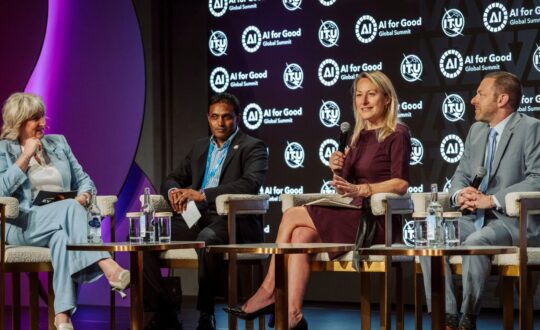


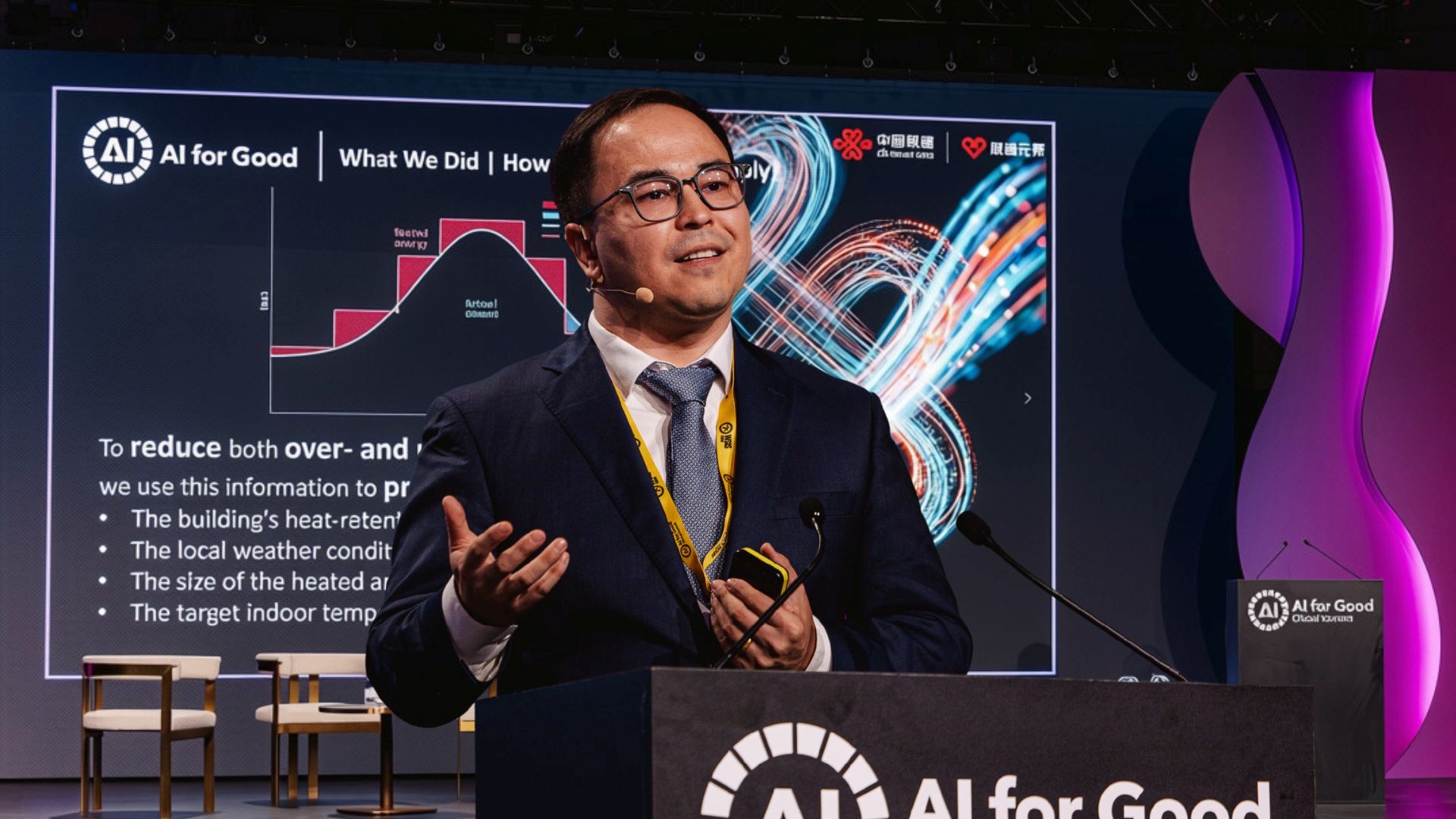
At the AI for Good Global Summit 2026, during the session Predict and Optimise: AI for Sustainable Urban Heating, Juxihong Julaiti, Principal Data Scientist and Founding Director of OPTIMA Lab at China Unicom, explained how forecasting and optimization are being applied to reduce energy waste across one of the world’s most demanding district heating networks.
According to Julaiti, China operates the world’s largest district heating network, serving nearly 400 million people – a population comparable to that of North America – and covering approximately 25 billion square metres. In parts of the network, winter temperatures average around -20°C and can fall to -30°C, creating extremely challenging operating conditions for the heating grid.
The scale of energy involved is considerable. As Julaiti put it, “The energy used for a single winter in this area can actually power up cities like New York City for more than a decade. So the energy consumption is quite significant. Even a little bit of energy saving would be significant as well.”
Managing a vast and complex heating network
Julaiti framed the challenge of operating a heating network at this scale around three closely connected problems.
The first is determining how much heat to supply. Operators must anticipate changing weather conditions and adjust supply without wasting energy or leaving end users with uncomfortable indoor temperatures.
The second is delivering that heat to the right place at the right time. The network is not controlled centrally, but through more than 100 substations, each serving a different number of buildings and located at varying distances from them. As a result, no single control strategy can be applied uniformly.
“We have to figure out how to use this heat network topology and the various information to control the entire network properly,” Julaiti said.
The third challenge is monitoring the health of the system. Because much of the network runs underground, faults may remain invisible until they become severe, by which point energy has already been wasted. Any miscalculation across supply, control, or monitoring can therefore lead to significant losses.
Applying AI in Changsha
To demonstrate how these challenges are being addressed in practice, Julaiti presented the case of a private district heating operator in Changsha, China.
The operator draws on six heat sources: three power stations, from which waste heat is recovered, and three in-house boilers that can be activated when recovered heat is insufficient. The network serves more than 140 substations and approximately 60,000 people.
The team’s approach combines three functions: forecasting demand, controlling supply, and detecting anomalies across the network.
Predicting demand and improving control
Operators traditionally adjust heat supply manually only three or four times a day. According to Julaiti, this creates a “zigzagging” control pattern that can deviate significantly from actual demand. Oversupply wastes energy, while undersupply leaves end users with uncomfortable indoor temperatures.
To improve forecasting, the team developed a model that accounts for weather conditions, historical load, and the heat-retention properties of different buildings. Newer buildings typically retain comfortable temperatures for longer than older ones and therefore require a different level of heat input.
The model must also account for the network’s thermal lag. Adjustments made in the present may take between six and twelve hours to affect indoor temperatures, making advance weather forecasts essential.
According to Julaiti, the model was trained on 340 days of data spanning two heating seasons and validated using a further 172 days. The transcript describes the model as achieving a mean absolute percentage error of 77% during training, although the later deployment results indicate an error rate below 8%.
Forecasting alone, however, is not enough. The data required for control decisions arrives in different formats, at different frequencies, and with varying levels of quality. It must therefore be pre-processed before it can be used by AI systems.
In addition, every substation behaves differently. Some are located close to the buildings they serve, while others are farther away, meaning that heat travels through the network at different speeds.
The team therefore developed a framework that combines forecasting and control, with the aim of making gradual adjustments rather than abrupt changes. The overall objective is to minimise energy input while ensuring that indoor temperatures remain above the required threshold.
Human oversight remains central to the process. Decisions generated by the system are reviewed by an operator before being executed, and the impact of each decision is tracked to improve future control.
“We are not replacing [operators]. They have to monitor it and make sure the control is okay, [so] they can focus on more valuable decisions,” Julaiti said.
Detecting faults before they lead to further waste
The third part of the system focuses on anomaly detection. The team developed a two-tier monitoring process. A short-cycle scan runs every 30 minutes and focuses on six priority anomaly types identified by the client. A separate 24-hour analysis is designed to detect issues that develop over a longer period.
This gives operators greater visibility into the network and helps identify faults before they become severe and lead to further energy waste.
Reducing energy use across the network
The system was deployed throughout a full heating season, running from the previous year into the beginning of 2026.
Based on figures presented by Julaiti, demand forecasting achieved an error margin below 8% across 24-, 48-, and 72-hour horizons. Electricity consumption fell by more than 10%, while the overall heat required to operate the grid decreased by 7%.
The anomaly-detection system achieved 100% precision and recall. Julaiti attributed this result to the relative simplicity of the anomaly types targeted during this stage of the project and acknowledged that future cases would be more challenging.
Taken together, the results demonstrate how forecasting, coordinated control, and continuous monitoring can reduce energy use while maintaining comfortable temperatures for end users.
From local decisions to network-wide optimisation
Despite these results, Julaiti identified an important limitation in the current approach: control decisions are still made at the level of individual substations rather than across the network as a whole.
Heillustrated the problem with an example in which three substations each request 40% of the available energy. Each request may appear reasonable when viewed locally, but collectively they exceed what the network can provide.
The next phase of the work will therefore focus on optimising the entire network at a global scale and extending the framework to other district heating operators.
This process is already under way with the Changsha client, which has acquired sensor manufacturing companies to support the rollout. The team is also developing a domain-specific chatbot powered by large language models, allowing operators to query the system directly and review the decisions it has made.
Julaiti’s account of the Changsha deployment points to a recurring theme across all three challenges: energy waste in large heating networks does not necessarily occur because operators lack expertise, but because the systems they manage are too distributed, delayed, and opaque to be optimised through manual adjustments alone.
Moving from substation-level control to network-wide optimisation represents the clearest unfinished step in the work ahead.