

For decades, the receiver has been the passive side of communication. Initially, it was a simple speaker with no intelligence. As digital technology improved, it gained a screen and a decoder, but the end user of information remained a person. With the advent of 6G, this changes: the listener at the receiving end could still be a human, but it could also be an intelligent agent, a robot, a drone or an augmented reality system, which, now integrated into the device, is capable of understanding, making choices and acting autonomously.
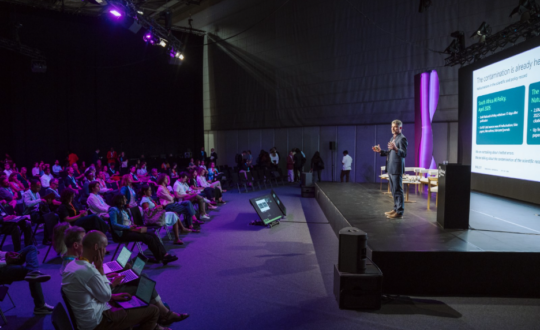
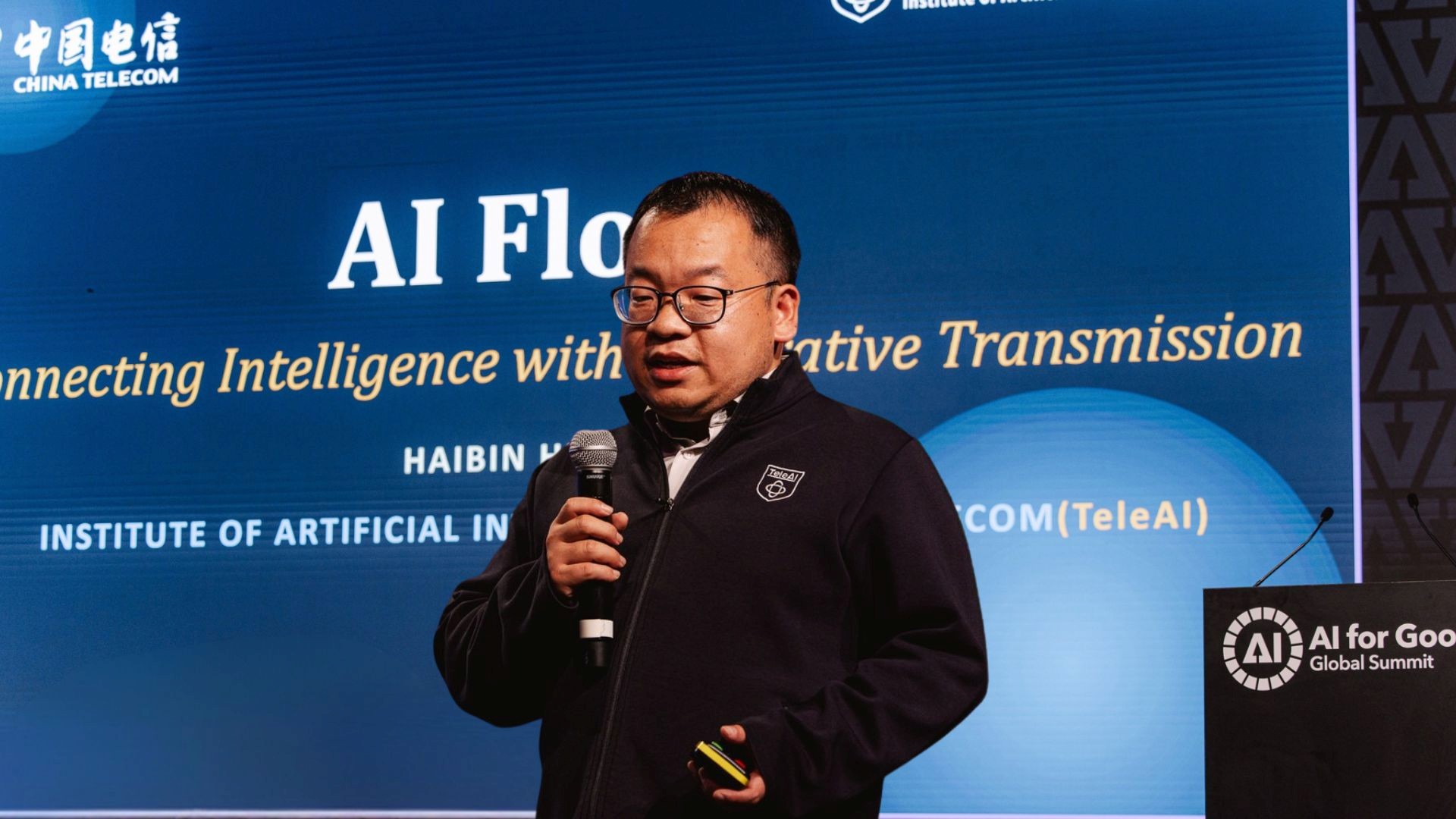
This shift was the starting point for AI Flow, the framework presented by Haibin Huang, Principal Research Scientist at TeleAI, China Telecom, during the session AI Flow: Connecting Intelligence through Generative Transmission, held at the AI for Good Global Summit 2026. The framework begins with a simple question: if the receiver can generate part of the information itself, does the entire content still need to be transmitted? AI Flow was developed to explore this possibility.
From a bit flow to a token flow
Huang did not merely describe a conceptual shift, he made it tangible by explaining how information is encoded and transmitted. In the traditional model, he explained, the sender tries to transmit samples of the original signal (bits), and the receiver simply tries to reproduce them as faithfully as possible. In the model proposed by AI Flow, the sender instead transmits meaningful units, called tokens, which can represent objects, motions, sound events or scene structures, rather than the unprocessed signal in its entirety.
At this point, the receiver no longer simply decodes what it receives passively: it can act based on the tokens it receives. The researcher underscored that physical channels, encoding and networks are still required, this shift does not remove the underlying infrastructure. What changes, according to Huang, is the overall design objective: rather than reproducing a signal faithfully, the aim is to transmit information that is useful for action. Referring to the receiver as an agent with intelligence, capable of thinking and deciding on its own, he asked:
“If it can sing, do we still need to send the whole thing?”
The researcher was careful to stress that none of this involves changing the fundamental physical constraints of communication.
“We didn’t break the physical law and the Shannon theory, and we didn’t magically make the channel larger,” Huang explained earlier in the session.
What changes is not the physical limit of the channel, but the nature of the information transmitted through it.
Four reasons for tokens
Tokens are employed for four reasons, as per Huang, instead of raw signal data. First, tokens are the natural representation used by contemporary AI models. Second, they provide a degree of resilience: a large model can still infer and generate content from context, even when bandwidth is very limited or some information is lost.
Third, tokens enable a significantly more compact representation, capable of encoding video, audio, images, sensor data, and, as Huang suggested, potentially spatial data in the future. Finally, tokens can be used directly for a range of tasks, including content generation, human interaction, and machine-to-machine communication.
Three problems still to solve
Huang identified three open issues that AI Flow needs to address.
The first concerns representation: how can the world be expressed through tokens that are compact, generative, and comprehensible while retaining as much relevant information as possible? To address this, his team uses a unified generative model capable of interpreting and generating content while expressing multimodal inputs in a shared token space.
The second challenge is selection: given a task, what information should be transmitted? Huang explained that different receivers require different kinds of information. A human may need complete detail for viewing, while a robot may only need information about obstructions and motion. An emergency response agent, meanwhile, may simply need to know the location of individuals or potential risks. According to Huang, both the available bandwidth and the receiver’s capabilities influence what should be transmitted.
The final challenge is reconstruction: how do you rebuild a scene when tokens are missing, delayed, or incomplete? Huang explained that his team addresses this issue in two ways: treating a certain amount of noise as beneficial rather than detrimental to the model’s understanding of context, and relying on the model’s generative capacity to infer missing information and produce a coherent result even when some tokens are lost.
Beyond human viewers: robots and multi agent systems
What happens when the receiver at the other end is not a person at all? Huang also explored scenarios in which the receiver is another machine or software agent. In these cases, he explained, the goal is less about perceptual quality and more about supporting effective decision-making, although meaningful and reliable tokens remain essential.
Consider a human operator controlling a robot remotely. Huang noted that maintaining a reliable communication link is crucial because “any video lag or control delay can disrupt the task.” He explained that AI Flow overcomes this by limiting what is conveyed to key visual and control elements such as obstructions, tool location, and motion.
He also described a scenario in which two robots collaborate to complete a task. In the example presented during the session, a human request for water was shared through a robot communication group and translated into a coordinated assignment. The robots completed the task by exchanging compact information, including location and general map data, through tokens.
In another scenario, a group of drones worked together to search an area, sharing information about which sections had already been covered.
A complementary approach, not a replacement
Huang was clear that AI Flow is not meant to replace network communication infrastructure like 6G, but to complement it. Even as bandwidth expands with future network generations, demand can still exceed capacity, similar to how even the biggest motorways can encounter traffic bottlenecks.
In his view, AI Flow provides a technique to improve communication efficiency across both high bandwidth lines, such as 6G, and restricted links, such as satellite connections.
He summarised his argument in three points. First, receivers are becoming more intelligent, and that communication design should account for the receiver as an active part of the system rather than just the sender and the channel. Second, tokens carry meaning, offering a compact and semantic representation that can support different tasks within a shared token space. Third, that AI Flow attempts to bring together a unified model, adaptive transmission, and generative recovery.
All things considered, the original question that started the session is still relevant: does communication need to carry the entire song if the other end can already think, decide, and, to use the researcher’s words, sing on its own? According to Huang, it must contain all the information that enables the receiver to comprehend, make a decision, and take action.