

Ask anyone building or using AI tools for research what their biggest concerns are, and hallucinations and citation problems come up fast. In fact, 64% of researchers cited potential inaccuracies and hallucinations as concerns preventing them using AI as much as they’d like in our global study.
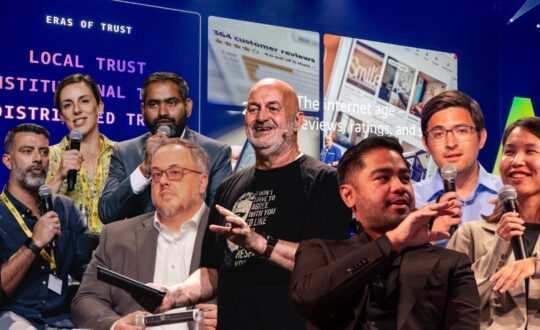
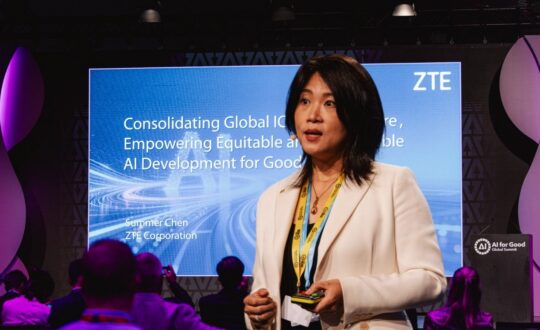
The collision between growing AI adoption and a persistent trust problem is exactly why we sponsored and presented at the AI for Good Global Summit. For over 200 years at Wiley, we’ve built our reputation on one thing: knowledge people can rely on. That work hasn’t changed, but its form has. AI is now one of the fastest-growing ways that knowledge reaches people, so we showed up alongside the world’s AI community, from UN agencies and governments to corporate research and development (R&D) teams, to talk through what responsible AI really means in practice.
Why we chose to sponsor
AI for Good brought together an audience we don’t often see in one room: policymakers writing the rules, engineers building the systems, academic researchers exploring them, and corporate leaders deploying them at scale. That mix matters to us, because the problem we care about – AI systems that hallucinate or produce claims nobody can trace – doesn’t respect those boundaries. A government agency and a pharmaceutical R&D lab can hit the exact same failure mode, for the exact same reason: the model was never properly grounded in verified, attributable content.
Our role at the Summit
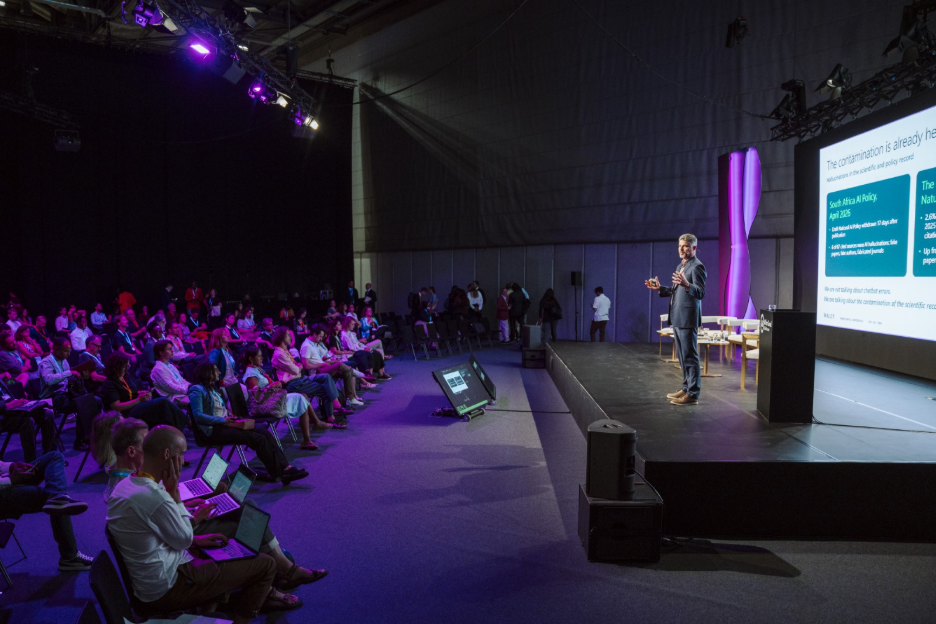
We brought this idea to the Solutions stage in a session called “From hallucination to verification: why trusted, responsible AI needs grounded knowledge.” Rather than treating responsible AI as a question of output filters and guardrails, we explored how trust starts one step earlier, before the model ever runs, with the knowledge a model is built on. We showed how retrieval-augmented generation (RAG), connected to peer-reviewed content, reduces bias by drawing on more diverse and authoritative sources, restores transparency through citation, and cuts the wasted computation of re-prompting a model to fix an ungrounded answer.
What we hope people took away
If there’s one idea we want to leave with this community, it’s that responsible AI requires responsible inputs. Most governance conversations focus on what comes out of a model. We think the more useful question, especially for teams actually building with AI, is what that model is standing on. Get the knowledge foundation right, and accuracy, transparency, and efficiency tend to follow. Skip that step, and no amount of downstream tuning fully makes up for it.
Where this connects to real-world impact
This isn’t hypothetical. In April 2026, South Africa withdrew its draft national AI policy after discovering that several of its citations were fabricated—invented papers and journals, that had made it all the way through to a government publication. Around the same time, the patient-safety organization ECRI named the misuse of general-purpose AI chatbots the top health technology hazard for 2026, warning that these tools aren’t validated for clinical use even as patients increasingly turn to them. Two very different institutions, hitting the same root cause.
Our ExplanAItions study found that AI adoption among researchers jumped from 57% to 84% in a single year. More people relying on AI outputs every day means more exposure to the same failure, which is exactly why grounding AI in trusted sources matters so much right now.
How this shows up in our own strategy
Inside Wiley, this thinking sits at the center of our AI strategy, especially when we’re partnering with AI companies and research corporations. Our recent partnership with OpenEvidence puts this into practice at scale: we’re licensing the Cochrane Database of Systematic Reviews and more than 400 of our journals and books directly into a clinical AI platform used by over 60% of US physicians, so a doctor’s question gets an answer traceable back to peer-reviewed evidence.
We’ve done the same with the European Space Agency, bringing curated Earth-science research into its Earth Virtual Expert (EVE) assistant, so policy teams and researchers can act on climate data with full attribution intact. Our AI Gateway connects more trusted, peer-reviewed content to Claude, AWS Marketplace, and Perplexity. Plus, our knowledge feeds turn scholarly content into structured, AI-ready data products for teams building models and applications in fields like life sciences, healthcare, engineering, and finance.
Building on that foundation, we’ve introduced Wiley Applied Research Intelligence, or ARI, a research intelligence layer built on decades of trusted, peer-reviewed content, and securely enriched with a team’s own data alongside sources like grants, patents, and clinical trial registries, so corporate R&D and AI teams can surface connections across the literature that a keyword search would miss.ARI gives those teams faster time to insight, a higher probability of success on the experiments and trials they run, and results they can defend. A corporate R&D team can trace a research decision back to the exact clinical trial or patent behind it, the same way a doctor traces an answer back to a study. Expert-built, repeatable methodologies show their work and let researchers stay in control, with an exportable audit trail behind every answer.
Where we go from here
We left Geneva with new conversations underway across governments, research institutions, and corporate partners, all discussing some version of the same question: how do you build AI you can truly trust at scale? We’re sure it starts with the knowledge underneath the model, rather than the model itself, and increasingly, with an intelligence layer built directly on top of that knowledge.
You can watch the recording of our talk here. These conversations continue well beyond Geneva. If you’d like to stay up to date with all things AI at Wiley and beyond, sign up to our monthly newsletter.
Watch the full session:
Author bio

Armughan is the Chief AI & Data Services Officer at Wiley, where he leads the company’s AI and data services strategy. Prior to joining Wiley, he served as Chief Analytics Officer at Norstella and held senior technology leadership roles at Clarivate Analytics, ASI Family of Companies, and Thomson Reuters, bringing over 25 years of experience leading complex technology and data organizations across life sciences, financial services, and publishing. A published innovator with patents in machine learning, Armughan holds a Bachelor’s degree from Karachi University, a Master’s degree from SZABIST, and an Executive MBA from the Stevens Institute of Technology.