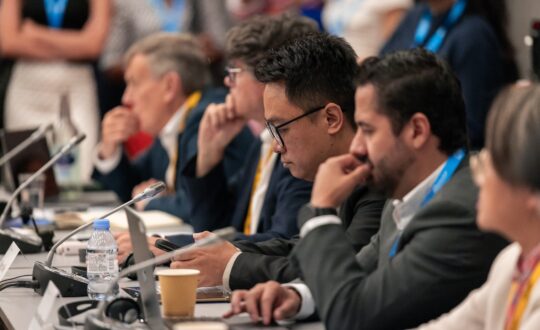



During the AI for Good Global Summit 2026, the workshop “AI for Manufacturing: Pharmaceutical Industry Workshop on Innovation, Applications and Standards,” organized in partnership with CAICT, brought together international organizations, research institutions, standards bodies, technology providers and pharmaceutical industry representatives.
Across the session, speakers examined how AI is being applied throughout the pharmaceutical value chain, from drug discovery and clinical research to manufacturing, quality control, supply chains and precision medicine. A recurring message was that technical capability alone is not enough: AI must be supported by sound governance, reliable data, skilled workforces and standards that allow solutions to be trusted and scaled across markets.
Creating the foundations for trusted adoption
The first discussion, moderated by Simão Campos, Counsellor for AI for Health Standards at the International Telecommunication Union (ITU), focused on the strategic foundations required to translate AI innovation into safe and effective pharmaceutical applications.
Dennis Chornenky, CEO of Domelabs AI, described an “AI governance gap” that emerges when technological development moves faster than regulation and institutional controls. In regulated sectors such as pharmaceutical manufacturing, this can expose companies to compliance, data-integrity and cybersecurity risks. He argued that companies need three connected elements: a written AI strategy, a governance policy defining responsibilities and risk controls, and an adoption roadmap that prioritizes use cases according to value, feasibility and available resources. Governance, in this context, should extend beyond one-time validation to continuous monitoring of model performance, errors, drift and security.
Vaibhava Lakshmi Ravideshik, Research Lead at the Massachusetts Institute of Technology, explored how multimodal AI, biomedical knowledge graphs and foundation models could support pharmaceutical innovation. She explained that useful AI systems must connect molecular and structural data, scientific literature, relational biomedical knowledge and real-world evidence. Knowledge graphs and shared medical ontologies can ground AI outputs in verified relationships between diseases, genes, drugs and treatments, making answers traceable rather than merely plausible. The ability to verify a result is particularly important in medicine, where a convincing but inaccurate output may create real clinical harm. She stressed that shared evaluation methods, expert comparison and transparent evidence are needed to ensure that models can be assessed by clinicians and regulators.
Jicui Dong, Unit Head for Product Policies, Access and Manufacturing Support at the World Health Organization, connected AI adoption with local and regional pharmaceutical production. She described AI as a cross-cutting capability that can support research and development, technology transfer, clinical trials, manufacturing, quality assurance, procurement and supply-chain monitoring. Applied effectively, it could strengthen production efficiency, predictive maintenance, real-time quality monitoring and access to medicines. However, she warned that AI must strengthen quality rather than substitute for it. Reliable regulatory systems, trusted data, infrastructure, financing and a workforce that understands both pharmaceutical manufacturing and data science remain essential.
“AI needs to benefit everyone, every country. We need to decrease the gap in access to health products, as well as the gap in access to new technologies such as AI,” Dong said.
Dong Min, Deputy Director at CAICT’s Institute of Cloud Computing and Digitalization, placed standards at the centre of trustworthy and accessible AI adoption. He identified interoperability, minimum quality and safety requirements, shared technical foundations and documentation as key areas for standardization. Rather than introducing rigid rules too early, he proposed beginning with open technical standards that reduce uncertainty and can later support regulatory recognition. Existing standards already cover areas such as data quality, risk management, clinical information and manufacturing. The challenge, he said, is to coordinate them for specific pharmaceutical AI applications and address remaining gaps in model evaluation, deployment, governance and workforce competencies.
“When we talk about AI for good in our industry, it means making better, safer medicines and making them more accessible, but on one condition: trust. Trust has to start with standards,” Min explained.
Turning AI into pharmaceutical applications
The second discussion, moderated by Noah Luo, Chair of ITU-T Study Group 21 and Director of European Standards & Industry Department at Huawei, shifted from strategy to practical applications in manufacturing, drug discovery, programmable biology, outbreak response and precision medicine.
Andrew Whytock, Head of Thought Leadership for Siemens’ Life Sciences Segment, examined how digitalization and AI can connect pharmaceutical research, development and manufacturing. He argued that autonomous manufacturing depends on a common digital backbone that links data across equipment, processes and business systems. With this foundation, manufacturers can move from reactive to predictive quality control, maintenance and material flows. AI can support faster batch release, equipment monitoring and paperless production, but only where data is interoperable, contextualized and reliable.
Alex Aliper, President of Insilico Medicine, presented generative AI as a way to change the speed and economics of drug discovery. He described how AI can help identify biological targets, design molecules and support preclinical development. According to him, Insilico Medicine has advanced AI-generated drug candidates into human clinical trials, demonstrating that the technology can contribute not only to research efficiency but also to viable pharmaceutical pipelines. Aliper also highlighted lightweight, domain-specific models as an important direction for organizations that need strong performance without relying entirely on very large systems.
Chris Lai, Co-founder, Chairman of the Board and CEO of Metis TechBio, introduced programmable biology as a new frontier for AI. He described cells as living systems operating through biological code. Rather than only blocking, replacing or destroying biological mechanisms, AI could help researchers understand and eventually reprogramme cellular behaviour. He presented work using AI to screen formulations, design targeted delivery systems and develop treatments more quickly, including research involving clinical-stage products.
Pascal Mayer, CEO of Alphanosos, focused on whether AI could accelerate the response to emerging outbreaks. Traditional drug discovery is too slow to produce treatments during the early stages of a new pandemic. Mayer described an approach using AI to search combinations of safe compounds and identify candidates for testing within days rather than years. Such systems could help bridge the period between the sequencing of a new pathogen and the availability of vaccines or other established interventions.
Yu Zhao, Research Fellow at the Western Institute of Computing Technology, presented computational medicine as a means of combining multi-omics and clinical data into individualized risk models. His work illustrated how digital representations of patients could support earlier diagnosis, proactive intervention and the market realization of precision medicine.
In their closing remarks, Seizo Onoe, Director of ITU’s Telecommunication Standardization Bureau, and Yu Xiaohui, President of CAICT, returned to the need for cooperation.
“We need global technical standards and we need to build these standards together,” Onoe said.
He emphasized the importance of secure data exchange, interpretability and trusted systems that can operate across organizations, sectors and borders.
Yu Xiaohui noted that AI is already reshaping how medicines are discovered, developed, manufactured and supplied, but that fragmented data, inconsistent evaluation methods and the difficulty of moving from proofs of concept to deployment remain major barriers.
“Standard coordination can help build a common language of data governance, model evaluation, risk management and interoperability,” Yu said.
He added that capacity building and technology transfer can help ensure that pharmaceutical innovation benefits more patients worldwide.