

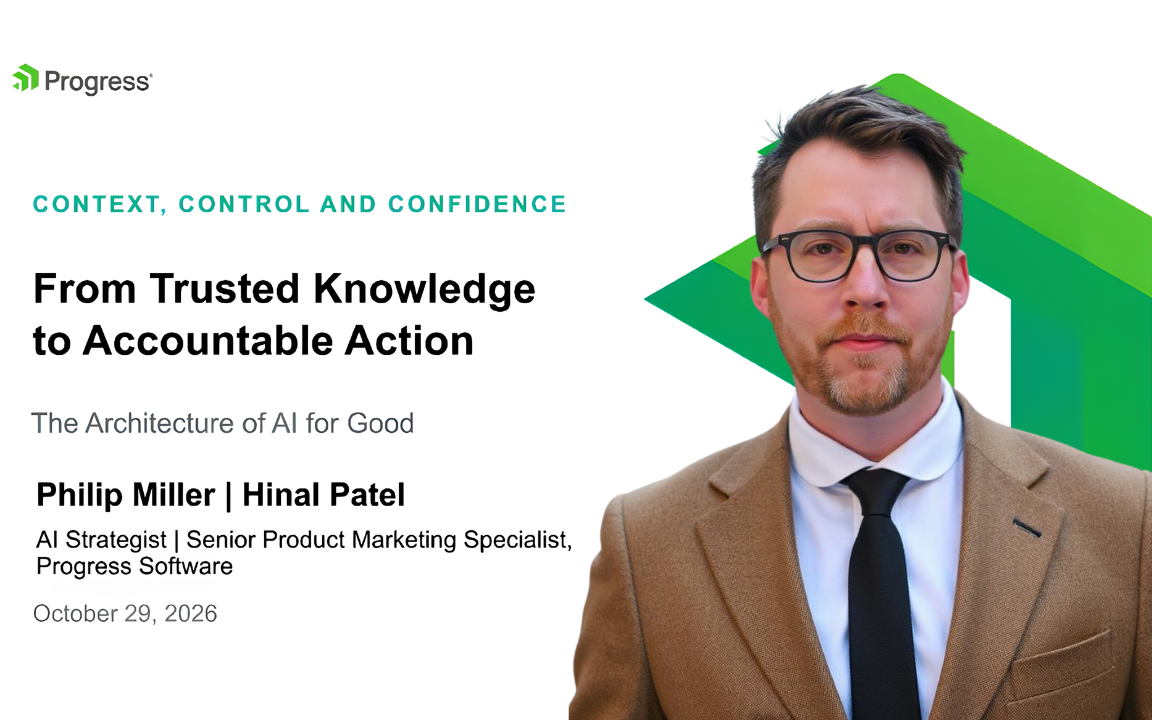
On 29 October 2026, the second webinar of a four-part AI for Good series with Progress explored how Context, Control and Confidence can be built into AI services used in public and humanitarian settings.
When AI is utilised to support a public service or humanitarian initiative, it is imperative that individuals comprehend the source of the information, the permissible actions of the AI system, and the individual responsible for conducting a review when necessary. Hinal Patel, Senior Product Marketing Specialist at Progress Software and moderator of the session, opened the discussionby addressing these questions alongside Philip Miller, AI Strategist and Product Marketing Director at Progress.
Context, Control and Confidence
According to Patel, the first part of the series explored why reliable knowledge, meaningful context and clear controls are necessary to obtain reliable results from AI, while this one focused on how to put these fundamentals into practice. She then revisited the three ideas that underpin the series: context, control, and confidence. Context is the knowledge that AI needs to perform a task, with clear meaning and known sources. Control is what the system is authorised to do with that knowledge. Reliability, as she explained, stems from the ability to trace the sources of an answer and verify what has happened.
To illustrate these principles, Patel described a coordinator using an AI service to locate clinics in a specific region. She stated that the service must have a formal agreement regarding its purpose, the approved sources it may use, what it may share, and who is responsible when information is insufficient before selecting any technology. It has the capacity to disclose a clinic’s public information, but it is prohibited from disclosing private contact information. A designated individual would evaluate the case in the event that there was a lack of information, conflicting information, or ambiguity. “For example, if a clinic’s availability has been updated, the service should make that gap visible and route it for review,” she said.
Putting such an framework into practice depends on how the underlying knowledge is managed. Patel emphasised that all sources must be approved, owned, and dated. Furthermore, the same clinic may be designated as a local entity in one system and an official entity in another. Technology can help with the classification of this information; nevertheless, she noted that local experience is required to ensure that the interpretation is correct based on the real conditions. The same care applies to the search. According to Patel, the recovery of a similar object does not substantiate the accusation. A result may precisely reflect the right type of clinic, but it may be out of date. As a result, she explained the protocols that must be followed before retrieving information, releasing a response, or taking any action. The service’s capacity to validate and apply a rule is dependent on its application at the proper moment.
A layered architecture
Miller then turned to the technology architecture, providing a comprehensive account of the controls that are present at every level of a system, including the application used by the auditor, the models, agents, and tools that execute the task, and the controls related to identity, access, policies, provenance, and evaluation. According to him, all of this should be predicated on an independent knowledge archive that allows an organization to extend its human intelligence to the machine. Within this framework, the language model interprets queries.
“The way to think of this is to think of AI as just another human being. You wouldn’t give it access to everything,” Miller said. He clarified that in practice, this entails verifying the identity and scope of each request, validating each tool call, and incorporating approval steps for sensitive actions into the workflow, rather than relying on the agent.
Returning to the clinic example, using fictional clinics and illustrative data, Miller explained that simply stating that a clinic is open is insufficient. The record must indicate the clinic’s name, the services it provides, the authority responsible for updates, and the date on which the information was implemented. Rather than silently selecting one update, the workflow flags the conflict when two updates are equally authoritative. There is a policy conflict that prevents the action from being taken until an accountable specialist reviews the missing evidence, which is returned to the source owner. According to him, AI expedites these tasks, but human accountability persists. He claimed that the knowledge should be able to be corrected and maintained through a simplified interface, as the individuals closest to the work possess the domain expertise.
Verify, then trust
On oversight, Miller described his approach as “verify, then trust”. It involves measuring whether tasks are completed correctly, how quickly useful answers arrive and how much human review is required. He recommended starting with a bounded pilot to test permissions, conflicts and potential failure paths before expanding the system’s autonomy. “You’ve got to earn authority to act,” he said. His guiding principle was simple: “If you don’t want a human being to do it, you probably don’t want an AI to do it.”
Questions from the audience
Asked whether AI is ever trustworthy, Miller suggested that the question should be whether we trust AI. He responded that the question should be whether we trust AI. Like a new employee, AI should not be trusted out of the box and should require training, policies, and access to the appropriate data.
For organisations looking to put these principles into practice, Miller advised starting small and focusing on a clear outcome. “We can’t do AI for AI sake,” he said. One example he gave was an agentic writing system to brief volunteers deployed to a disaster zone. Success, in his view, depends partly on whether the system can cite the specific paragraph or sentence behind an answer, which makes review easier and reduces computing costs. Miller recalled an experiment by his colleagues that showed a saving of roughly 50 times in tokens, though he said he was unsure of the exact figures.
The question of human oversight also emerged, particularly when determining which decisions AI systems can make independently and which require human approval. Miller referred to a quote he attributed to IBM in the 1980s, saying machines cannot be held accountable. “The human being is always responsible for the outcome,” he said. He added that regulation is moving more slowly than AI itself and needs to become more dynamic.
In closing, Miller argued that what is often called context must also include rules and governance, held in an “intelligence vault” capable of evolving as organisations and regulations change. “Similarity isn’t enough. You want specificity,” he said. Looking ahead, he indicated that the next webinar would explore how to put these principles into practice, including the tools involved.
Watch the full session: