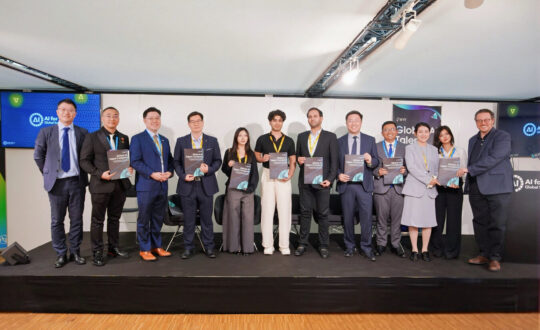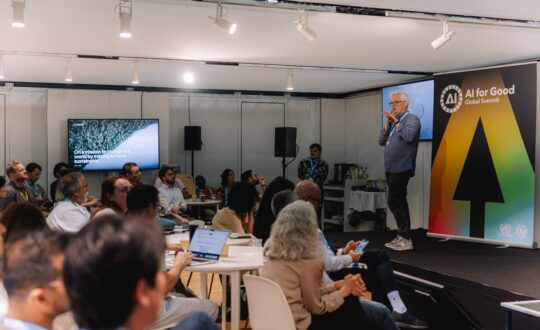


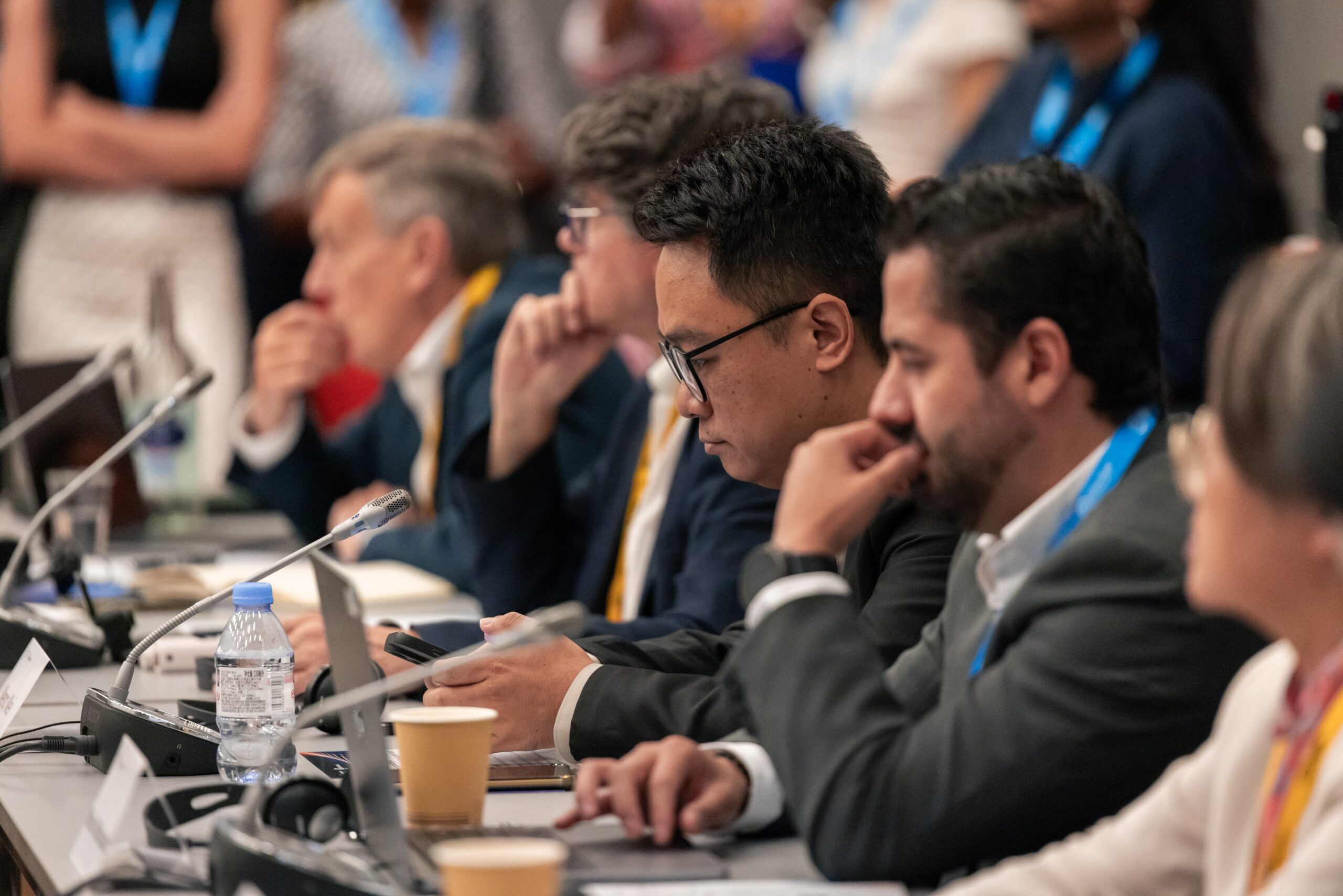
During the AI for Good Global Summit 2026, the workshop Advancing responsible AI: Open source for inclusive development and collaborative governance was organized in partnership with the World Internet Conference (WIC). Moderated by Liang Hao, WIC’s Executive Deputy Secretary-General, the workshop examined how open-source ecosystems can widen participation in AI development and how countries and institutions can coordinate governance as AI systems move across borders.
Opening remarks by Francis Gurry, WIC Vice Chairman and former Director-General of the World Intellectual Property Organization, framed the discussion around the different speeds of innovation and the pace of AI governance. Gurry cited two figures from 2024 to illustrate what he described as an imbalance in international priorities: approximately USD 212 billion in foreign aid contributed by major donors across infrastructure, education and health, alongside an estimated USD 252 billion in global corporate investment in AI. He presented open-source ecosystems as one way of countering the growing emphasis on competition by allowing the benefits of AI to be shared more widely. Governance, he argued, should not be viewed only as a constraint on innovation, but as a framework that enables technologies to be used effectively.
Seizo Onoe, Director of the ITU Telecommunication Standardization Bureau, added that standards and open source share the principles of contribution-driven, consensus-based development. Open-source toolkits, platforms and simulation environments, he said, are supporting rapid prototyping and bringing feedback from real-world deployments into the standardization process.
Open source in the AI ecosystem
John Higgins, Co-Lead of the Standards Promotion Program of the WIC Specialized Committee on AI, said the choice between open and proprietary AI is not the most useful framing for the industry. His central point was that openness does not remove costs or responsibility. Organizations may need greater technical expertise, stronger validation processes and a clear understanding of the provenance and licensing of the components they use. Common standards can also help reduce regulatory friction across markets.
Wei Kai, Vice Chair of the WIC AI Specialized Committee and director of the AI Institute at the China Academy of Information and Communications Technology (CAICT), described the growth of the Chinese open-source AI ecosystem. Wei said that releasing model weights alongside technical reports allows ideas to circulate between developers, supporting faster technological iteration and helping narrow the performance gap between open and proprietary models. He also argued that openness can only generate inclusive value when users trust the technologies being shared. His presentation outlined work on voluntary industry commitments, disclosure and verification of company practices, safety benchmarks and common standards.
Safety, diversity and international cooperation
Dame Wendy Hall, Co-Chair of the WIC AI Specialized Committee and Regius Professor of Computer Science at the University of Southampton, opened the second session by noting that women represent half of the world’s population but are underrepresented in AI decision-making. Hall cautioned against treating AI as a purely technical product. Once deployed, she said, it becomes part of a sociotechnical system shaped by developers, institutions, users and the wider context in which it operates.
Drawing a comparison with the development of the World Wide Web, Hall recalled that its open infrastructure was initially associated with wider access to knowledge, while many of its later social consequences were not anticipated. AI systems, she argued, are similarly being tested through their use in society. She described AI measurement, evaluation and assurance as an emerging field requiring auditing, independent assessment and internationally aligned standards.
Yi Zeng, Wu Yuzhang Chair Professor at Renmin University and a researcher at the Beijing Institute of AI Safety, presented findings from his team’s testing of large language models. Zeng referred to the UN Secretary-General’s call for companies not to deploy AI systems accessible to children without child-specific safety testing and independent oversight. Based on his team’s evaluations, he argued that current models do not yet meet that threshold. He also presented tests of models used in embodied and agentic systems. In some scenarios, simple adversarial attacks succeeded against certain models approximately 40% of the time, with performance deteriorating further as the attacks became more complex.
At the corporate level, Zeng discussed the Future of Life Institute’s AI safety assessments. He reported that no company evaluated had achieved a grade above C-plus, pointing to gaps in safety, accountability and preparedness.
Maxime Stauffer, Founder and CEO of the Simon Institute for Long Term Governance, distinguished between the governance of AI development and the governance of AI deployment. Because most frontier models originate in the United States and China, he argued, governance of their development is primarily a domestic and bilateral issue involving those two countries. Deployment, however, is a universal concern: every country needs the capacity to evaluate the systems it adopts and determine the infrastructure and safeguards required for their use.
Stauffer also noted that open-weight models can make advanced capabilities easier to deploy, but may allow safeguards to be removed more easily. This creates a tension between expanding access and managing increasingly capable systems.
Moises Maldonado, Data Scientist and Innovation Officer at UNHCR, closed the workshop by applying the Swiss cheese model from safety engineering to AI systems used in humanitarian contexts. The model assumes that no safeguard is perfect. Each protective layer contains weaknesses, and harm can occur when those weaknesses align across the system. For humanitarian applications, Maldonado proposed four layers: principles incorporated during system design, collaborative governance, sociotechnical evaluation, and community feedback combined with human review.
He illustrated how non-representative training data, skipped field testing and excessive reliance on an AI recommendation could combine to deny a family access to essential assistance. Field evaluation, low-confidence warnings, human review and rapid takedown procedures could prevent the same weaknesses from producing harm.
The workshop concluded with an observation shared by several speakers: the pace of AI development is outrunning the pace of governance. The discussions highlighted how open-source models and tools can reduce barriers to participation, but openness also redistributes technical and institutional responsibility.
Widening access must therefore be accompanied by the capacity to understand where technologies come from, evaluate how they behave in different contexts and determine who remains accountable when they are deployed. Safety testing, measurement, common standards, human oversight and cross-border cooperation will be essential if the benefits of greater openness are to be shared effectively.