

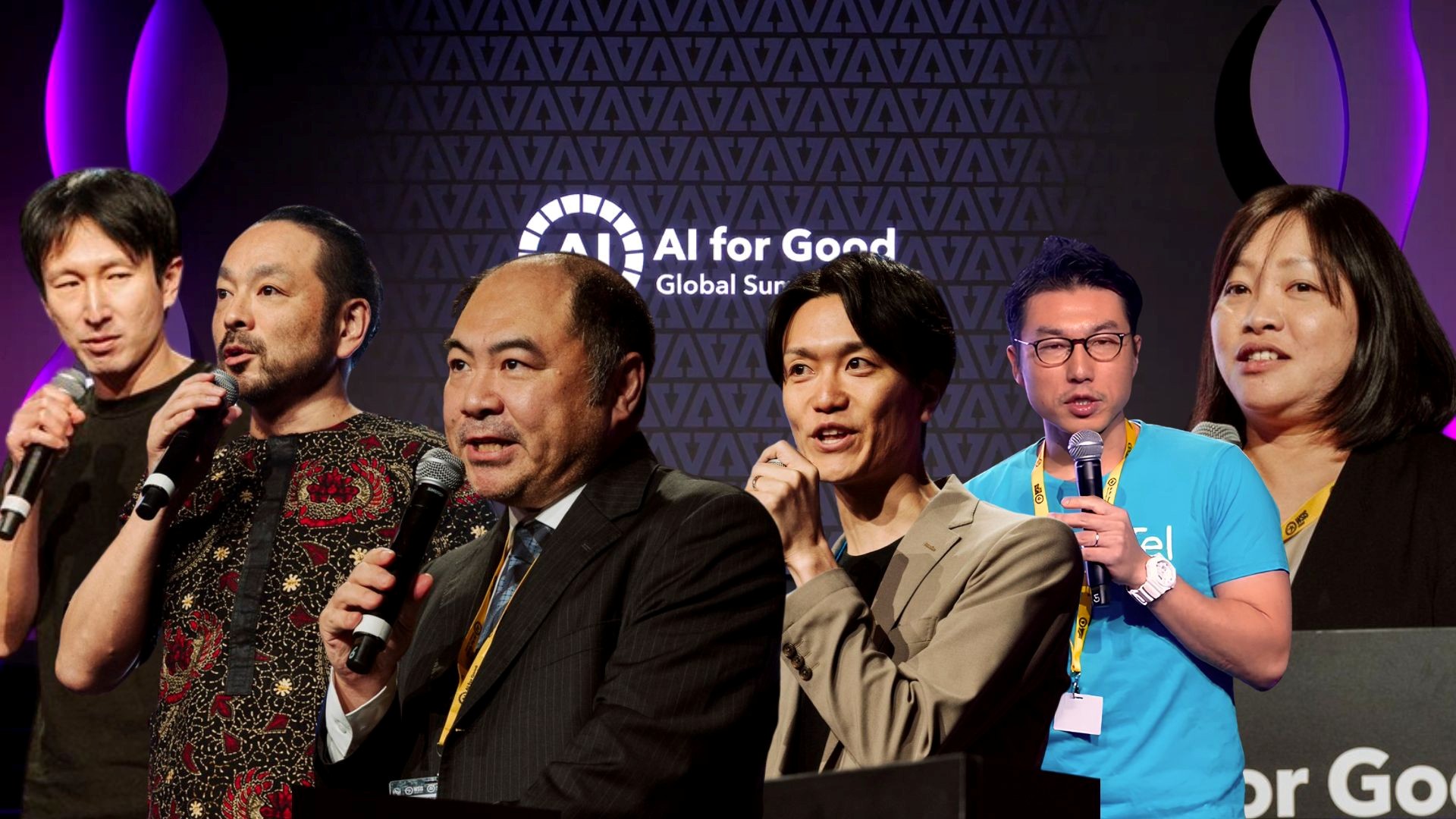
During the session Innovative Japanese AI start-ups addressing social challenges,hosted by the Japan Pavilion at the AI for Good Summit 2026 and moderated by Tomoka Katsumata, four Japanese startups presented AI-powered solutions addressing challenges across cybersecurity, digital and financial inclusion, international trade and business communication.
Yukio Teramura, Assistant Vice-Minister for International Affairs at Japan’s Ministry of Internal Affairs and Communications, opened the session. Noting that AI is transforming areas including infrastructure, education, healthcare and communications, Teramura also highlighted the challenges associated with its implementation and long-term use.
He explained that the Japanese government is supporting efforts to address social challenges through AI by encouraging industry participation and connecting international standards with practical implementation. According to Teramura, the four companies featured at the Japan Pavilion are using advanced technologies and services to address challenges around the world, including in developing countries.
Protecting employees from AI-driven cyberattacks
Taiga Inagaki, Sales Manager at AironWorks, presented the company’s AI-based cyber security platform, built around three components: a simulation agent that tests employees through realistic simulated attacks, an educational agent that creates customised training programmes and content, and a defence agent that automatically scans employee inboxes for high-risk emails.
Inagaki described the growing threat posed by AI-enabled cyberattacks, including deepfakes capable of cloning voices and faces, tools designed to generate sophisticated attacks and malware that can adapt autonomously. He referenced a case in which a financial employee transferred $25 million following a video call with a deepfake chief financial officer. He also cited a major theft from the cryptocurrency platform Bybit.
“Our mission is protecting humans from AI-driven cyberattacks, so AI can serve humanity, not attackers,” he said.
According to Inagaki, the platform is used in 20 countries, with more than 1,400 corporate clients and over 700,000 user IDs. He explained that this expanding user base generates simulation and scanning data that can be used to improve the company’s algorithms and develop new AI agents.
He said the platform has cut workload by more than 85% and improved employee awareness by more than 200%, citing clients in the banking sector. Inagaki pointed to a partnership with SoftBank, whose sales network distributes the product without requiring AironWorks to expand its own headcount. The company said it is aiming to expand into areas including human resources and insurance, with a goal of going public around 2030.
Bringing digital services to rural communities
Carlos Oba, CEO, CIO and founder of Dots for Africa, described a business model built around solar-powered digital hubs designed to bring digital access and services to rural villages in West Africa that lack reliable connectivity.
“The true problem is limited access to the digital tools,” Oba said.
The company’s compact hubs connect to solar panels and batteries and can provide access to services including financing, video-based education, agricultural support and printing. Its model also includes instalment payments for income-generating tools and a credit-scoring system built from data collected in offline communities.
Oba said the company has provided financing to more than 10,000 people in villages, many of whom were accessing financial services for the first time. The instalment programme has achieved a 97% collection rate, which Oba presented as evidence that the model can support both social impact and commercial sustainability.
Dots for Africa is currently operating in Benin and Senegal. Oba explained that these countries were selected because they share a currency and French as a common language, providing a foundation for expansion across a broader regional market. He also highlighted a partnership with Japanese manufacturer Brother Industry to install printers in villages, allowing residents to access printing and copying services without travelling to nearby towns
The company is also developing voice-based AI in local languages. By collecting language data in rural communities, it aims to enable people to ask questions and receive spoken answers in their own languages rather than relying on text-based interfaces. Oba said nearly one million people have begun using the company’s digital services, while revenue is growing by 45% each quarter.
Helping smaller manufacturers reach global markets
Kazumasa Oba, CEO of KiAI, described the company’s aim of helping small and medium-sized manufacturers expand internationally through AI.
Drawing on 15 years of prior experience at international organisations including the World Bank and the OECD, Oba said he had repeatedly observed the same problem: small manufacturers with strong technologies but limited means of reaching international markets.
He compared global expansion to setting sail. While international trade once depended on ships made from wood and sails, he argued that today’s equivalent is built from data and information. Yet smaller companies can still struggle to access the expertise and resources available to larger firms. KiAI’s vision, he said, is “global returns for everyone.”
KiAI’s solution, called Trst, functions as an AI-powered global expansion agency that identifies target companies and verifies overseas partners on the ground through local verification networks. Oba said the platform identified more than 114 target companies within eight days, and described it as roughly 20 times more efficient than traditional consulting firms. However, he stressed that speed alone is not sufficient. KiAI therefore combines the speed of AI with human verification, allowing potential partners to be checked locally before companies move forward.
Oba argued that this reduction in time and cost could also be relevant to policymakers by creating a more level playing field and making international market entry more accessible to smaller manufacturers.
Turning business conversations into actionable data
Takeshi Aida, CEO of RevComm, presented Sequoia Meditech, a voice AI platform designed to analyse sales conversations conducted by phone, video call and in person. The system analyses sentiment, speech rate, pauses, interruptions and filler words, transcribes conversations in full, and feeds the results automatically into systems such as CRM platforms, Notion or Slack.
“You can transform voice communication into an actionable asset,” Aida said, describing the platform as a self-coaching tool for sales and customer-facing teams.
Aida cited the case of a sales representative from a securities brokerage firm who, after an aggressive communication style was flagged by the platform, adjusted his approach and saw a 15% increase in appointments booked and conversion rate. RevComm now has more than 3,000 corporate clients globally, with over 400 million conversations recorded on the platform.
Beyond individual coaching, Aida explained that aggregated conversation data can help managers identify customer needs, improve products and develop AI agents grounded in their organisations’ own communication data. He presented RevComm’s wider objective as turning previously underused voice data into a resource that companies can analyse and act upon.
Taking Japanese innovation to global markets
The four presentations offered a view into a group of Japanese start-ups applying AI to a diverse range of practical challenges: protecting employees from cyberattacks, extending digital and financial services to rural communities, helping smaller manufacturers enter international markets and transforming business conversations into usable data. Although their technologies and target markets differ, the companies shared an ambition to expand beyond Japan and develop partnerships capable of supporting their growth.
Together, their presentations reflected the wider purpose of the Japan Pavilion: showcasing technologies developed in Japan while exploring how international cooperation can help bring them to communities, organisations and markets around the world.