


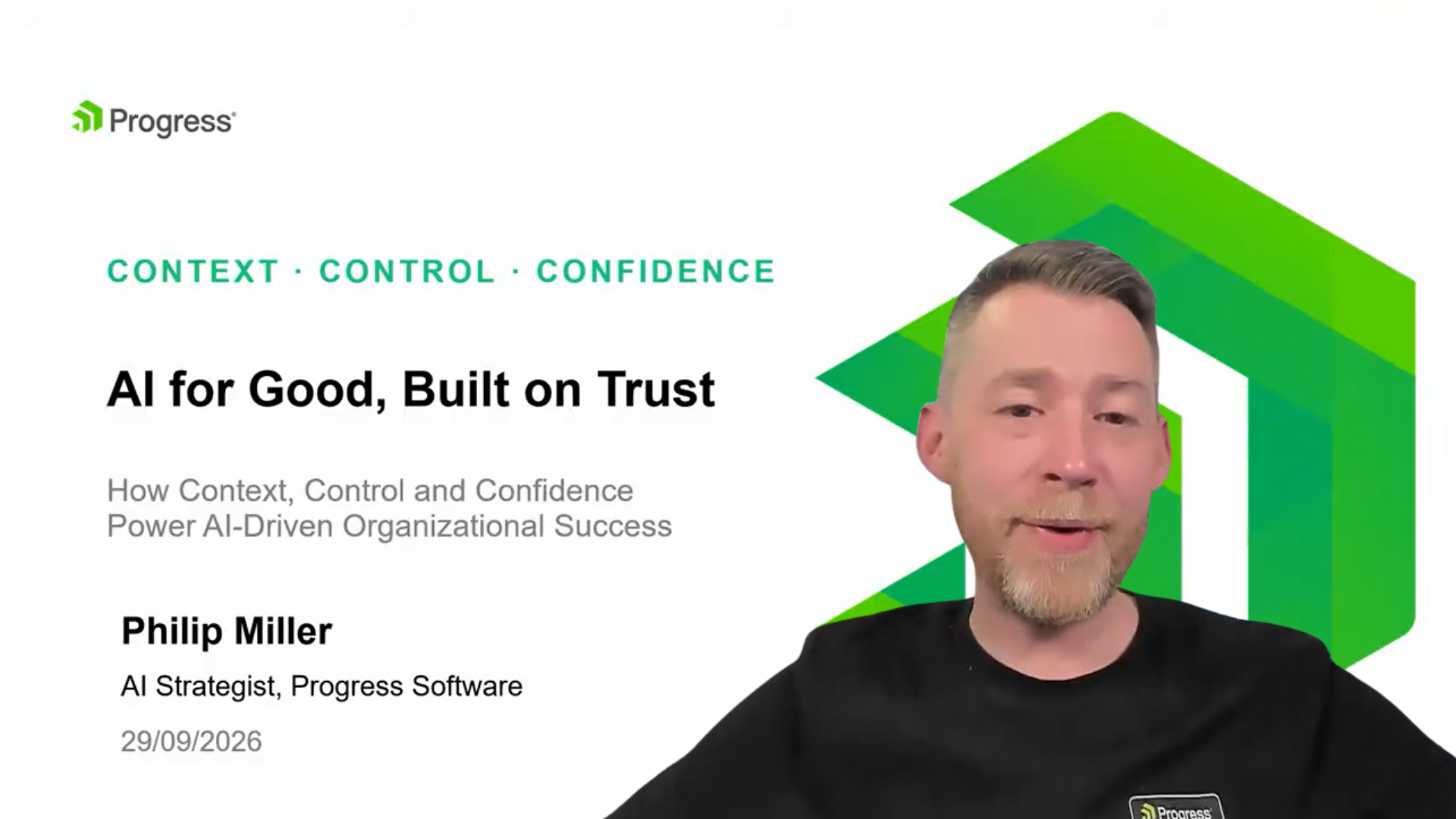
Trusted information, enforced boundaries and accountable decisions are the foundations of dependable AI, argued Philip Miller in an AI for Good webinar.
After a flood, a coordinator needs a public list of clinics that are still open. An old directory says one is operating. A recent field report says it has closed. Another clinic’s status is uncertain, and some staff contact details are restricted.
Which information should an AI system use, what should it withhold, and when should it ask a person to intervene?
Philip Miller used this illustrative scenario to explain a central challenge in deploying AI: producing a plausible answer is different from providing information people can safely act upon.
Miller, AI Strategist and Product Marketing Director at Progress, spoke at the AI for Good webinar Built on trust: Why dependable outcomes need trusted context and clear control, held on 29 September 2026. The session examined how organisations can use AI while maintaining trusted information, clear controls, and accountability for their decisions.
Why a convincing answer is not enough
His starting point was the person relying on the service. A useful answer needs to be current, relevant, and safe to use. Generative AI can produce convincing errors, while organisations often need dependable responses to practical questions: whether a service is open, where treatment is available, or how to reach emergency assistance.
Miller associated this with the operation of the technology. AI is well-suited for drafting, discovery, and research due to its probabilistic nature, which involves identifying patterns in vast quantities of data and generating predictions. However, deterministic responses are necessary for numerous organisational enquiries, as the same inputs and regulations should yield consistent outcomes.
At scale, even a small error rate can affect many people, compounding over millions or billions of responses. Miller’s argument was that organisations need trusted context and controls around AI, rather than treating the model as the final authority.
Context before capability
That context includes information a model may never have encountered: internal policies, local guidance, private records, and organisational knowledge. Making it available requires more than collecting documents. The system also needs shared definitions, relationships between information, and traceable evidence.
Miller explained how taxonomies organise terms, ontologies define concepts and relationships, and knowledge graphs connect services, places and supporting information. Provenance records where information comes from, while its age helps determine whether it remains useful. “It’s no good telling me where the fire was six hours ago. I need to know where the fire is now,” he said.
In the clinic scenario, those distinctions change the response. A recent, verified closure report should take precedence over an old directory. A clinic without current evidence should be referred for review. A clinic confirmed open by field reports from that day can be included, with its source cited. Restricted staff contacts should remain protected.
The independent knowledge store described in Miller’s follow-up materials is presented as a governed foundation for preserving this organisational knowledge, its meaning and provenance. Alongside it, a control framework is designed to govern how information can be discovered, used and acted upon.
Control must sit outside the model
Miller distinguished two questions: what can the AI know, and what can it do? Permissions and policies need to apply to both. An AI agent should have an identity and access restrictions, just as a human user would.
Crucially, he argued, these boundaries need enforcement outside the model. If an organisation relies solely on instructions embedded in AI, “they’re not rules, they’re suggestions.” Because of its random nature, he explained, the AI could simply choose to ignore them.
Checks should operate throughout the workflow: before retrieval, before an answer is released and before an action is taken. They should establish access rights, require current evidence, identify gaps or conflicts, and trigger approval or escalation where necessary. Records should support auditing and correction, and allow a decision to be replayed, which Miller described as key for many regulatory and governmental bodies.
Watch the full webinar here:
Building trust before granting autonomy
Miller likened the procedure to the recruitment of a new employee. An organiszation shares its policies, restricts access, and monitors the individual’s work. Their recommendations are only trusted as their comprehension increases, and their independent actions are eventually accepted. He suggested that systems be developed in a sandbox, with externally established rules, before they are allowed to take action, as AI adoption is frequently progressing at a faster pace than this type of trust.
An audience question raised the difficulty of human review when services reach millions of users. Miller’s response was that people need not inspect every action. A rules-based system can perform routine checks, with ambiguity thresholds defined for the particular use case determining when review is required. Reviewers should receive the supporting context and evidence, rather than being asked to accept the model’s confidence.
Where to start
Miller advised organisations to commence this endeavour by focusing on the workflow and the pertinent data, and to evaluate the potential for damage prior to constructing. The individuals responsible for formulating the rules should be identified and permitted to challenge the AI’s results and propose corrections. Prior to deployment, systems are recommended to undergo pilot testing.
For organisations beginning this work, Miller recommended a limited, useful task with a named accountable owner. Start with approved data and current sources, define permissions and review points, then test locally before expanding.
This need not take months, Miller said, as AI can help draft terms and ontologies for people to review. He described a team that built a knowledge graph in a day, keeping 195 of the 400 concepts proposed by AI.
“Test the outcome, not the answer,” he said. Evaluation should consider the time needed to verify information and complete a task, the quality of evidence, required corrections, access-policy failures and errors across languages and groups. Local context and affected communities should inform the design.
Miller connected those foundations to their purpose: “AI for good starts with the people who depend on it. Trusted context, clear controls and human accountability are how we earn their confidence and turn AI capability into meaningful impact.”
For further engagement, the Progress Data Platform Validation Program invites participants to share requirements and use cases with Progress experts and contribute feedback on the platform’s development.