

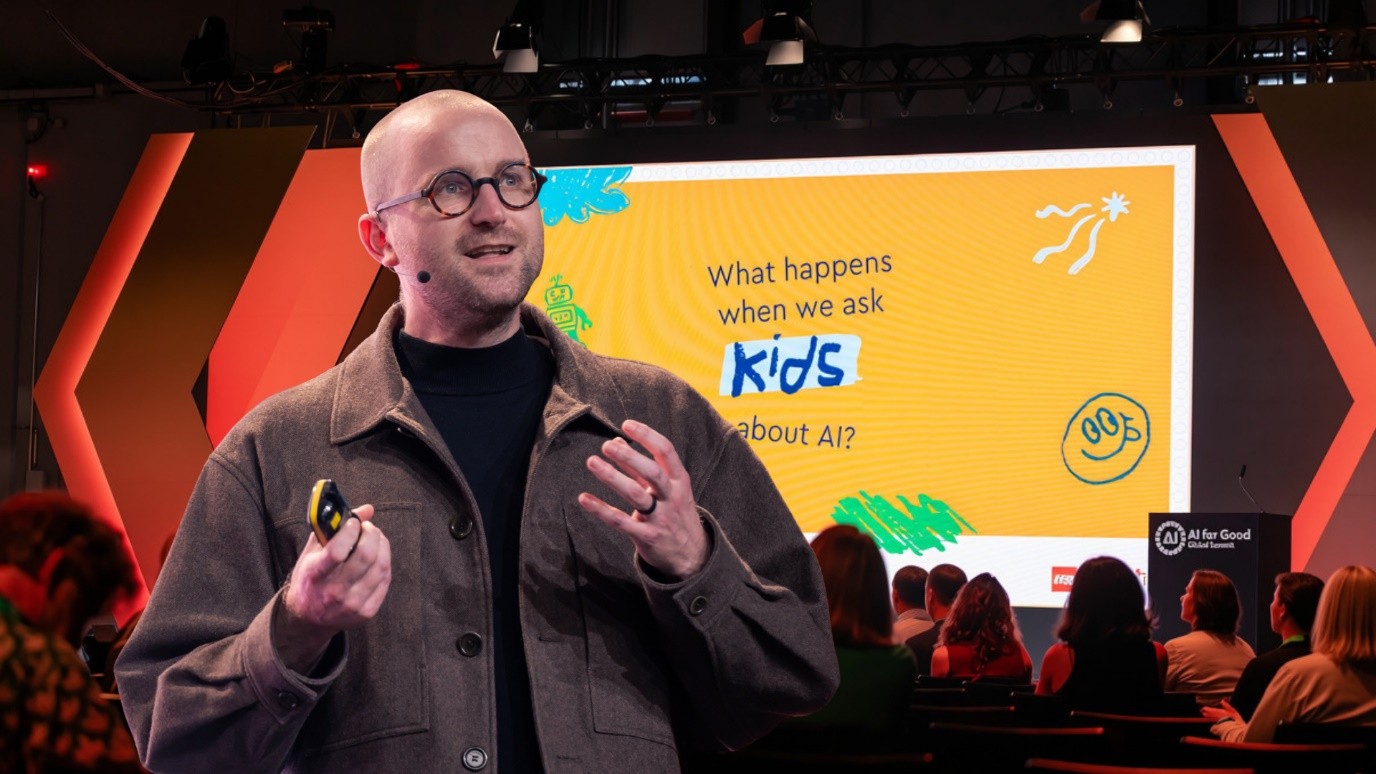
Children are often presented as passive recipients of AI, expected to adapt to systems they did not design and cannot influence. At the AI for Good Global Summit 2026, Andrew Sliwinski, Vice President and Head of Product Experience at LEGO Education, challenged that narrative with a different question: “What if we focus on what children are capable of?”
During the session “Child agency in the age of AI,” Sliwinski argued that the speed and uncertainty surrounding AI have led adults to focus too heavily on the technology itself and underestimate the next generation.
“We’ve lost track of what children are capable of,” he said. “We’ve lost track of what they can do in our haste to respond to this incredible technological shift.”
At the LEGO Group, he explained, the principle that “children are our role models” informs the design process. This means talking to children, asking what they think, and involving them in conversations about the technologies intended for them.
What children already understand about AI
Sliwinski shared a video in which a group of children discussed AI and worked together to develop their own policy for its use.
Their responses revealed a nuanced understanding of both its possibilities and risks. They raised concerns about incorrect information, deepfakes, cheating, unequal access and the possibility of becoming overly dependent on AI.
“AI should be a tool and not a friend,” one child said. Another argued that AI should only be used if everyone has access to it, whether they own a device or have an internet connection. A third called for classes that teach children how to navigate AI without allowing it to weaken their ability to think and learn independently.
For Sliwinski, the discussion demonstrated that children are not only eager to use AI. They also want to understand how it works, question how it is used and participate in shaping the rules around it.
At the same time, enthusiasm does not necessarily equal comprehension. Younger children may see generative AI as a “magic box” into which a prompt is entered and an image, video or school assignment appears.
“But AI isn’t magic. AI is technology,” Sliwinski said.
AI literacy, he argued, should not simply teach children how to operate this magic box. It should hand them a screwdriver, allowing them to take it apart, understand its components and build something new from the pieces.
Watch the full session:
Preparing children to build, not only use
Supporting children to use current AI systems safely and effectively is important, but Sliwinski argued that this is not enough.
“We need to stop preparing children for a world where they’re secondary to AI,” he said.
Children should develop an understanding of the foundations that underpin AI systems, including computer science, data, probability, sensing and algorithmic bias. These concepts should not be treated as specialist knowledge available only to a small group of students. Sliwinski argued that they should become as fundamental to education as reading and numeracy.
The objective is not to make children resistant to technology, but to equip them to lead, design and critique the systems of the future.
The five capabilities children need
Sliwinski identified five capabilities that children will need in the age of AI: creativity, curiosity, collaboration, care and computational thinking.
Creativity allows children to imagine new approaches to problems. AI models, he argued, draw on ideas that humans have already produced.
“AI models look backwards. We need children to be able to look forward,” Sliwinski said.
Curiosity helps children think critically, question systems and resist cognitive offloading. The goal is to ensure that they continue to enjoy learning and want to investigate how the world around them works.
Collaboration is equally important. Although many AI experiences place children alone in front of screens, Sliwinski stressed that children need opportunities to learn, build and solve problems together.
Care means considering the effects that technologies may have on other people. As the time between having an idea and creating a working prototype becomes shorter, children need to develop empathy and think about the consequences of what they build.
Finally, computational thinking teaches children to reason systematically and understand how complex processes are structured. Coding remains a valuable way to develop this capability, but Sliwinski cautioned against confusing the method with the objective.
Establishing red lines for AI and children
Responsible AI education also requires boundaries.
Sliwinski introduced ten principles developed by the LEGO Group to guide its use of AI with children. Described as “red lines,” they are intended to protect children’s agency, privacy, safety and wellbeing. He highlighted three principles in particular.
First, AI features should never undermine children’s creativity, agency or understanding. Children must remain active learners and builders. When AI performs the thinking for them rather than supporting their own thinking, it can weaken the learning it is meant to enable.
Second, AI should not be presented as possessing human intelligence, emotions or social abilities. Children need an honest understanding of AI as a powerful tool that responds to their ideas, but does not have a mind, feelings or intentions of its own.
Third, the processing, training and inference associated with AI models should remain local to a child’s device. Sliwinski described privacy as a fundamental human right and argued that on-device processing offers strong protection by preventing children’s data from being transferred across networks or stored on external servers. It can also support access in places without reliable internet connectivity.
Together, these principles place the child’s learning, agency and wellbeing ahead of the capabilities of the technology itself.
“Never let the technology lead the child,” Sliwinski explained. “We need to start with what we want children to learn, how we want them to learn it, and then the technology needs to follow.”
Learning by building together
Sliwinski also reflected on how children learn. Recalling his early work in mathematics education, he described classroom problems that were abstract and disconnected from children’s lives. He argued that computing and AI education risk repeating the same mistake when children are placed alone in front of screens and asked to complete tightly constrained tasks with little connection to their interests, communities or motivations.
Decades of education research, he said, point towards a different approach. Children learn best when they build, experiment and connect technology to subjects they already care about.
LEGO Education summarizes this approach through four principles: prioritizing children’s agency and engagement, building foundational AI literacy that extends beyond using current tools, treating safety and wellbeing as non-negotiable, and creating hands-on, collaborative experiences that encourage creativity and a lifelong desire to learn.
These principles were also reflected in LEGO Education’s wider participation at the Summit. Its involvement included hands-on Youth Zone activities and discussions on trust, privacy and inclusive AI learning.
Yet tools, curricula and standards alone will not determine how children experience AI. Sliwinski emphasized that educators, parents and communities remain indispensable to their learning and development.
The pace of technological change may feel overwhelming, but he presented it as an opportunity to reconsider the environments adults create for children and the kind of learning they want to encourage.
He closed with a reminder that adults do not need to have every answer. One of the most powerful things they can say to a child, he argued, is: “I don’t know. Let’s go find out together.”