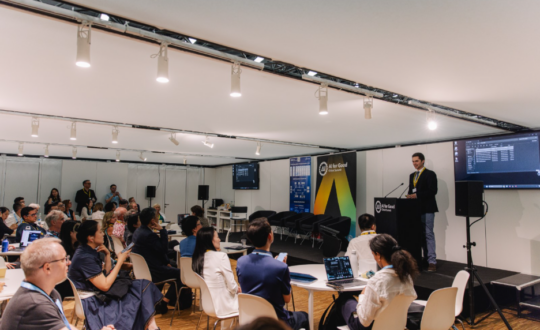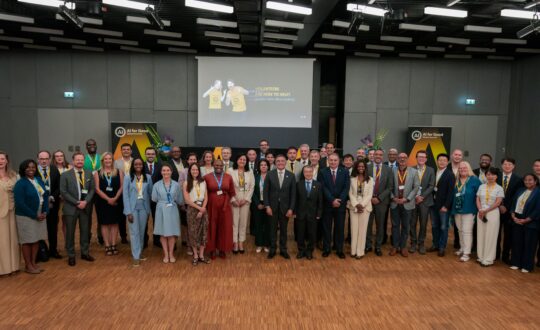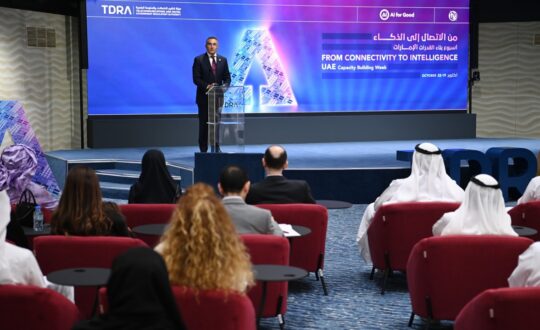


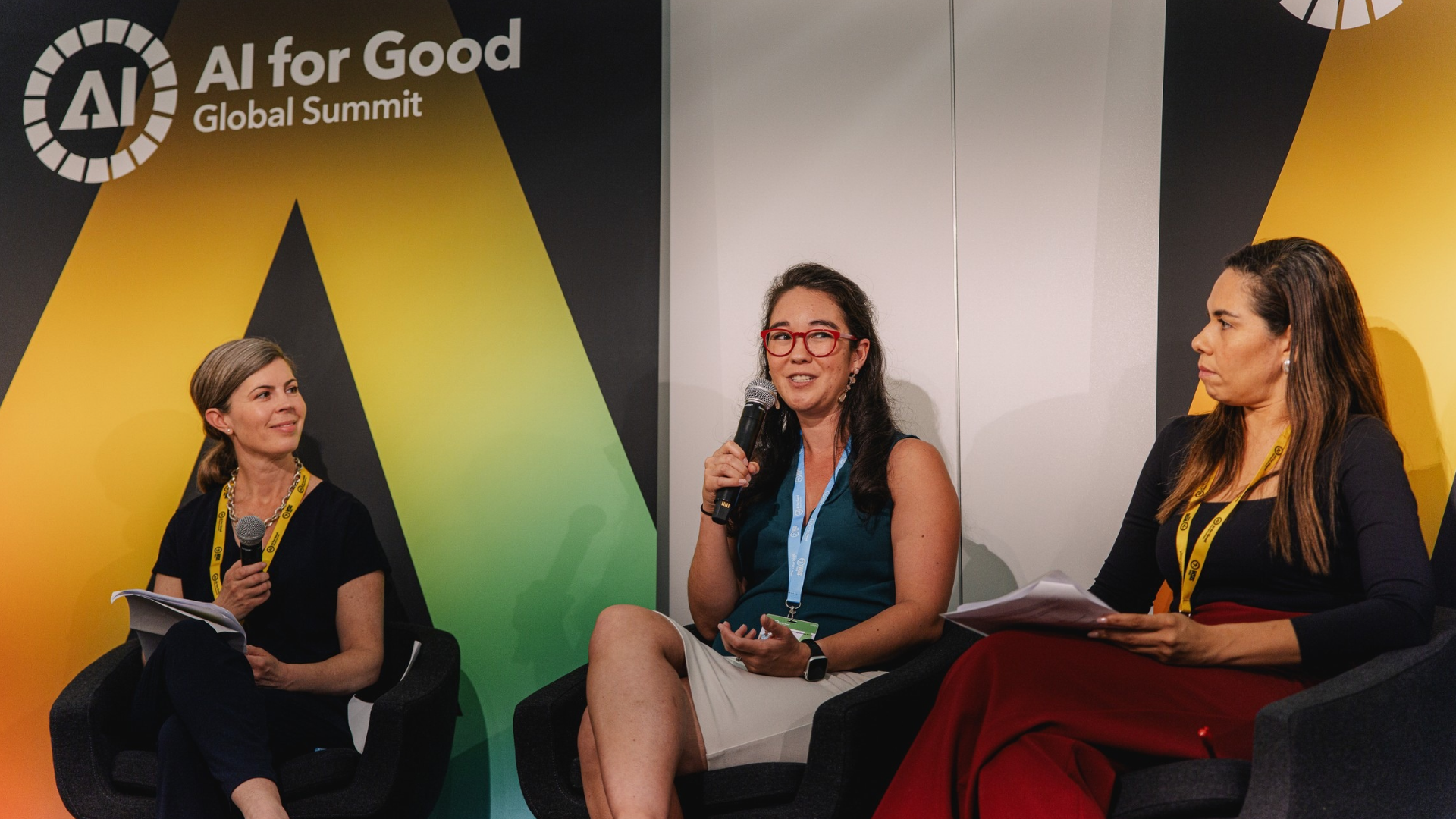
As I reflect on the AI for Good Summit, two speakers stay with me.
One was Sarah Alonso Vega. At 14, Sarah was a world semifinalist in the 2018 Technovation Challenge. At 17, she was the youngest speaker at the Digital Enterprise Show. Today, at 22, Sarah is a tech founder whose innovations include AMBLIA, an AI-assisted wearable set to revolutionize how we treat childhood lazy eye syndrome. Her story is a stunning endorsement of value of teaching young girls tech and AI skills.
The other was Korea Advanced Institute of Science and Technology (KAIST) researcher, Dr. Moon Choi, who’s been studying how older adults engage with AI globally. Her policy lab’s findings were stark: AI use drops sharply with age – falling from around 31% among those aged 30–44 to just 8% for people over 60 –The overwhelming concentration of AI infrastructure sits in developed regions, while the most aging growth (the 40–64 cohort) is concentrated in developing regions — a direct geographic mismatch.
At first glance, these speakers have little in common. Yet both of them underscored the need for helping communities acquire the skills to participate in an AI-enabled world. As AI becomes part of how we learn, work, access services and function in society, we need to decide:
- Who will benefit from AI?
- Who will use it?
- Who will shape it?
Member firms of the global EY organization sponsor the AI for Good Global Summit because they want to help the answers to these questions are equitable. The summit brings together leaders from across government, business, academia and civil society to explore how AI can be developed and applied in ways that improve lives and address global challenges.
For the global EY organization, this is an opportunity to contribute to a theme it believes will define the next chapter of AI: AI skills for everyone.
AI literacy is a foundational capability for participation in society
Functioning in society requires people to understand how to use AI, evaluate AI-generated information and apply these tools safely in their daily lives and work. Yet access to those skills remains uneven – especially in marginalized communities.
If we are serious about building an AI future that benefits everyone, addressing this inequity must be at the top of our priority list.
That belief shapes how EY approaches AI for Good. Through EY Ripples, our global corporate responsibility program, one of our three pillars is helping people build the skills they need to participate in the future economy.
Creating opportunities for the next generation
One of the gaps we’re trying to close is youth representation.
For example, the EY Ripples AI for Good program and ITU Telecommunication Development Sector have launched the AI Skills Accelerator. The program equips young, underserved women aged 18–25 with a blend of technical AI training, leadership development and ethical perspectives on AI.
Provided through in-person workshops in multiple countries, including India, Jordan, Kazakhstan, Kenya, Malta, Paraguay, Uzbekistan Egypt and Mozambique, the initiative brings together local NGOs, ministries, regulators and community organizations to create learning experiences that are both practical and locally relevant. By October 2026, the program will have reached its first 1,000 participants.
Even though, for some, the program is their first experience using a computer, the objective is to help more young people see themselves not just as users of AI, but as future innovators, entrepreneurs and leaders. In the words of one of our participants, Paraguay engineering and business information technology undergraduate, Lorena Jiménez, “The workshop was truly gratifying and extremely helpful.”
Most importantly, the program is helping participants see new possibilities for the future. In Nairobi, Kenya, more than 90% of those completing the workshop reported an interest in pursuing AI-related careers or further study. In Uzbekistan, more than 92% of participants reported high or very high interest in technology education and career pathways.
Their stories are powerful reminders that access to skills can change the trajectory of a life.
Alongside the International Telecommunication Union (ITU) and the GSM Association (GSMA), the global EY organization works with for Her Digital Skills under the EQUALS coalition, which aims to promote gender balance in the technology sector by advancing equal access, skills development, and career opportunities for both women and men.
Ensuring older generations are not left behind
For older adults, AI has the potential to support lifelong learning, improve access to healthcare, financial and government services, enhance independence and strengthen social connection. But those benefits will only be realized if older adults have the knowledge and confidence to use AI safely and effectively – skills that many did not have the opportunity to develop before leaving the workforce due to retirement. Without intervention, older adults risk facing new barriers to participation, particularly if technologies are not designed inclusively or if opportunities to build AI literacy are limited.
This challenge is the focus of a publication developed by ITU, the global EY organization and KAIST.
As Dr Cosmas Luckyson Zavazava, Director of the ITU Telecommunication Development Bureau, emphasized during the presentation of the report’s preliminary findings on 30 June: “An inclusive digital future will not happen by chance. It requires vision, deliberate choices and sustained commitment. We must ensure that digital transformation empowers people throughout their lives and contributes to more inclusive, resilient and sustainable societies for all.”
Drawing on global research and 14 case studies, the publication explores how aging populations – and older women in particular – are engaging with AI-enabled technologies. It highlights barriers to accessing and understanding these technologies, and presents evidence-based recommendations to advance AI literacy, adoption, and inclusion among aging populations. This report emphasizes practical, scalable approaches to help ensure that older adults – are not left behind in the AI era.
Did you know? In Japan, Masako Wakamiya designed her first iPhone app at the age of 81 – despite not having touched a computer until she was 60. Her story captures exactly what this report is about: with the right tools, support, and open opportunities for learning regardless of age, later life can be a time of creation, not just catching up.
Why conversations like AI for Good matter
The AI for Good Summit is a critical forum for connecting like-minded organizations from different sectors, bringing together leaders who are developing new technologies, shaping policy, conducting research and delivering programs on the ground. It’s such a valuable channel for sharing learning, challenging assumptions and identifying practical collaborative actions.
That’s why the global EY organization made sure its contribution to the summit was grounded in real-world experience. The global EY organization shared what it is learning through initiatives like the AI Skills Accelerator, through its research partnerships, and through its broader work helping organizations use AI responsibly and effectively.
And the global EY organization used the summit as a platform to raise the profile of the organizations, innovators and researchers making important advances in delivering AI skills for everyone.
The future of AI should include everyone
The choices we make today will help determine whether AI becomes a force that expands opportunity or one that deepens existing inequalities. By investing in skills, fostering collaboration and designing for inclusion from the outset, we can help build a future where people of all ages, backgrounds and communities have the opportunity to benefit from AI.
That is the conversation we brought to AI for Good. And it’s one we look forward to continuing. In fact, here’s our next question: Who else is being left behind in AI skilling? And how can we reach them?
Learn more
How older generations are engaging with AI – and why it matters
Artificial intelligence and ageing: Inclusive pathways for older persons in a digital world
The views reflected in this article are the views of the author and do not necessarily reflect the views of the global EY organization or its member firms.