


Every day, in large factories that manufacture heavy machinery such as excavators and bulldozers, planners decide which parts to produce together. But that decision, taken without considering the downstream process, can prove costly.
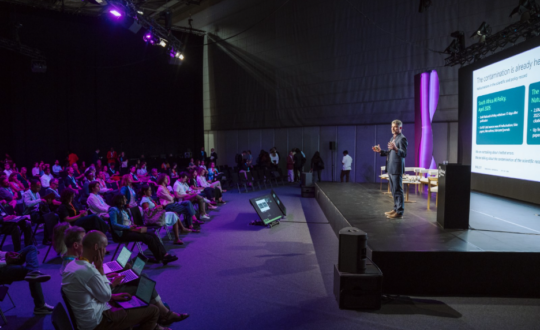
Speaking during the session “From Plan to Plate: AI that Designs Out Waste” at the AI For Good Global Summit 2026, Juxihong Julaiti, Principal Data Scientist and Founding Director of China Unicom’s OPTIMA Lab, explained that some combinations of parts make efficient use of steel sheets, while others generate a great deal of waste, even when different plants are producing the same type of machinery at the same time. The problem, he explained, is that the planning phase does not take into account the actual use of the steel sheets further down the production line. This creates a form of “silent” waste, invisible to those deciding on the production plan.
Heavy machinery such as diggers, excavators and bulldozers, is built from parts including the base, the track and the digging arm, most of which are cut from steel plates. Julaiti illustrated the issue with two examples: in one, the plates were well utilised; in the other, produced by a different plant but for essentially the same set of machinery within a comparable timeframe, a great deal of material wasted. The project aimed to close the gap between planners and the actual downstream use of steel, giving planners visibility into which plan would make good use of the plates.
The context is not irrelevant. According to the World Steel Report 2025, cited by Julaiti, around 1.85 billion tonnes of steel are produced each year, with approximately 2.2 tonnes of CO₂ emitted per tonne. When cutting steel sheets, typically 20% to 30% of the material is lost as scrap. It is this recoverable portion that the China Unicom team set out to address.
The initial attempt and its limitations
Julaiti, whose background is in operational research, explained that he initially tried to formulate the problem as a classical mathematical optimisation problem. However, arranging many small components on a steel sheet is itself a highly complex combinatorial problem. The difficulty increases rapidly as the number of parts grows.
The client produces new plans three or four times a day, but solving the problem at full production scale could have taken three or four days. A solution that required several days to calculate could not support a process that needed to be repeated several times daily. As Julaiti summarised, this approach was ruled out, leaving the question of what to do next.
Two approaches for two production scales
The researchers therefore developed two approaches tailored to different plant sizes. For a smaller facility producing around ten machines per day, the team used historical data to estimate steel utilisation rather than repeating a computationally expensive calculation for every feasible plan. This was based on the assumption that, although individual configurations may change, the basic components of the machines remain broadly similar over periods of five to ten years.
For larger operations producing approximately 500 machines per day, this approach was still too slow. As a result, the team developed a deep learning model that was trained on historical data to determine the relationship between the items to be manufactured and the related sheet metal utilisation. In production, the system first determines whether a combination has already been examined, resulting in an instant estimate via a very rapid search; if the combination is new, the predictive model is activated. Every time a plan is carried out, the results are utilised to retrain the model, which, according to Julaiti, gradually improves with use, resulting in a virtuous cycle.
Integration with the existing system
A central concern during development was how the new estimate would fit into the client’s existing decision-making process. Julaiti explained that, during the development phase, the planners were worried that their way of working might be disrupted. For this reason, he explained, the team opted for a different approach: “So we thought […] maybe we don’t have to break what you were already doing.”
As Julaiti himself summarised, “the beauty in this is that we don’t replace what’s there.”
Instead of replacing the existing optimisation criteria, the team added predicted sheet-metal utilisation as a new factor alongside plant capacity, production priorities, and deadlines.
Julaiti visualised this as a layer of rectangles, each representing a feasible solution that planners might otherwise consider equivalent. The new dimension his team introduced sits as a curve on top of that layer, showing which of those feasible solutions would deliver the best plate utilisation, allowing planners to choose accordingly without altering the underlying planning logic.
Assessment and results
Before the system’s large-scale implementation, the team conducted three series of small-scale experiments, each of which generated four sets of combinations. The model classified two of these sets as “good” and two as “poor.” Julaiti asserts that the results were verified in practice when the model indicated a good combination, and the same was true for combinations that were deemed to be poor. The staff responsible for arranging the parts tested the results.
According to the data presented by the speaker, the system demonstrated an increase in sheet metal utilisation when it was incorporated into the optimisation process, as opposed to the process that did not account for this factor. Julaiti reported a model error margin of less than 0.6%, which he considered to be sufficiently precise to inform planning in conjunction with the client’s chief scientist.
The system has now been implemented in numerous facilities of the client over the past six months.
Some plants reported improvements of between 2% and 3% in sheet-metal utilisation, while others recorded gains of slightly more than one per cent. Julaiti estimated that these improvements corresponded to annual cost savings of more than RMB 10 million. He did not disclose the precise number of tonnes of steel saved in order to prevent the disclosure of information regarding the client’s production capacity.
Implications and future developments
The work completed so far has focused on a single business unit, but Julaiti noted that other units within the client’s company have shown interest in applying a similar approach to improve their own material utilisation.
He concluded with a broader reflection on how AI is adopted in industrial settings:
“In manufacturing settings, AI is not scaled by mandate but by the result,” Julaiti said.
The project illustrates a non-linear journey: from an initial attempt at pure mathematical optimisation, which proved impractical on a large scale, to a hybrid approach combining historical data and predictive models, designed to integrate with existing decision-making processes rather than replace them.