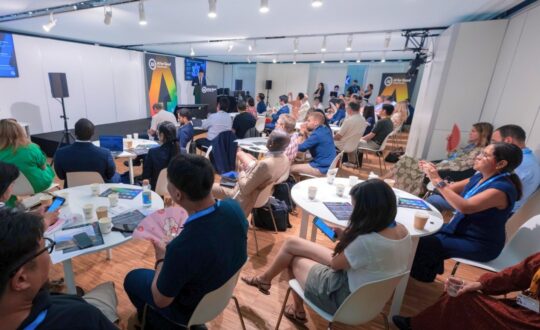


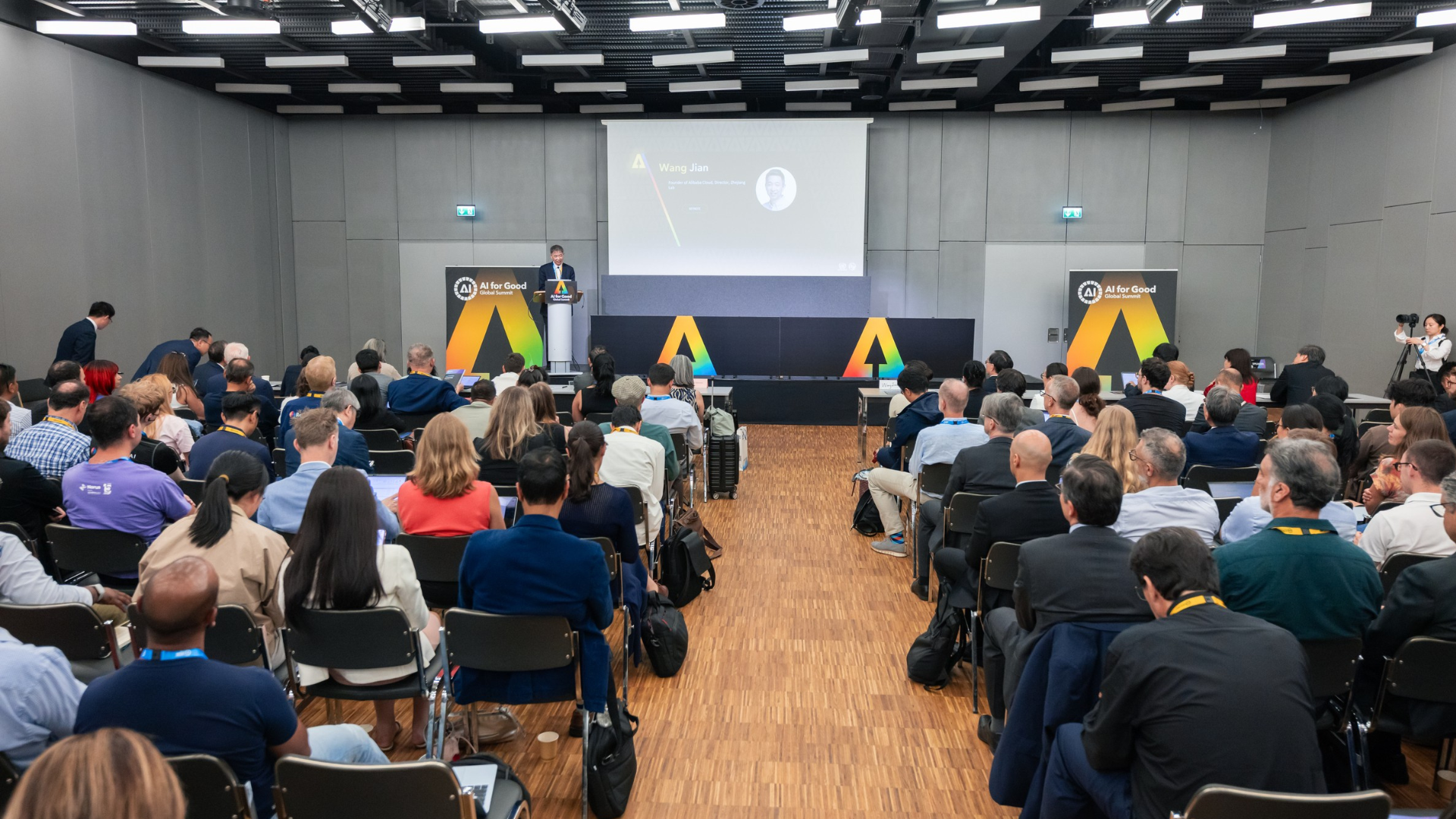
During the AI for Good Global Summit 2026, the workshop “Brain-Computer Interface: Technology for Good and Application Cooperation“ gathered scholars, engineers, clinicians and industry leaders from China, Switzerland, the Republic of Korea, the United States, the United Kingdom, Italy, India, Singapore and other countries. The session, organized in partnership with the China Academy of Information and Communications Technology (CAICT), addressed how brain-computer interface (BCI) technology can move from research to safe, accessible and internationally coordinated application.
A field still finding its footing
Opening the session, Yu Xiaohui, President of CAICT, framed BCI as a technology sitting at the crossing point of brain science and AI, one that could help people with impaired neurological function regain independence, connect people with sensory impairments to the world around them, and support dignified ageing.
Wei Wei, Director General of the Science and Technology Department at China’s Ministry of Industry and Information Technology, attending at the commission of Minister Lecheng Li, laid out China’s roadmap for the sector. He pointed to the recent market approval of what he described as the world’s first invasive brain-computer interface medical device, and outlined four priorities: a solid technological foundation, standards leadership, application scenarios expanding beyond healthcare into industry and consumer use, and an industrial ecosystem that, he said, already counts nearly 350 members in its Brain-Computer Interface Industrial Alliance. He proposed three pillars for international cooperation: a shared platform for exchange, a coordinated international standards system, and a joint framework for safety and ethics.
Tomas Lamanauskas, Deputy Secretary-General of the ITU, cited figures from the World Economic Forum that put the BCI market at $6.2 billion by 2030.
“Imagine a world where people who have lost the ability to speak or move can regain their speech and mobility through intention alone, where we can restore someone’s dignity and freedom regardless of physical limitations,” Lamanauskas said.
He warned that today’s ecosystem remains fragmented, with different countries and regions adopting different approaches and systems. “Without standards, groundbreaking BCI innovation can widen disparities and create new challenges,” he said. “Therefore, international cooperation is vital to make the technologies work consistently, safely and accessibly.”
When the interface leaves the lab
The first roundtable, on applications of BCI, was moderated by Liyan Liang, Senior Engineer at CAICT, who stepped in after the planned moderator was unable to attend.
Sebastian Tam, Chief Technology Officer of the Brain-Computer Division at Entropy Base Technology, described pairing biometrics with EEG sensing to support workers such as delivery riders and drivers.
“For us, the most important question is never whether we can detect the brain signal,” Tam said. “The more important question is what human problem does that signal help solve?”
Javier Minguez, co-founder and Chief Scientific Officer of Bitbrain, took the conversation into sleep itself, describing a technology that detects deep sleep in real time and delivers acoustic stimulation to deepen it, with early trials focused on Alzheimer’s disease.
Olivier Oullier, co-founder and CEO of Inclusive Brains and Visiting Professor at Mohamed bin Zayed University of Artificial Intelligence (MBZUAI), then moved between mind-controlled exoskeletons for people with disabilities and real-time stress monitoring for surgeons during operations, arguing against reducing people to simple metrics.
“We’re dealing with real lives, and we are way too precious and way too complex for a bunch of questionnaires to summarize us for a job or for a mood,” Oullier said.
Sarah Aboerjaib, founder of ScansX, joined the discussion in the question period. Asked how she weighs the urgency of saving a life against the risk of a wrong reading with her portable brain hemorrhage detector, she pointed to the danger of a false positive in triage.
Writing the rulebook mid-flight
The second roundtable, on standards, brought together four panelists: Tiancheng Sheng, Deblina Sarkar, Anja Kaspersen and Max Ortiz Catalan, scientist and humanitarian, who also steered much of the discussion.
Sheng, BCI Researcher at CAICT, argued that invasive and non-invasive BCI need different starting points for regulation: testing methods for implantable electrodes for the former, given the risk of tissue damage from flawed electrode design or material choice; data formats and testing methods for decoding algorithms for the latter.
“At this present, I think the mainstream electrical technical rules are basically finalized,” Sheng said. “And so maybe it’s time to standardize some testing method for invasive method to drive large scale industrialization.”
Sarkar, Associate Professor at MIT and founder of Cahira Technologies, argued that a single standard cannot fit every disease. She explained that standards needed to remain dynamic and vary according to the disease, particularly because existing drugs were ineffective for many conditions. She added that a new technology should still be approved when it was safe and demonstrated benefits, even if only for a smaller population.
Kaspersen, Director for Global Markets Development, Frontier Issues and Critical Technologies at IEEE, argued that approval is a beginning, not an ending. She stressed that verification was continuous and that a system which passed its tests at release could not be assumed to remain adequately tested indefinitely.
Ortiz Catalan raised the tension between excessive oversight and insufficient regulation. He argued that the sector needed to find a middle ground between what he viewed as Europe’s overly extensive regulatory approach and the absence of meaningful oversight.
A discipline still being written
Across both panels, a shared unease emerged: BCI is moving faster than the frameworks meant to hold it steady, and closing that gap will take shared terminology, shared testing methods, and sustained cooperation among engineers, clinicians, regulators and international bodies. During the workshop, CAICT launched a Pre-research Group for the Standardization of Brain-Computer Interface Technology with experts drawn from multiple continents. As Li Wenyu, Director of the Intellectual Property and Innovation Development Center at CAICT, put it in closing, the future of this technology belongs to no single country or organization, but to a global standards effort built for all of humanity.