


As AI moves into everyday services, the infrastructure beneath it is becoming increasingly important. Connectivity, computing capacity, energy efficiency, security, and affordability all influence who can benefit from AI and where those benefits can be realized.
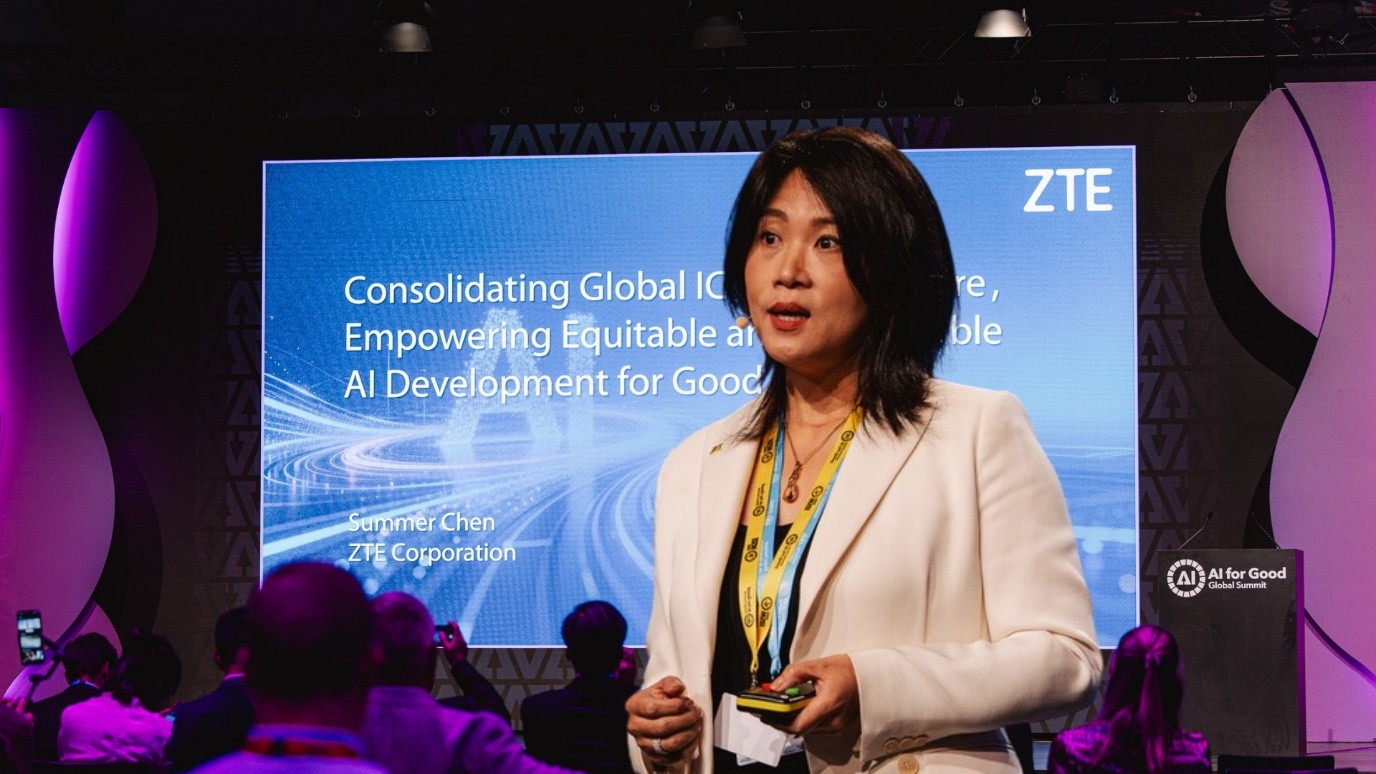
During the session Consolidating global digital infrastructure, empowering equitable and responsible AI development for good at the AI for Good Global Summit 2026, Summer Chen, Chief International Ecosystem Representative at ZTE Corporation, explored how digital infrastructure must evolve to support the next phase of AI development.
Drawing on ZTE’s experience in the information and communication technology sector, Chen focused on expanding connectivity, integrating computing and networks, reducing environmental impact, and building trust into AI infrastructure.
AI infrastructure as an essential resource
Chen argued that the infrastructure supporting AI should be considered in a similar way to other essential resources.
“AI infrastructure should be like water or electricity, accessible everywhere,” she said.
As AI develops from large language models toward AI agents, its computing requirements are growing. For the ICT sector, this means moving beyond connectivity alone. Networks must increasingly be integrated with computing capacity so that AI services can reach communities, industries, and individuals in different locations.
Chen emphasized that this infrastructure must also be affordable and sustainable. Without those conditions, AI development risks reinforcing existing inequalities between countries and regions.
Understanding the AI value chain
Chen divided the AI ecosystem into three stages: token production, token transmission, and token consumption.
Token production refers to the data centers and computing facilities required to run AI systems. Token transmission concerns the networks that carry AI-generated information between computing centers and users. Token consumption includes the devices, applications, industries, and public services that use those capabilities.
Together, these stages form a value chain extending from the computing resources behind an AI model to the person or organization using its output.
The framework also shows why infrastructure cannot be developed in isolated parts. More powerful data centers have limited impact without networks capable of distributing their services. Faster connectivity is also insufficient if users lack suitable devices, applications, or affordable access.
Reducing energy demands
Token production brings significant energy challenges. AI data centers require substantial power, and not every region has the capacity to support high-density computing infrastructure.
Chen described energy efficiency and lower-carbon design as core requirements rather than optional additions. This includes liquid cooling, more efficient power systems, and the joint optimization of chips, hardware, and software.
Simply placing more graphics processing units in a data center is not enough. The wider system must use computing resources efficiently while reducing pressure on energy supplies.
Chen highlighted a ZTE green energy project developed with Tencent as an example of efforts to reduce power consumption in data center operations. She also noted that renewable sources such as solar and wind may contribute to powering AI infrastructure, although meeting the scale and consistency of data center demand remains challenging.
Extending access through connectivity
Once AI resources are produced, they must be made accessible through networks.
Chen pointed to the uneven distribution of computing power, with much of it concentrated in China, the United States, and Europe. At the same time, many people remain disconnected from the internet and therefore unable to access digital services, including emerging AI applications.
Closing the AI divide requires both computing capacity and the connectivity needed to reach users.
Fiber, fixed wireless networks, mobile infrastructure, and satellite solutions can each play a role depending on local geography and needs. Rural communities, cities, islands, and desert regions may require different combinations of technologies.
Chen referred to ZTE’s work with telecommunications operators and partners in African markets to expand network coverage. Such projects can provide access not only to the internet, but also to the AI-enabled services that increasingly depend on it.
The objective, she said, is to ensure that people are not left behind by either the digital transition or the AI transition.
Supporting AI use across industries
The final stage is token consumption, where AI reaches users through devices, applications, and industrial systems.
Chen pointed to developments including AI-enabled glasses, AI-native smartphones, embedded AI, and other connected devices. As these technologies become more widely used, networks will need to support new forms of interaction and larger volumes of information exchange.
AI infrastructure also matters beyond individual consumers. Industries can integrate AI into production processes to improve efficiency, monitor operations, and support digital transformation.
This creates new demands for telecommunications networks and computing systems. Infrastructure must provide AI services with sufficient speed, reliability, efficiency, and affordability across different economic and operational environments.
Building trust into infrastructure
Chen also emphasized that trust must form part of the infrastructure itself.
As AI becomes more deeply embedded in services and industrial processes, technical progress requires a secure foundation. This means addressing cybersecurity, ethics, compliance, and operational controls throughout a system’s lifecycle.
Chen described trust as more than a theoretical principle. It requires investment, governance structures, and collaboration with partners and third parties.
For infrastructure providers, security and compliance therefore need to be considered during project design, product delivery, operations, and ongoing management.
Cooperation across borders and sectors
Chen compared the current challenge with the international coordination that has shaped telecommunications over previous decades. Shared standards, aligned frequency bands, and common frameworks helped countries and industries build globally connected systems.
AI infrastructure will require a similarly broad approach. Governments, companies, international organizations, public institutions, and other stakeholders must contribute to discussions about standards, governance, and long-term development.
Countries face different challenges, including limited connectivity, uneven power supplies, language barriers, and restricted access to computing resources. These issues cannot be addressed through technical innovation alone.
Chen argued that institutions such as the International Telecommunication Union and the United Nations can help bring stakeholders together and support continued dialogue.
Closing the digital and AI divides
Chen concluded by returning to the relationship between infrastructure and inclusion.
AI may create new opportunities for industries, public services, and communities, but those opportunities will remain uneven if the underlying infrastructure is concentrated in only a few regions.
Expanding access therefore means addressing both the existing digital divide and the emerging AI divide. Connectivity must continue to reach underserved areas, while computing resources, energy-efficient systems, secure networks, and appropriate devices must become more widely available.
Infrastructure is not simply a technical layer operating in the background. It determines where AI can be deployed, who can use it, and whether its benefits can be shared more equitably.
Building that foundation will require sustained investment, lower-carbon design, trusted systems, and cooperation across sectors and borders.