


From financial regulation and clinical safety to agricultural protection, a range of responsible AI principles can be translated into practical, locally grounded solutions.
In Riyadh, innovators put responsible AI into action at the ITU AI Readiness Hackathon 2026, transforming complex governance and readiness challenges into practical solutions designed for real-world use.
Organized by the International Telecommunication Union (ITU) and the International Center for AI Research and Ethics (ICAIRE), the competition took place alongside the UNESCO Global Forum on the Ethics of AI in Saudi Arabia. Four winning teams were recognized for solutions addressing challenges across financial regulation, AI governance, healthcare and agriculture.
This journey began at the AI for Good Global Summit in Geneva in July, and brought together 668 registrations, 84 active teams and 243 participants across the region.
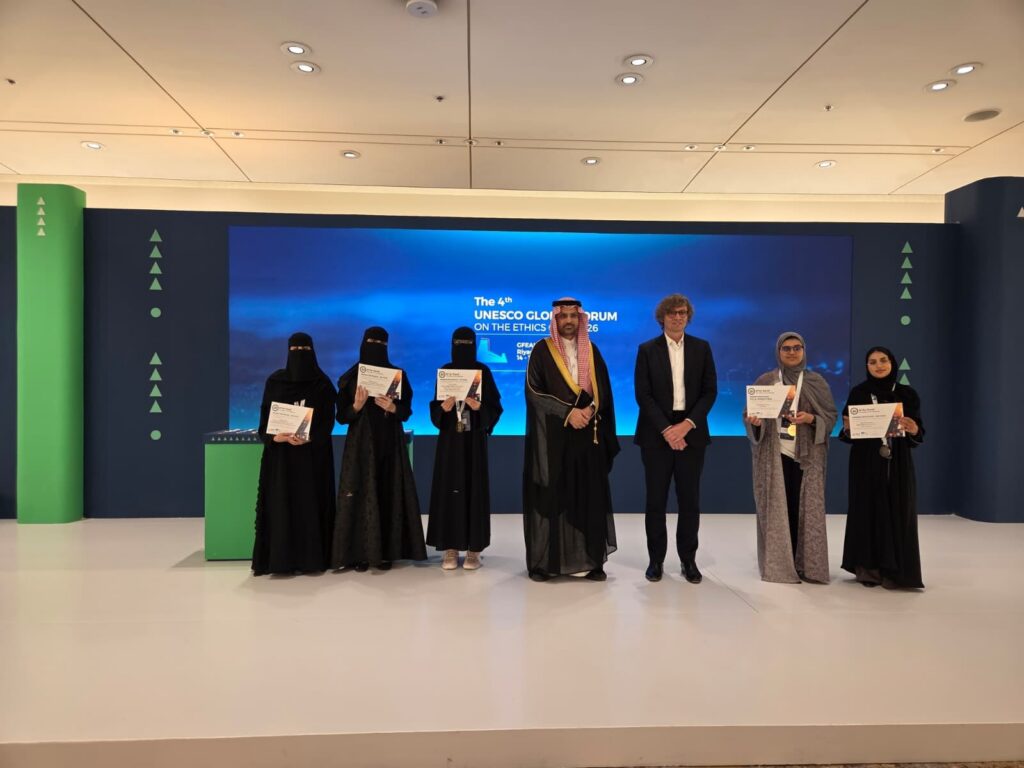
The Prizes ceremony included Tomas Lamanauskas, the Deputy Secretary-General of ITU and ICAIRE Director, Dr Majed Al-Shehri to present the certificates to the winning teams.
“The ITU AI Readiness Hackathon demonstrated the depth of innovative AI solutions, with participants applying standards and ITU AI Readiness framework while identifying important policy gaps. With women making up 70% of participants, and every winning team including women – including women-only teams – the hackathon showcased the value of inclusive innovation in shaping the future of AI” said Tomas Lamanauskas, ITU Deputy Secretary-General.
SANAD takes first place with evidence-first regulatory intelligence
First place went to SANAD, an agentic solution designed to map national regulatory frameworks to the international standards underpinning them.
The team’s evidence-anchored, multi-agent system maps Saudi financial regulation from SAMA against NIST standards. It is designed to reject any finding that it cannot support with a verbatim citation, strengthening traceability and trust in regulatory analysis.
SANAD also applies an Arabic scholarly verification approach and uses a bilingual policy corpus. These resources contribute to Arabic local-language large language model collaboration while enriching the sandbox knowledge base. The solution demonstrates an approach that could be extended across different regulatory domains.
AI Guardian brings continuous governance into production
Second place was awarded to AI Guardian, a production-oriented platform for continuous AI governance, risk management and regulatory intelligence.
The prototype separates probabilistic AI assistance from deterministic compliance controls. AI agents retrieve, analyse and propose information, while deterministic software governs applicability, scoring, audit sealing and system-of-record transitions.
This division is designed to support AI governance that remains continuous, traceable and accountable to human decision-makers, including in regulated environments.
Samaam introduces a policy gateway for oncology radiology
Third place went to Samaam, a policy gateway designed for oncology radiology.
Positioned between a technologist’s console and a medical device, the prototype reviews each worklist before an acquisition proceeds. It reads the patient’s renal function and compares the requested settings with applicable Saudi regulation.
If the settings meet the requirements, Samaam releases the acquisition. If they do not, the system returns an “HTTP 403: Policy Violation” response, together with the relevant provision, issuing authority and a working link to the source document.
Nakheel Doctor connects agricultural AI with trusted guidance
The “Women’s Team Special Prize” was awarded to Nakheel Doctor, an agricultural AI prototype focused on detecting Red Palm Weevil – and the team was just one-woman!
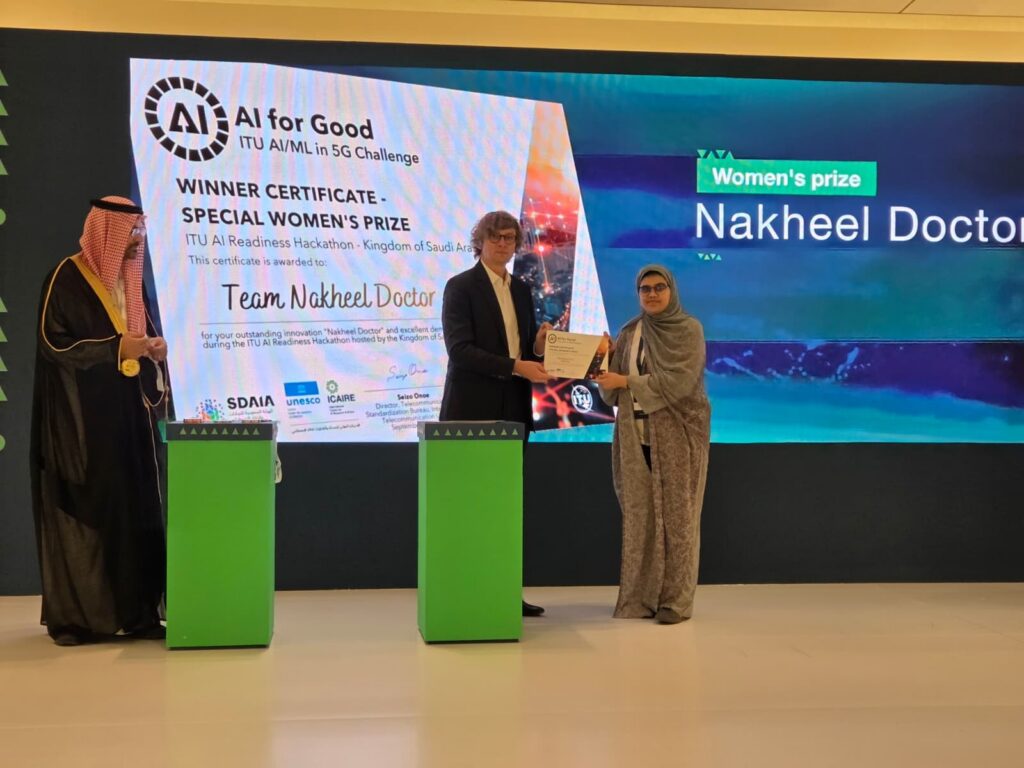
The solution connects acoustic detection with a Retrieval-Augmented Generation knowledge base. Instead of treating a machine-learning prediction as the final answer, Nakheel Doctor retrieves authenticated Saudi agricultural guidance and AI and data-governance materials.
The prototype communicates uncertainty, cites the evidence used and keeps higher-impact actions subject to human confirmation. By bringing together technical inference, national context, policy guidance and human decision-making, the project illustrates a policy-aware approach to deploying AI in agriculture.
Turning AI readiness into action
Together, the winning projects show how AI readiness can move beyond high-level principles and into practical workflows. Across all four solutions, a common theme emerged: responsible adoption depends not only on technical performance, but also on reliable evidence, regulatory alignment, local context, traceability and meaningful human oversight.
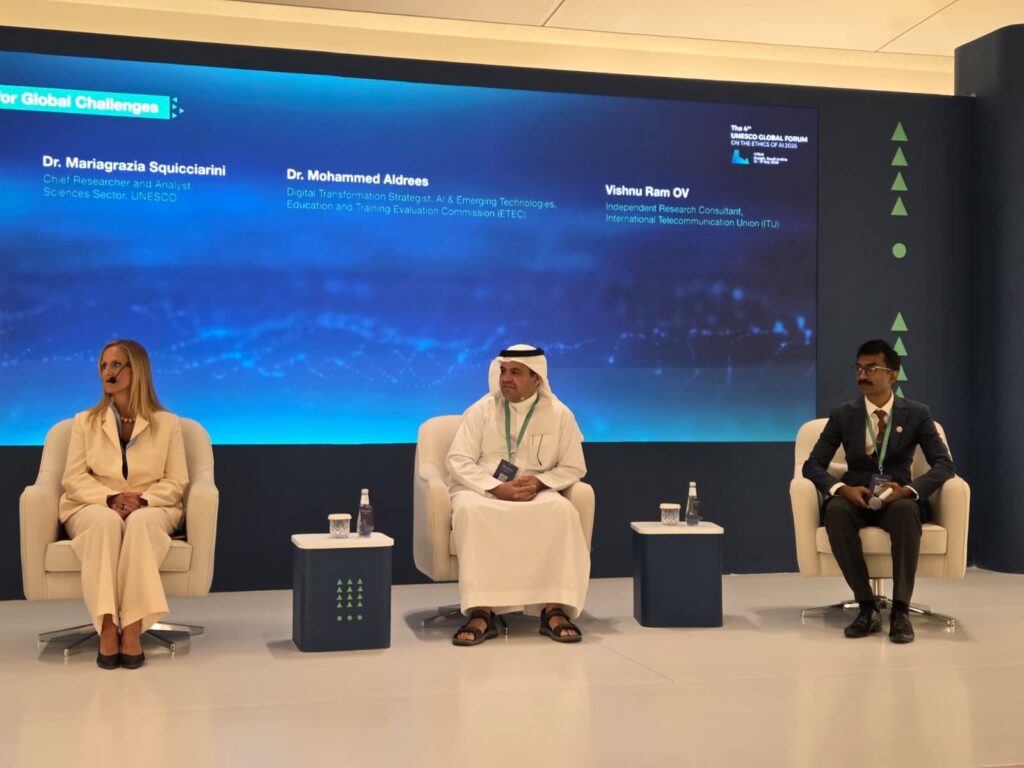
Members of the Judging panel included Vishnu Ram from ITU, Mariagrazia Squicciarini from UNESCO and Mohammed Aldrees from ETEC.
By tackling concrete challenges in finance, governance, healthcare and agriculture, the ITU AI Readiness Hackathon 2026 demonstrated how innovators can turn responsible AI commitments into tools built for real-world impact