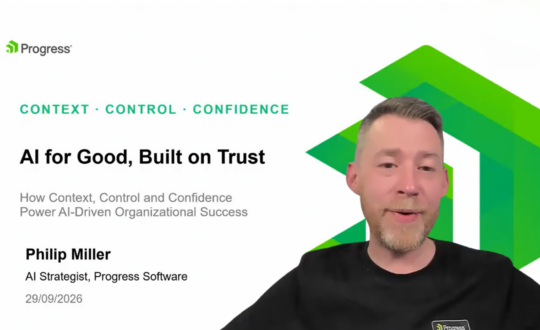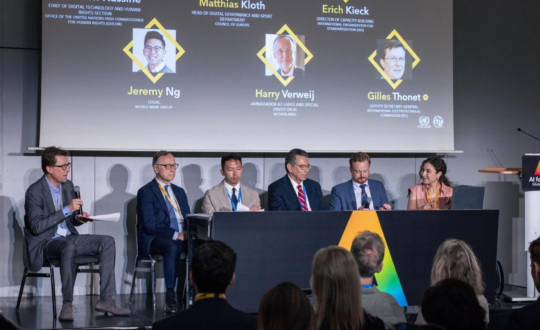
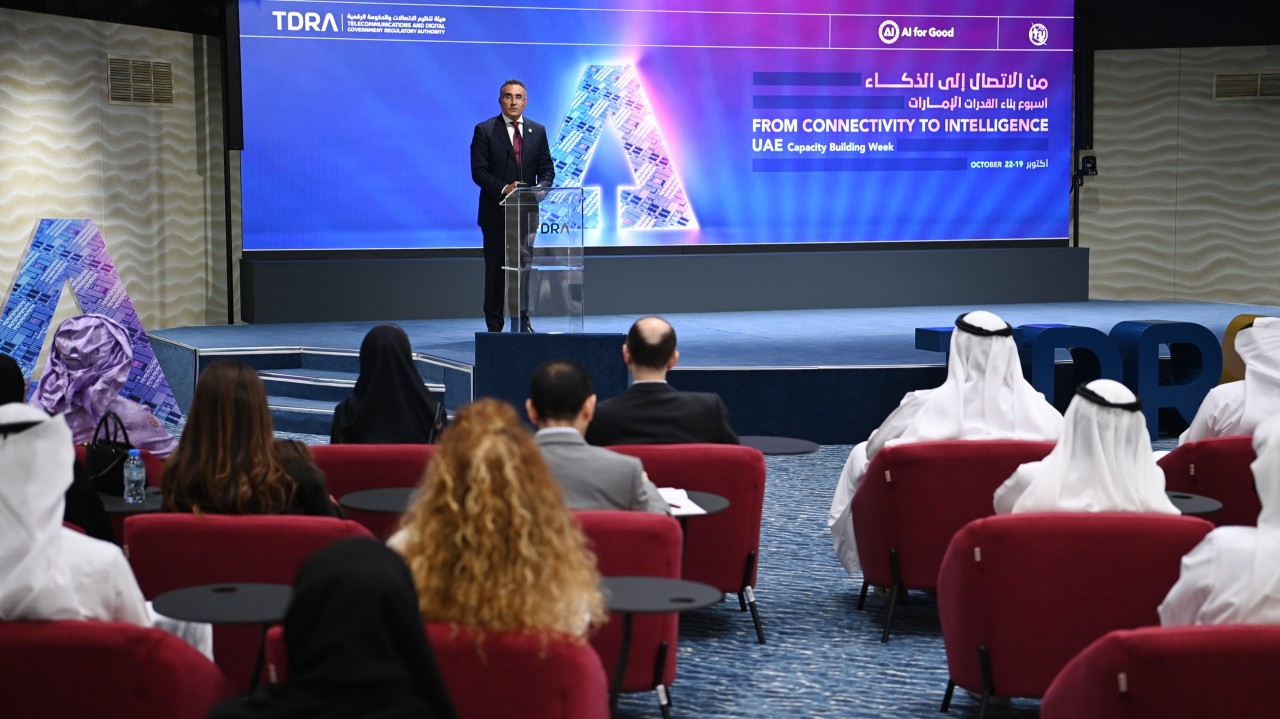
Dr. Bilel Jamoussi, Deputy Director of ITU Telecommunication Standardization Bureau addresses delegates in UAE.
The United Arab Emirates (UAE) is advancing from digital connectivity towards AI-enabled transformation. Activities around “From Connectivity to Intelligence: UAE Capacity Building Week”, held during 19–22 October 2026, brought together policymakers, regulators, researchers, innovators and technical experts to explore practical AI implementation.
The main workshop on 21 October 2026, organized by the International Telecommunication Union (ITU) with the هيئة تنظيم الاتصالات والحكومة الرقمية (TDRA), focused on innovation, skills, governance and priority-sector applications. The activities form part of the ITU–TDRA collaboration signed at the AI for Good Global Summit in Geneva, supporting an AI for Good Lab and sandbox for standards-based experimentation, including agentic AI for government and telecommunications networks.
A central message of the AI for Good Lab is that responsible, scalable AI requires more than sophisticated models: it depends on institutions, skills, infrastructure, standards and collaborative ecosystems.
During the opening of the workshop, ITU and TDRA jointly launched the following projects for the AI for Good Lab for UAE:
1. The Sandbox Network for Arabic-AI (SNAI) a pan-Arab Arabic-AI platform hosted on the ITU AI for Good Sandbox.
2. A call for collaboration on domain-specific open knowledge bases.
3. The launch of the Global Open Repository of AI Agents and metadata, hosted in the ITU AI for Good Sandbox.
4. The launch of the ITU AI for Good Sandbox Global Hackathon – UAE.
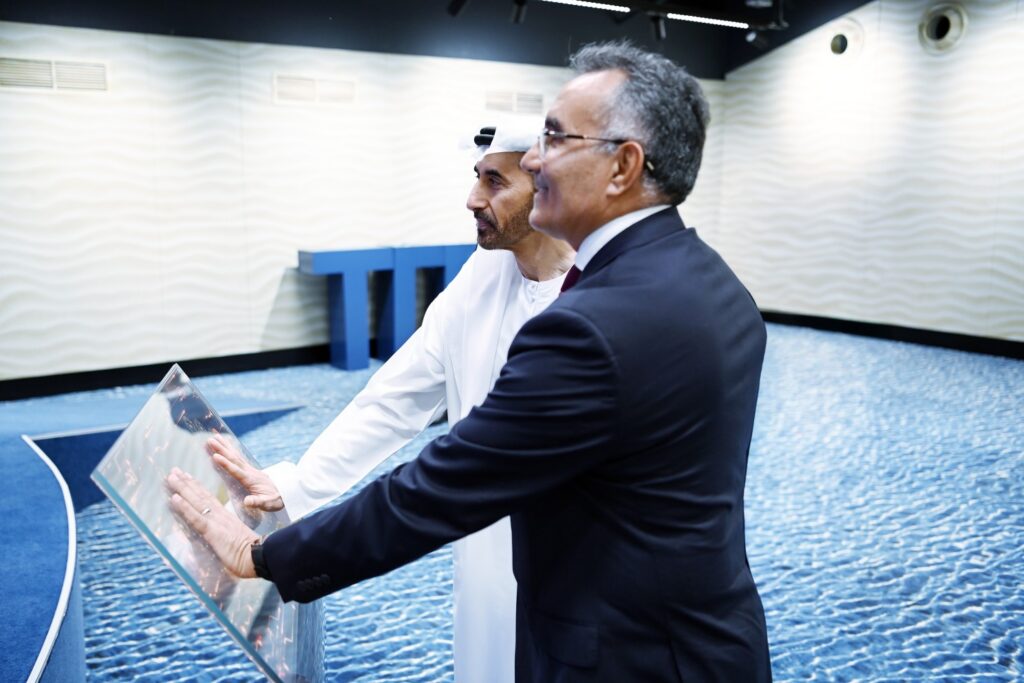
HE Engineer Majed Sultan Al Mesmar and Dr. Bilel Jamoussi launching AI for Good Lab – UAE
From AI strategy to implementation
The proposed AI for Good Lab – UAE can bridge strategy and implementation through three complementary pillars: AI readiness and policy, skills development, and public AI infrastructure. It would assess readiness, identify gaps, build capabilities and accelerate locally relevant solutions, providing realistic testing conditions before deployment.
For the UAE, the Lab can connect government priorities with universities, researchers, start-ups, technology providers and international expertise. It offers a structured way to address policy, standards, skills and innovation gaps, helping promising research progress towards applications in healthcare, education, telecommunications and government services.
The Sandbox translates international standards into operational infrastructure, covering governed data handling, AI/ML pipelines, marketplaces, controlled testing, model serving and lifecycle orchestration. Cross-cutting controls address identity, provenance, licensing, security, audit, sovereignty and data residency, supporting progression from prototypes to validated solutions and national-scale deployment.
Building UAE capability through practical learning
The UAE Sandbox training material demonstrated practical applications through four sector case studies covering healthcare, education, telecommunications and government. It combined AI readiness, standards and sandbox experimentation, incorporating the ITU AI Readiness Framework’s 13 dimensions alongside practical exposure to AI agents and relevant ITU-T standards.
Sustainable capability requires local expertise to adapt models, govern data, evaluate risks and apply standards to national needs, rather than relying solely on imported technologies.
The Lab could also strengthen the UAE’s contribution as a regional platform for developing, testing and sharing trusted AI solutions.
Turning the week into action through the Hackathon
The AI for Good Sandbox Global Hackathon – UAE offers a practical mechanism to carry the week’s momentum forward. Participants can address real problems, use datasets and models, build prototypes and evaluate solutions in a structured environment, extending learning beyond training and discussion.
Linked to the Sandbox, the UAE Hackathon can support a scale-up pathway: prioritize national problems, source suitable models and data, adapt solutions locally, validate them, package them for reuse, deploy through approved infrastructure and continuously monitor performance. UAE hackathon launched during the workshop attracted 500+ registrations from 28 countries, forming more than 230 teams, addressing healthcare, education, telecom and government services domains.
A platform for sustained impact
The week’s principal opportunity is to establish a sustained innovation cycle: capacity building enables experimentation, experimentation produces validated solutions, and those solutions can progress towards deployment and national scale.
By linking the AI for Good Lab, its Sandbox pillar, sector use cases and Hackathon outcomes, the UAE brought government, academia, industry, start-ups and young innovators together around national challenges. This could be a winning formula for a repeatable mechanism that turns promising pilots into trusted, interoperable and scalable AI solutions that benefit society.