

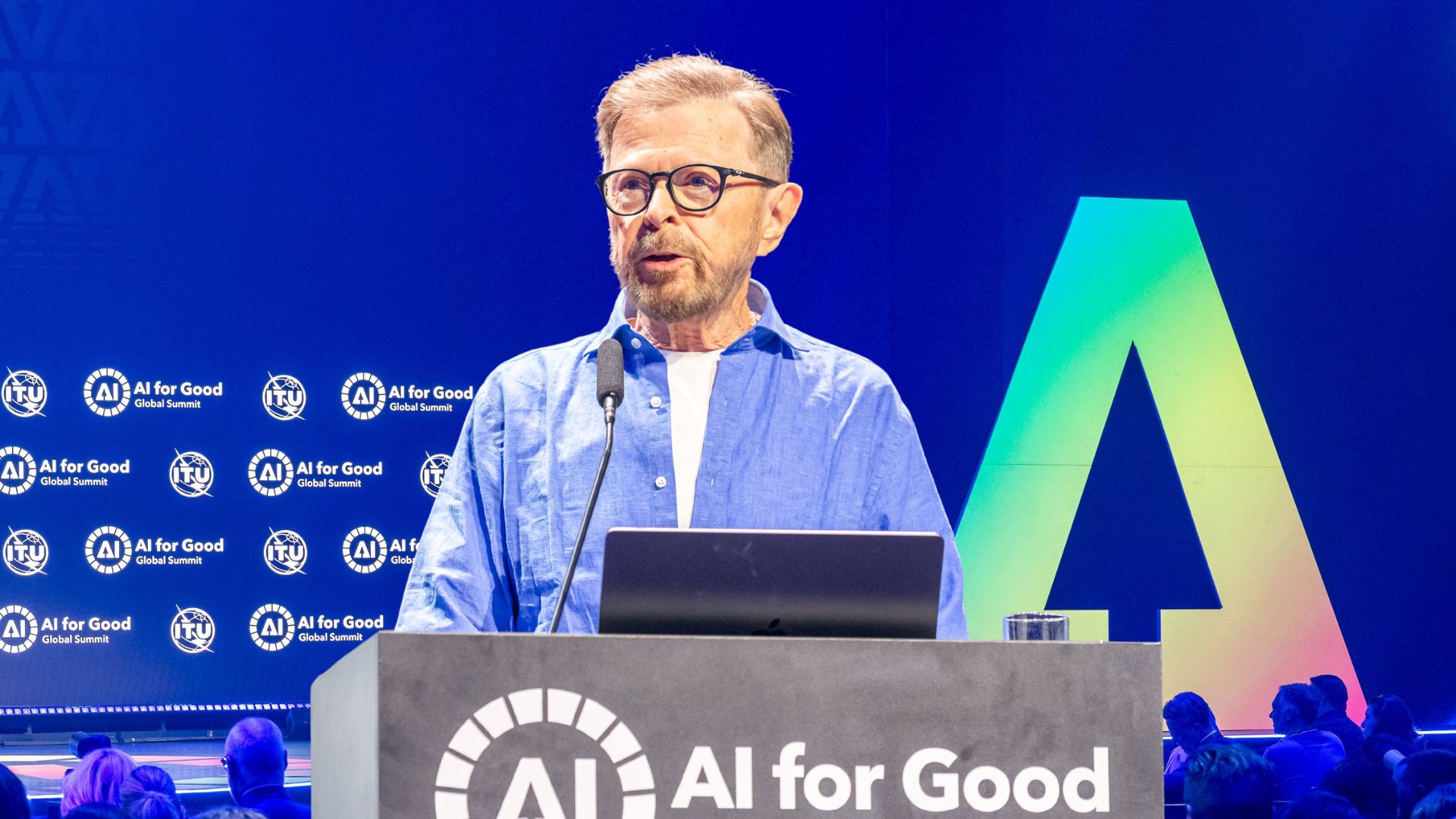
Speaking at the AI for Good Global Summit 2026, Björn Ulvaeus, co-founder of ABBA and president of the International Confederation of Societies of Authors and Composers (CISAC), argued that AI should amplify human creativity, not replace it, and called for creators to become partners in shaping the technologies their work has helped build.
More than two centuries after France became the first country to recognize authors’ rights in law, Ulvaeus believes the world has reached another defining moment for creativity.
Opening his keynote at the AI for Good Global Summit 2026, Ulvaeus traced the history of creators’ rights from Paris, where creators’ rights were first enshrined in legislation, to Geneva, where international agreements extended those protections across borders. Today, he argued, AI presents an opportunity to renew that commitment for a new technological era.
For Ulvaeus, that does not mean framing artists and AI as opposing forces. He challenged the increasingly common narrative of creators competing against machines, arguing instead for collaboration in which the people whose work has shaped these technologies remain active participants in their development.
“The title of this summit contains a question,” Ulvaeus said. “Good for whom?”
According to Ulvaeus, the answer should be measured not only by technological progress, but by whether the people whose work made AI possible are recognized, included and fairly rewarded.
To illustrate his vision, Ulvaeus pointed to ABBA Voyage, the concert residency that combines motion capture, machine learning and digital avatars to recreate the band on stage. The production has frequently been cited as an example of AI transforming live entertainment. For him, however, its success lies not simply in the technology itself, but in the way it was developed.
“We chose it. We participated in it. We are paid for it,” Ulvaeus said. “The technology serves the artist because the artists were at the table from the very beginning.”
The distinction, in his account, is the creator’s involvement. When artists participate in decisions about how technology is used, he argued, AI can expand creative possibilities rather than replace the people behind the work. That question of participation becomes more complicated when it comes to the systems themselves. While Ulvaeus praised the capabilities of modern AI systems, he also emphasized that they are built upon decades of human creativity.
Generative AI models can produce vast quantities of music, he argued, because they have been trained on existing creative works created by composers, musicians, producers and performers around the world. Although he described these technologies as “extraordinary,” he said admiration for their capabilities should not be confused with accepting how they have been developed.
“The tools are extraordinary,” he said. “But they could not have been built without us.” For Ulvaeus, that dependence establishes a different relationship between AI companies and creators. “That makes us partners. Not protesters, not obstacles, not a problem to be managed by lawyers. Partners.”
Partnership, in his view, means having a role not only in shaping how these technologies evolve, but also in sharing the value they generate. That led to the question of how creators should be compensated.
Ulvaeus challenged the idea that compensation should depend on tracing every individual AI-generated output back to its original sources. The more important question, he argued, is what went into training the system in the first place.
“Our work went in. We should be paid for what went in,” he said.
For a possible model, Ulvaeus turned to an earlier technological shift in the music industry: streaming. When services such as Spotify emerged, he said, the industry developed collective licensing systems that enabled revenue to flow back to rights holders rather than attempting to value every individual interaction in isolation.
A similar system, he suggested, could be applied to AI: proportion of subscription revenue could be distributed collectively to creators whose works contributed to training AI models. According to Ulvaeus, much of the necessary infrastructure already exists, leaving political commitment as the primary barrier to implementation.
But his argument for compensation was not limited to the work that has already been created. It also concerned what might be created next.
“If human creators cannot earn a living,” he said, “fewer people will devote years to mastering an instrument, finding their voice, or writing songs that matter.”
Fair compensation, in Ulvaeus’s argument, is therefore tied to whether people continue to produce the original human creativity from which AI itself learns. And that creativity, he argued, cannot simply be reduced to the data used to train a model.
“Human creativity is not just content. It is not just data. It is testimony,” he said, describing songs as expressions of lived experience, emotion and individual perspective.
Ulvaeus closed where he had begun: with the history of creators’ rights. More than two centuries after creators’ rights were first recognized in Paris and later strengthened through international agreements centered in Geneva, he argued that governments, technology companies and creators now face another defining moment.
“The future does not require us to choose between creators and technology,” he said. “It requires us to decide whether creators remain partners in the future they help build.”
Watch the full session on our YouTube channel: