

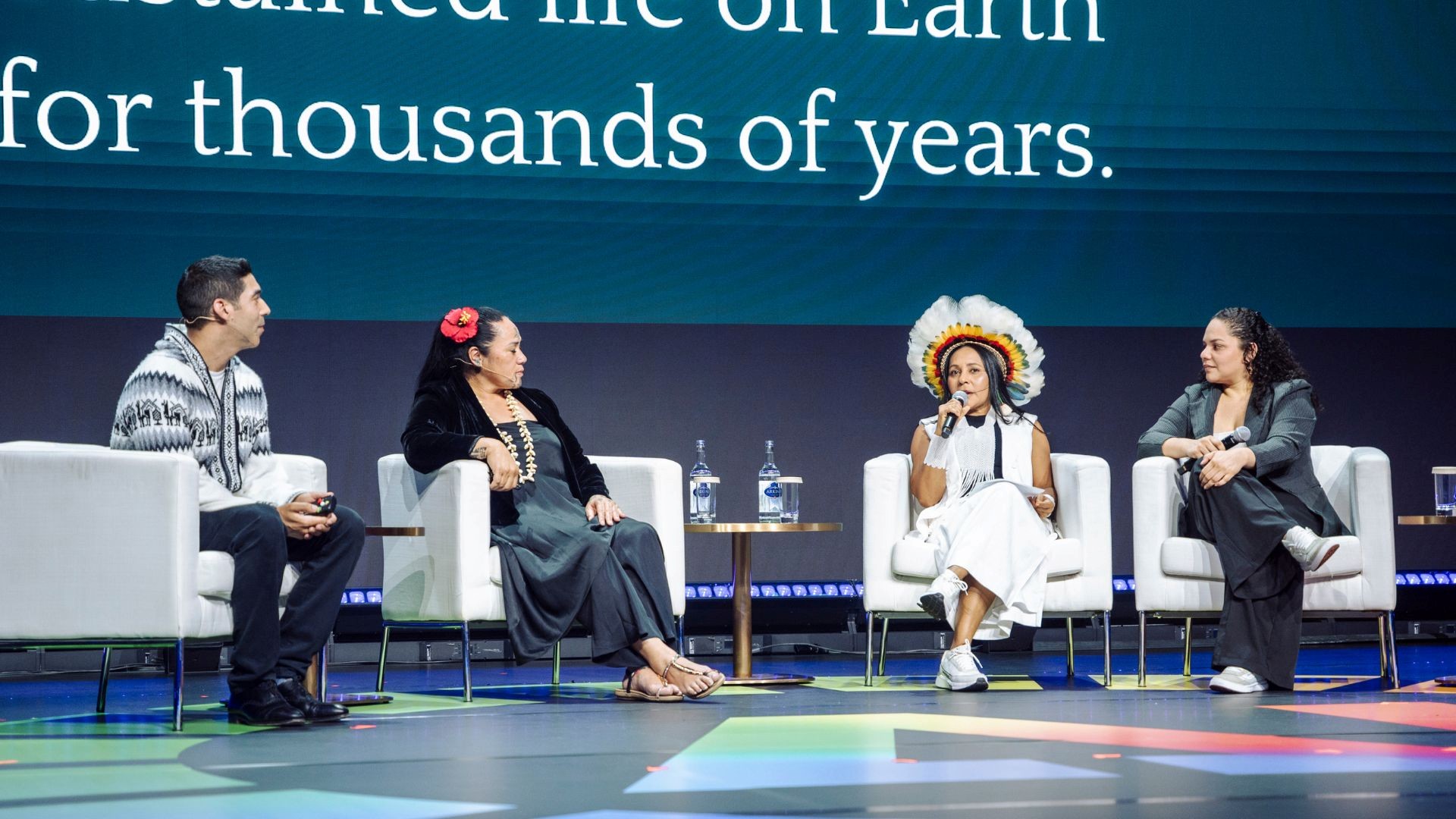
Ivy Smith, Indigenous Systems Strategist, Stewardship & Systems Advisor, Cultural Innovation Leader, opened the session “AI, Indigenous Wisdom, and the Future of Humanity” at the AI for Good Global Summit 2026 with an ancestral calling, a reminder to give thanks to ancestors for the work they carried out before us.
How many people in the room, Vijay Karia asked, had ever stopped to consider the electricity, water, computing power and natural resources behind every AI interaction? Karia, the co-founder and CEO of OptiCloud, referred to generative AI as the most rapidly adopted transformative technology in human history. He stated that the global investment in AI infrastructure is anticipated to reach between $5 trillion and $7 trillion over the next five years. He believes that this magnitude of investment entails a correspondingly significant level of responsibility.
Karia attributed this perspective to his own upbringing. His father was a refugee from Uganda, and his grandmother is a 94-year-old indigenous woman from the Amazon region of Ecuador. There was no waste in the household; instead, items were repaired or reused.
The habit eventually became a question he still asks: if AI becomes the largest computing platform humanity has ever built, how does it avoid also becoming the largest generator of digital waste?
“That simple question is what became the inspiration for Opti Cloud,” he said.
OptiCloud’s work centers on reducing cloud infrastructure costs while lowering energy use, water consumption and emissions in data centers. As an example, Karia pointed to a critical 911 emergency response provider in the United States, whose infrastructure costs OptiCloud reduced by more than 30% within two weeks, alongside a roughly similar drop in energy use, water consumption and emissions. The company’s aim, he said, is not simply to reduce harm but to create value for business, people and the planet.
The industrial revolution, in Karia’s framing, taught humanity how to extract; the AI revolution must teach it how to regenerate. Innovation, he argued, is not only about creating something new, sometimes it means remembering what has been forgotten. Indigenous peoples, he noted, represent about 5% of the world’s population while safeguarding around 80% of the Earth’s biodiversity, and their accumulated wisdom offers a model for thinking beyond the next quarter, toward the next seven generations.
This reasoning led Karia to Puyr Tembé, former secretary of Indigenous Peoples of Pará in the Brazilian Amazon, whom he introduced as “one of the greatest teachers I’ve ever had the privilege to meet.” What does the forest mean to you, he asked her, and why is it so important to protect?
Deforestation, illegal mining, river contamination, and impacts intensified by climate change: this is what the forest is facing, Tembé said. But she also spoke of what it represents, identity, life, the future, describing it as a heritage that belongs to all of humanity. Nature, in her framing, is not a resource but a relationship. Water depends on the forest. The forest depends on the rivers. The rivers depend on the plants. The plants depend on the air. And all of us depend on them. What humanity most needs to learn, she said, is that we do not belong to nature. We are part of it.
Language and oral tradition, Tembé said, are where she sees the clearest role for AI in indigenous communities: preserving indigenous languages and knowledge passed down orally, on the condition that the technology strengthens indigenous autonomy rather than replacing indigenous voices. Intelligence, for her, has little to do with algorithmic speed. It lies in listening, in respecting different ways of existing, and in taking care.
Smith returned to the conversation from a different angle: ancient intelligence, which she described as knowledge passed down through generations, a connection to the planet, the natural world and the animal kingdom, still alive today among indigenous peoples. AI, in her view, is only a tool; it is ancestral intelligence that supplies the wisdom to guide it.
Several images of ancestral initiatives built around AI followed, which Smith used to illustrate a broader point: bridged with Western tools, AI can help restore history, songlines, knowledge and wisdom. Karia then closed the session by introducing a message recorded by Ecuadorian ambassador Yvonne Baki.
Ambassador to the United States, France and the Gulf region over the course of her career, Baki has worked on diplomacy, peace, and the protection of some of the planet’s largest natural areas, including the Galápagos Islands and Yasuní National Park in the Ecuadorian Amazon. AI should not replace humanity, she said in her message, it should help bring humanity into its greatest era. The true measure of the technology, in her view, is not how intelligent it becomes but how much it strengthens human dignity, opportunity and peace, a promise she said should belong equally to the Global North and the Global South.
Guardians not only of forests and biodiversity, but of knowledge developed over thousands of years, stewardship, humility, living in balance, is how Baki described indigenous communities, arguing that this wisdom should help shape the values built into artificial intelligence. She also referred to nature as humanity’s largest living library and stated that safeguarding ecosystems like the Amazon and the Galápagos means safeguarding future scientific advancements, medicines, and unimagined discoveries. None of it, she said, will be decided by technology alone, but by leadership, which she described as service requiring courage, cooperation and humility. She closed by calling for an artificial intelligence that “leaves the world better than we found it.”
Tembé closed the session, thanking participants and saying it was time to return home and reflect. Leave the world better than it was found, she said, for today’s children, for the generations still to come, and for those, she added, who have yet to arrive.