


According to a recent report from the World Health Organization (WHO), more than half of the world’s population still lacks access to essential healthcare services. Yet advances in AI and genomics are opening new possibilities to predict disease, detect conditions earlier and personalize treatment.
For decades, healthcare has largely focused on diagnosing and treating disease after symptoms appear. AI and genomics are beginning to shift that model towards earlier detection, precision medicine, and more predictive approaches to care. Whether those advances benefit everyone may depend however on the data, governance and trust that underpin them.
At the AI for Good Global Summit 2026, experts from the World Health Organization, Harvard University and industry explored that shift, from AI-enabled cancer detection to national genomics programs. That discussion was moderated by Habiba Mizouni Professor of Radiology at the Faculty of Medicine of Tunis and Head of the Radiology Department at La Rabta University Hospital in Tunis. Across the different applications, speakers returned to a broader question: how can countries build the data, governance and regulatory foundations needed to ensure these innovations improve health outcomes for everyone?
For Professor Alireza Haghighi, Chief Executive and Director of the Harvard International Center for Genetic Disease, part of the answer lies in the convergence of two fields: AI and genomics.
Haghighi noted that more than half of the world’s population lacks access to essential healthcare services, while billions of people experience financial barriers to clinical care. Against this backdrop, advances in genomics have made biology “the most data-rich field in history,” creating unprecedented opportunities to better understand disease and improve healthcare through AI.
The volume of data, however, is only part of the equation. Indeed, Haghighi outlined that AI provides the analytical capability needed to transform vast quantities of biological data into clinically meaningful insights, helping improve diagnostic precision while potentially reducing healthcare costs. The greatest advances, he argued, will come not from either technology independently, but from their convergence.
“The combination of these tools will hopefully help us to live longer, to live healthier, and make sure that people on the other side of the planet do the same thing,” Haghighi said.
Who is represented in that data is another question. According to Haghighi, approximately 90% of existing genomic data comes from people of European ancestry, limiting the ability to develop equitable precision medicine for diverse populations. Expanding genomic data collection globally, he argued, is essential not only for scientific progress but also for improving health equity.
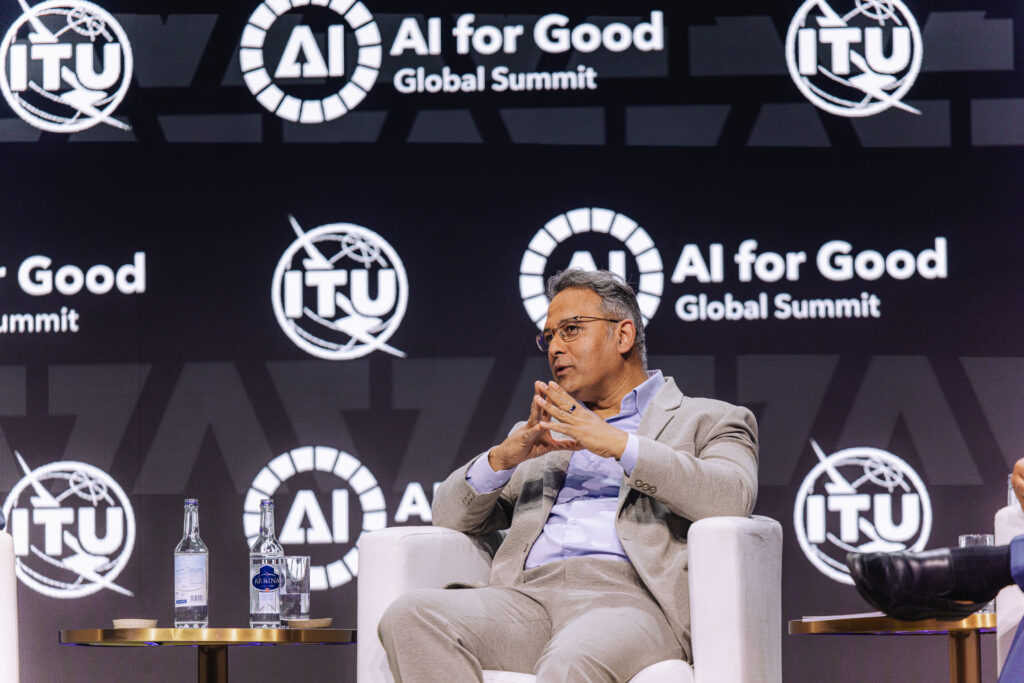
One application of that combination of AI and biological data is earlier disease detection. Ashish Tripathi, Founder and CEO of Tzar Labs, outlined the company’s work developing an AI-enabled blood test designed to identify multiple cancers at an earlier stage.
Tripathi explained that survival rates improve significantly when cancers are diagnosed early, but that existing liquid biopsy approaches face challenges detecting disease during its earliest stages because only a small volume of blood is analyzed, increasing the likelihood of false negatives.
Tzar Labs’ publications and research describe its work on a blood test designed to detect changes in stem cells that may signal cancer before a tumour forms. During the session, Tripathi said the team had identified a marker that could appear 12 to 18 months before a tumour forms. He also said its Indian data showed 80–90 per cent sensitivity at Stage 1. Tripathi added that the team had completed what he described as an NHS study and said it was expected to be published the following quarter.
“Cancer is a weak disease so long as you catch it early. It’s a death sentence if you catch it late,” Tripathi said.
That approach could also extend beyond oncology, Tripathi said. Analyzing stem cells from blood samples may enable researchers to identify molecular signatures associated with neurological conditions including dementia, Parkinson’s disease and Alzheimer’s disease, potentially reducing the need for more invasive diagnostic procedures.

Such application depends, however, on the systems available to support them. Indeed, both Haghighi and Professor Alain Labrique, Director of the Department of Digital Health and Innovation at WHO, argued that AI alone cannot transform healthcare.
For Labrique, adoption starts with the underlying health infrastructure. Countries must first establish reliable, interoperable health data systems capable of supporting increasingly sophisticated technologies. He identified high-quality datasets, electronic health records, a trained healthcare workforce and robust regulatory capacity as essential prerequisites for responsible implementation.
Haghighi made the corresponding case for genomic infrastructure. Governments, he argued, should invest not only in AI infrastructure but also in generating high-quality genomic data. He described those datasets as national assets, with applications extending beyond patient care to public health, research, and drug discovery.
“The main application of AI is when you have data. The most valuable data is life science data,” Haghighi said.
From that argument, Haghighi identified three priorities for governments: generating health data, investing in AI systems capable of analyzing those data, and ensuring sufficient energy infrastructure to support AI technologies. According to him, these three pillars will play an important role in shaping the future of precision medicine while creating scientific and economic value for countries investing in them.
Data and infrastructure, in turn, raise questions about how AI systems are evaluated and governed. The panel argued that public trust and effective governance will determine how quickly AI becomes embedded within healthcare systems.
Labrique said health ministers are often less concerned with whether a technology is innovative than whether it has been rigorously evaluated, can be sustained financially and is appropriate for their country’s healthcare system. As increasingly complex generative and agentic AI tools enter healthcare, he also pointed to questions of accountability when AI systems influence clinical decision-making
Traditional evaluation methods remain appropriate for many machine learning applications, Labrique said. Newer forms of AI, however, require updated regulatory approaches because they may produce variable outputs rather than consistently generating the same result from identical inputs.
“We need countries to have that capacity to make a sovereign decision about the tools that they’re not just inheriting from a vendor, but they’re actually choosing to adopt because those tools are fit for purpose,” Labrique said.
Supporting that capacity also requires international cooperation. Labrique pointed to WHO’s collaboration with the International Telecommunication Union (ITU) and the World Intellectual Property Organization (WIPO) to develop international guidance supporting governments, innovators and regulators in adopting AI-enabled health technologies responsibly.
The question of governance also returns to one raised earlier in the discussion: whose data these systems represent. Labrique cautioned that AI models trained primarily on data from high-income countries may contain biases that become apparent only when they are deployed in different healthcare settings. Building representative datasets, strengthening governance and investing in regulatory capacity, he argued, will be essential if countries are to adopt AI safely and effectively.
Haghighi made the same point from the perspective of genomics. Expanding datasets beyond populations of European ancestry will improve research, drug development and precision medicine while ensuring that future healthcare innovations are more representative of the global population.
From earlier disease detection to precision medicine, the technologies discussed during the session rely on the same underlying foundations. The speakers argued that the potential of AI and genomics will depend not only on technological innovation, but on the quality and representation of the data, the governance surrounding its use and the partnerships that support it.
Watch the full discussion and hear directly from the experts exploring how AI and genomics could shape the future of healthcare: