

AI is entering a phase in which the chat window is no longer the main interface. Instead of asking a chatbot for an answer, users are increasingly delegating tasks to AI agents that perceive, infer and act. The shift is not only in what these systems do, but also in what has to sit beneath them, from the mix of centralised and edge compute to the safeguards that keep autonomous execution within its intended limits. It reopens infrastructure and governance questions that had barely been settled for the previous generation of AI systems.
That framing sat at the centre of the session AI for good, Intelligence for Inclusive Coexistence at the AI for Good Global Summit 2026. Zhiyong Huang, Vice President of China Telecommunications Corporation, outlined how the company is preparing its network, cloud and computing infrastructure for an environment moving from conversational models to AI agents. He also presented three proposals for how the international community could shape that transition..
From chatbots to agents
Huang described the change as a paradigm shift. AI agents, in his account, are becoming a new “digital workforce,” and industry attention is moving from model training to inference services, changing the shape of demand for the underlying infrastructure.
Networks and compute, he explained, are undergoing changes in both scale and architecture. On the quantitative side, connectivity and inference demand are climbing sharply. On the qualitative side, the architecture is changing: cloud, edge and device compute are converging into a three-tier system. The cloud remains the primary source of computing power, while edge and on-device computing support low-latency and real-time local inference. Communication, in Huang’s framing, is transitioning from a human-centric model toward “human machine symbiosis,” and network control is moving from centralised to distributed autonomy.
Applications, Huang said, are expanding across sectors, and integration models are moving from adding AI to existing processes, or “plus AI” to designing them around AI, “AI plus”. Industry agents already possess capabilities for autonomous planning, execution and deep integration with business processes, and are helping enterprises move from digitalisation to what he described as intelligent transformation. Manufacturing, finance, healthcare and transport were among the sectors he identified as likely to see AI agents redefine services, production processes, organisational models and wider industrial structures.
That trajectory, Huang cautioned, is not free of strain. Data security risks, difficulty in keeping AI agents within their guardrails, a widening AI divide and rising energy consumption all pose threats to sustainable development.
“To address these shared challenges,” Huang said, “we must remain committed to AI for good.”
A five-layer stack
China Telecom presented its own operational framework for the shift: what Huang called a “fine-in-one intelligent cloud system” spanning computing, platform, data, model and application layers.
At the computing layer, the company said it is building integrated infrastructure across general-purpose, intelligent, super and quantum computing. At the platform layer, it offers computational-power scheduling and AI development services. At the data layer, it has developed data-governance tools and what Huang described as compliant, high-quality datasets. At the model layer, it offers proprietary large models alongside open- and closed-source options. At the application layer, standardised AI products sit alongside industrial large models and AI agent services, with security protection running across the stack.
Full-stack security services extend across all five layers. Through this system, China Telecom aims to provide integrated AI services and support AI development that is accessible, safe, green and inclusive, an approach Huang described as “telecom for AI.”
Watch the full session:
Networks, compute and green data centres
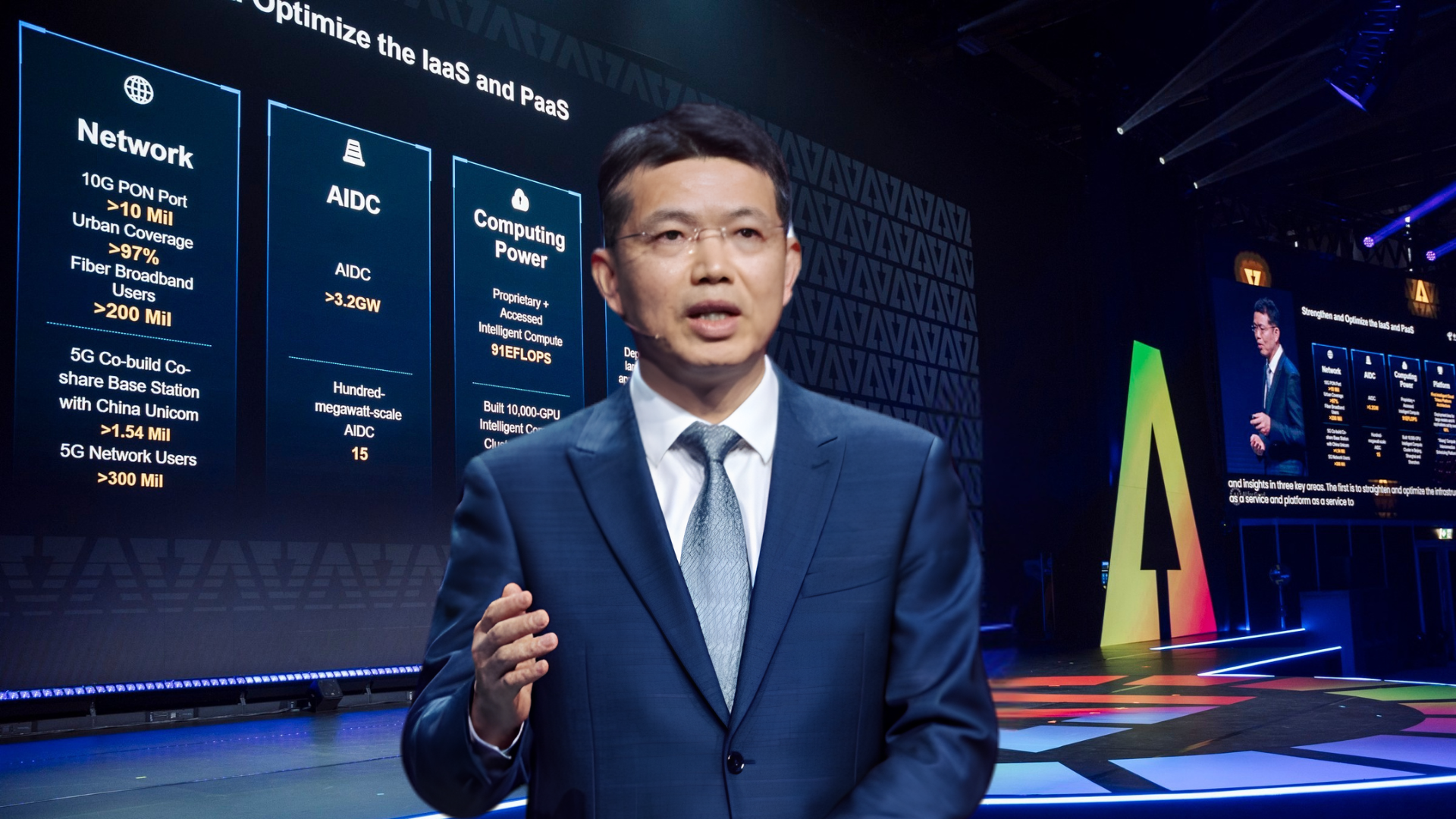
Huang then outlined the infrastructure supporting this system. According him, China Telecom’s optical transmission network now covers 97 percent of Chinese cities, its fibre broadband user base is around 200 million, and its 5G footprint, co-built and shared with China Unicom, runs to more than 1.54 million base stations. On the compute side, Huang cited 1,500 megawatt-scale data centres with total rack power capacity exceeding 3.2 gigawatts, and intelligent computing clusters holding tens of thousands of GPUs in Beijing, Shanghai and Shenzhen. Total computing power across the network, he said, has reached 91 EFlops.
The company also developed a platform architecture designed to enable applications to be developed and deployed more independently, reducing deployment time for large models and AI applications by more than 60%.
A significant part of the infrastructure strategy focuses on energy use. Huang described an underwater data centre located 35 metres below the surface of the East China Sea and connected directly to offshore wind power. Natural seawater is used for cooling. According to Huang, the project achieves a green-energy supply rate exceeding 95 per cent, reduces electricity consumption by 22.8% and eliminates freshwater use.
Huang also described a high-altitude, cave-based AI data centre in a Tibetan autonomous prefecture in Gansu Province. Powered by a combination of hydropower, wind and solar energy, the facility operates on 100% renewable energy.
Applying AI across industries and households
On the application side, Huang said China Telecom has developed more than 110 industrial models and over 350 intelligent agents, serving 37,000 enterprises. Two examples highlighted how these systems are being applied in industry. An agricultural large model helps fruit and vegetable producers manage pests and diseases, reducing crop losses by more than 30% while increasing farmers’ incomes. An energy-efficiency management agent developed for a Chinese railway vehicle manufacturer forecasts overall energy supply for the following day or week and has improved energy efficiency by approximately 8%.
For household customers, Huang presented smart screens, AI smartphones and other intelligent products. According to him, the smart screen is usable through voice, including regional dialects, and is designed to detect falls, prolonged inactivity or other abnormal activity in the homes of elderly users living alone. When it does, alerts are sent to social service providers or carrier services. Within China Telecom, large models have also been integrated into network operations, customer service and sales. Huang said 981 digital employees across 23 categories have increased network service-handling efficiency by 30% and reduced network fault-processing time by 14% year on year
Strengthening security
The third practice area was security. China Telecom said it has continued upgrading its cyberattack protection capabilities and developed a security-focused large model with threat-identification accuracy exceeding 95%.
The company has also released what Huang described as China’s first open-source guardrail for foundational large-model security and its first carrier-level security solution for AI agents. Together, these measures form part of a broader full-stack protection system intended to address risks across cloud networks, large models and AI applications.
Huang also emphasised China Telecom’s participation in international discussions on AI governance, with the goal of supporting AI development that is safer, more reliable and more controllable.
Three proposals for AI’s next phase
The session closed with three proposals directed at the wider global community. The first focused on inclusive infrastructure. Huang argued that AI capabilities should be made as universally accessible, affordable and usable as water and electricity. Achieving this, he said, requires faster development of next-generation digital infrastructure and collective action to bridge both the digital and intelligent divides.
The second proposal concerned governance. Huang called for improved multilateral dialogue, testing and evaluation mechanisms, joint research on frontier security technologies, and full-life-cycle security governance.
“If safety is not ensured, intelligence falls short,” Huang speaker said.
The third proposal called for an open and open-source AI ecosystem, with common technical standards for model development and joint data collection, developed through international platforms including the International Telecommunication Union and the World Broadband Association.
Taken together, the three proposals point back to the framing the session’s central argument, that the shift from chatbots to agents is reshaping infrastructure, applications and governance at the same time.
Ensuring that these areas develop together will be essential if AI agents are to become widely accessible, practically useful and safe enough to support the people and sectors they are intended to serve.