


What makes a city “smart” is not the number of sensors installed across its streets. It is the ability to turn data into services that are useful, responsive, secure, and adapted to the people who live there.
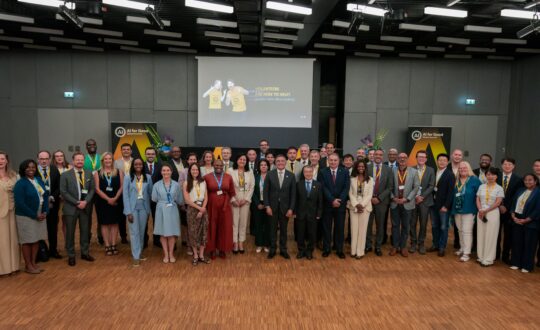
During the workshop Smart city technologies: Implementing IoT and AI for efficient urban services, organized in partnership with Fadwa AlBawardi Consulting Office at the AI for Good Global Summit 2026, Fadwa AlBawardi explored how cities can combine Internet of Things (IoT) technologies, AI, data architecture, and governance to improve transportation, public safety, and waste management.
Blending technical explanations with international examples and interactive exercises, the workshop examined not only how smart city systems operate, but also why successful deployment depends on localization, clear measures of impact, public participation, and trust.
Understanding the city as a connected system
AlBawardi invited participants to think of a smart city as a living, interconnected nervous system. In this model, IoT devices and sensors act as the physical nerves, gathering information from traffic systems, public spaces, infrastructure, environmental monitors, and other urban assets. Data flows through communication networks, while AI acts as the brain, processing these signals and turning them into predictions, alerts, and operational decisions.
She outlined an end-to-end framework beginning with sensors and connectivity, followed by edge computing for rapid local processing, cloud platforms for storage and analysis, AI models for pattern detection and prediction, and applications that deliver practical services to residents and municipal operators.
The value of this architecture lies not in collecting data for its own sake, but in connecting each layer to a defined urban need.
Turning data into better services
Transportation was one of the workshop’s central use cases. Cities can combine traffic sensors, cameras, vehicle data, passenger counters, and weather information to predict congestion, adjust traffic signals, improve public transport routes, and respond more quickly to incidents.
AlBawardi shared examples from Saudi Arabia, including the use of adaptive traffic systems in Riyadh and real-time analysis during periods of high visitor numbers in Makkah and Madinah. She also presented Singapore’s national digital twin, which uses sensor data and urban modelling to support planning, predictive maintenance, and transport coordination, as well as Seoul’s multifunctional smart poles combining lighting, connectivity, environmental monitoring, and public-safety functions. Workshop participants were also encouraged to share success stories, challenges, recommendations and lessons learnt, from their countries, as will be mentioned in details, later in this article.
In public safety, AI and IoT can support incident detection, emergency response, and situational awareness. Cameras, environmental sensors, and acoustic systems can help identify falls, collisions, or other events, while centralized dashboards allow operators to assess alerts and allocate resources.
However, AlBawardi stressed that these systems must incorporate safeguards such as data minimization, anonymization, bias audits, and strict access controls.
Waste management showed how relatively simple technology can also produce measurable gains. Fill-level sensors installed in bins can estimate when collection is needed, while predictive models help municipalities plan routes based on demand rather than fixed schedules. This can reduce unnecessary journeys, lower fuel consumption, and make services more responsive.
Measuring what works
The workshop moved from presentation to participation through a series of group exercises. In the first, attendees shared smart city initiatives from their own countries and considered how success should be measured.
The examples ranged from intelligent transport systems and energy management to pollution monitoring and connected public services. AlBawardi repeatedly returned to the importance of measurable outcomes, such as reduced congestion, faster journeys, lower pollution, improved energy efficiency, or shorter response times.
One participant, Advisor to the Minister and Head of the Department of Information Technologies of Moscow, described how Moscow’s intelligent transport system combines traffic signals, cameras, predictive tools, and public transport management. Its performance was assessed through indicators including fewer private-car journeys, shorter traffic jams, and a reported increase in average traffic speed.
The discussion also showed that the same technology can produce different results in different places. Participants compared adaptive traffic signals designed to prioritize buses in Ljubljana and Lausanne, noting that the system had been discontinued in one city but appeared to work successfully in the other.
For AlBawardi, this illustrated a common mistake in smart city planning: assuming that a successful system can simply be copied from one location to another.
Street design, population density, climate, connectivity, infrastructure, institutional capacity, and public behavior can all affect performance. Localization is therefore not a final adjustment to an imported solution. It must be part of the design process from the beginning.
Designing with people, not only for them
The exercise also highlighted the role of residents and local organizations.
One participant described a project that struggled because the intended users had not been consulted before new infrastructure was offered to them. The technology did not fit their available space, operational needs, or long-term plans.
This led to a broader discussion about moving beyond consultation toward co-design, co-development, and shared implementation.
“[Citizens] also have a word, so it’s important to include them during the creation of policies. Governments, Private Sector, Experts and Researchers are usually included in decision-making, yet not regular citizens.” AlBawardi said.
A technically sophisticated project can still fail when it does not respond to the priorities of the people expected to use or host it. Successful smart city development therefore requires municipal authorities, companies, researchers, community groups, and residents to be involved early enough to shape the project itself.
Balancing public safety and civil liberties
The workshop’s second exercise asked participants to simulate a town hall considering the deployment of facial recognition and acoustic gunshot-detection systems in a public park.
Each group considered the issue from a different perspective, including those of technology officials, civil-liberties advocates, data-governance officers, and local businesses. Their proposals reflected the difficult balance between safety and privacy. Participants discussed limiting access to sensitive information, setting short and clearly defined retention periods, processing data locally where possible, informing residents, testing systems through pilot phases, and allowing people to challenge the collection or use of their data.
Several groups stressed that surveillance should have an explicit purpose and that responsibility for accessing, interpreting, and acting on the data must be clearly assigned. They also called for human review, cybersecurity protections, independent oversight, and regular evaluation.
The exercise demonstrated that smart city governance cannot be reduced to technical compliance. Decisions about who collects data, who can use it, how long it is retained, and what happens when systems make mistakes are ultimately questions of rights, accountability, and public trust.
From smart technology to better cities
Across the workshop, AlBawardi emphasized that AI, IoT, cloud infrastructure, connectivity, and cybersecurity must work together as part of a single urban system. All emerging technologies, in the Digital Economy ecosystem, must act as interconnected pillars rather than isolated tools.
Yet technology alone does not make a city smarter. Projects must solve clearly defined problems, generate measurable public value, reflect local conditions, and include the people affected by them.
The most successful smart city initiatives will therefore be those that connect technical capability with governance, ethics, security, and community participation, turning data not only into more efficient services, but into cities that are more responsive, inclusive, and worthy of public trust.