


Access to basic public services now runs largely through screens. Consumption, banking, transport, healthcare and government all sit behind digital front doors, and for older users in particular, that arrangement has never been neutral. As populations age and digital systems deepen, the two trends have begun to press on each other, and the question of how older people are meant to fit into a technology environment they did not grow up with has moved from a design footnote to a governance question in its own right.
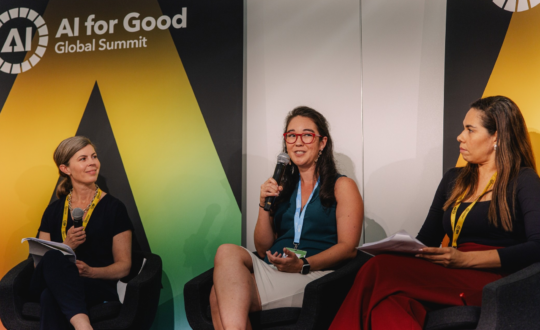
That was the argument brought to the AI for Good Global Summit 2026 by Ce Wang, Senior Researcher in the User and Market Research Department of the China Mobile Research Institute (CMRI), during the session Bridging the Digital Divide and Securing Safety Frontiers – AI-Enabled Paradigm Shifts in Aging-Friendly Innovation.
Wang’s research divides the development of age-friendly digital services into three stages that build on one another: securing basic access to information, easing the actual use of digital applications, and reaching what she called precise service adaptation, which is where AI is now beginning to intervene.
From access to ease of use
The first stage, in Wang’s framing, is essentially an infrastructure question. Mobile and broadband coverage needs to reach rural and remote areas so that older people have the underlying conditions required to access digital services.
The second stage is about the reducing the barriers to using them. Large text, simpler interfaces, voice reading and one-touch calling all belong here. Alongside these features, Wang stressed the importance of keeping traditional offline channels open, including dedicated staffed service counters, so that older users can still choose how they access services rather than being pushed into a single digital route.
Together, these two stages seek first to make digital services available and then to make them easier to navigate. AI, Wang argued, is now opening the way to a third stage focused on adapting services more precisely to individual needs.
From people adapting to technology to technology adapting to people
The third stage in Wang’s framework is what she called “precise service adaptation.” Enabled by technologies such as natural language processing, multimodal sensing and AI agents, this stage moves age-friendly services beyond standardised accessibility features towards more personalised and precise responses to users’ daily needs, language patterns and abilities.
Wang this third stage through two related paradigm shifts. The first is a move from “people adapting to technology to technology adapting to people.”
Rather than climbing through menus, older users can speak, gesture or share images, the system asks follow-up questions and breaks complex tasks into manageable steps. Wang illustrated the shift with China Mobile’s Link Screen, a home AI terminal that accepts voice, remote control and mobile input, and lets users search for information, play audio and video, control home appliances and ask for help without navigating a conventional interface.
From people searching for services to services reaching people
The second paradigm shift moves service delivery from reaction to anticipation. Rather than requiring older users to actively seek services, Wang said, AI can integrate risk alerts, resource matching and service coordination into daily life so that support reaches them more proactively. In her account, this can help identify concerns that older users may find hard to describe or may not yet have noticed themselves, and can extend the arc of care “from monitoring and early warning to intervention and response.”
The example she gave was an integrated care system built around China Mobile’s app and connected devices. Older users living alone are equipped with age-friendly devices such as electronic blood pressure monitors, whose readings feed an AI-enabled care platform. Abnormal readings, Wang said, can trigger alerts to village doctors and family members for timely intervention.
Preventing a new intelligence divide
The gains, Wang argued, come with a matching set of risks. Older users differ significantly in physical condition, cognitive ability and digital literacy, and she said AI systems can create new gaps in access, understanding, use and evaluation. Some older users, in her account, may not know what AI can and cannot do. Some may find AI products too expensive. Others may be able to operate a device but not know how to ask effective questions, assess whether an AI-generated answer is accurate or verify its source.
The remedy, in Wang’s view, is design that begins with the older user rather than attempting to accommodate their needs afterwards. Cognitive patterns, language habits, physical conditions and living environments should be factored in from the start of the design process, she said, and older users should be included in needs assessment, scenario testing and outcome evaluation. The goal, in her framing, is to shift age-friendly work from fixing problems after the fact to preventing them through inclusive design from the outset, reducing the risk that technological progress creates new forms of inequality.
Safeguarding data, algorithms and high-risk applications
Wang identified three technical risk points that recur across the lifecycle of AI-enabled services for older users. At the data layer, services often draw on sensitive information about health, location and family life, and unclear limits on collection can lead to excessive monitoring and privacy breaches. At the algorithm layer, older users are under-represented in current internet training data, which she said can lead to age bias or unfair service outcomes. At the application layer, in high-risk fields such as healthcare and finance, model hallucinations and errors in judgement can put users’ health or property directly at risk.
The protective framework Wang proposed is correspondingly layered. She called for clear limits on data collection and clear procedures for informed consent, high-quality datasets that reflect the diversity of older users, regular reviews of algorithmic fairness, and impact assessment and accountability mechanisms in high-risk scenarios. The purpose of the framework, in her framing, is to prevent efforts to make services more accessible and convenient from producing new safety risks or new forms of digital inequality along the way.
Designing age-friendly AI from the start
The development of age-friendly digital services, Wang argued, has never been only a matter of technical adjustment. It also touches social governance, equal access to public services and the protection of older users’ rights. Two directions, she suggested, need to run alongside each other. Interaction models should match older users’ physical and cognitive habits and reduce, as much as possible, the barriers they face in AI-enabled life. Early design and what she called bottom-line safeguards should apply across the full life cycle of products and services, so that as technology continues to change, the needs of older users are built in rather than fitted afterwards.
Only when government, enterprises and society work together, she said, can the value of AI be unlocked while the equal rights, dignity and daily safety of older users are effectively protected. She closed on the vision that has guided China Mobile’s work in the area: “mobile intelligence with universal access beyond boundaries.”