

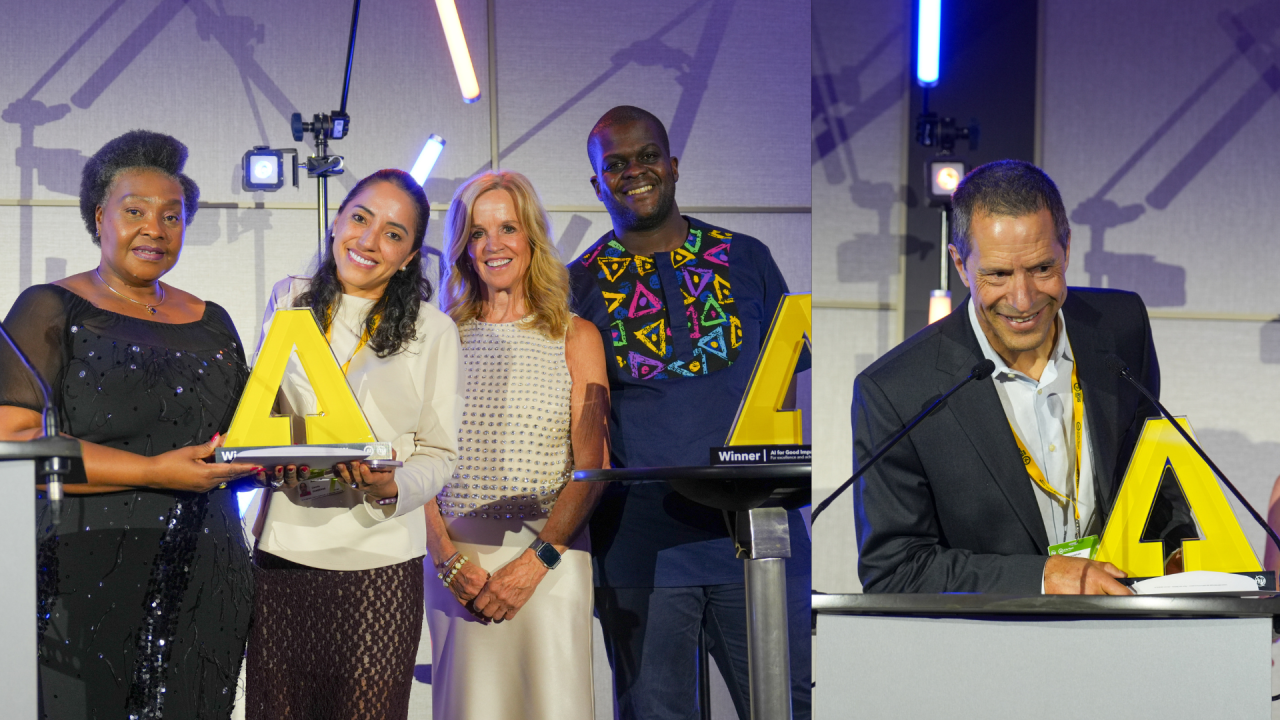
As AI transforms industries and our daily lives at a rate never-before-seen, the question of whether it can be used to grapple with humanity’s greatest concerns has moved from aspiration to measurable fact. On 8 July, the AI for Good Impact Awards 2026 unveiled its winners during the Gala Dinner,
This year, close to 300 applications from 65 countries on six continents were submitted by SMEs, large corporations, non-profits, academic institutions, government bodies, international organisations and independent initiatives. An international team of government, academic, business and social impact ecosystem specialists evaluated each entry against criteria including innovation, measurable value, ethical issues and long-term sustainability.
Moderated by Emmy Award-winning television journalist and communications coach Jane Hanson, the ceremony featured Vukosi Marivate, Director of the African Institute of Data Science and Artificial Intelligence at the University of Pretoria, who did the honours of presenting the nine finalists to the Gala Dinner audience across the three award categories: AI for People, AI for Planet and AI for Prosperity. The winners were then announced and presented with their awards by Yvonne Chaka Chaka, internationally renowned singer, humanitarian and advocate for social change.
AI for People Winner
ReadBuddy, an AI-powered literacy platform developed by Rising Hope Girls Educational Foundation (RHGE), an NGO based in Nigeria, was crowned the winner of the AI for People category at the AI for Good Impact Awards 2026. Powered by speech recognition and natural language processing, the platform supports primary and secondary school students, struggling adolescent readers, and out-of-school youngsters, especially girls in underserved and low-resource communities, in improving their reading fluency. Beyond the literacy outcomes, it provides real-time personalised feedback that adapts difficulty to each learner’s level.
With many classrooms having little or no internet connectivity, its offline-first architecture tackles Nigeria’s literacy crisis, where more than 70% of students cannot read with comprehension.
The platform has reached more than 1,200 students, and 1,000 instructors, in schools across Nigeria’s Federal Capital Territory and with integration into a bigger STEM programme, coverage has extended to more than 7,000 children. After six weeks of use, participating learners’ reading accuracy went from 58% to 83%. RHGE is deploying ReadBuddy through its AI Literacy Labs, a network of digital learning hubs in the communities of Byazhin, Dutse and Kubwa. The platform is available on mobile phones, tablets and laptops, with a focus on reaching girls and learners moving from local languages to English. The 2026-2027 growth plan is set to reach another 40,000 learners and 5,000 teachers in seven new labs in Nasarawa, Niger and Kogi states, with the backing of partnerships with Ford Foundation, Amazon Web Services and Team4Tech.
The AI for People category recognised two other finalists. Among them is HungerMap Live 2.0, developed by the World Food Programme, the Rome-based United Nations agency founded in 1961, which is an AI powered- application capable of measuring food safety in near real time and designed to predict famine outbreaks six months in advance. The other finalist was Migrasia, a Hong Kong-based nonprofit organization, has developed PoBot, a multilingual chatbot that provides Filipino and Indonesian migrant workers with real-time legal information and a confidential way to report mistreatment via WhatsApp and Facebook Messenger in over 50 countries.
AI for Planet Winner
Happywhale, an AI platform for cetacean photo-identification, received the AI for Planet category award at the AI for Good Impact Awards 2026. The use of deep learning and computer vision enables to match images of individual whales and dolphins sent in by contributors throughout the world, turning solitary sightings into continuous life-histories spanning decades and whole ocean basins. It fills a long-standing gap in marine science: individual photo-identification is the gold standard for non-lethal cetacean monitoring, but manual matching has been traditionally too slow for the broad-scale collaboration required for conservation strategy.
It has more than 1.5 million photos and has identified more than 120,000 humpback whales and other cetaceans with the assistance of 53,000 citizen scientists from more than 100 countries. AI matching, by reducing the identification time from more than an hour per photo to seconds, has enabled collaborations that were previously impossible, such as a North Pacific humpback research in 2024 with 250,000 encounter records from 15 groups. Happywhale data has been utilised in over 40 peer-reviewed studies, including in Nature, and influences conservation policy for the International Whaling Commission, the Commission for the Conservation of Antarctic Marine Living Resources, and the US National Oceanic and Atmospheric Administration. Documentation of ship-strike risk has led to the construction of a geofenced slow-navigation zone of some 40,000 square kilometres in the Antarctic Peninsula.
Two other finalists in the AI for Planet category were: Aquashield, from Sokoine University of Agriculture in Tanzania, which uses an AI-powered offline training platform to educate rural communities living next to a protected biodiversity hotspot on sustainable pond aquaculture, reducing illegal fishing and supporting conservation of freshwater ecosystems. Vivent Biosignals, developed by Vivent SA in Switzerland, uses unique sensors and machine learning to record plants’ electrophysiological impulses in real time, enabling farmers to detect stress, illness and drought before apparent signs and eliminate wasteful agricultural inputs.
AI for Prosperity Winner
Rounding out the winners, Ramona AI, an AI platform integrating anti-trafficking screening with algorithmic bias audits, was awarded the AI for Prosperity category at the AI for Good Impact Awards 2026. The technology uses natural language processing to scan job postings in real time and identify trafficking tendencies, including unverifiable employers, unrealistic claims, and dubious locations, thereby notifying candidates prior to engagement. Simultaneously, it evaluates corporate recruitment algorithms to detect and rectify discrimination based on gender, age, and race. The dual method tackles two interconnected issues in labour markets: deceptive recruitment as a conduit for human trafficking and algorithmic prejudice that marginalises women, older workers, and indigenous communities from formal employment.
Ramona has assessed over 100,000 job offers across 11 Latin American countries since its deployment, identifying over 3,500 fraudulent recruitment situations deemed as trafficking hazards prior to candidate engagement. Within organisations utilising the platform, the representation of women in leadership positions has risen by 38%, and indigenous employment has surged by 35%, while reducing hiring durations by 42% due to the removal of discriminatory screening filters. The Mexican state of Querétaro was the inaugural government in Latin America to implement the anti-trafficking screening platform, in collaboration with corporate entities like DD360 and academic institutions such UNAM, ITAM, Tec de Monterrey, and Anáhuac. In 2025, Ramona was designated as one of five worldwide innovations at the UN Industrial Development Organization’s ONE World Sustainability Awards in Riyadh and was acknowledged by the Latin American development bank CAF as the most significant innovation of the year in the region.
The two other finalists in the AI for Prosperity category also showed how AI can expand access to opportunity, finance, and better public services. KhetScore, by Dvara E-Registry in India, uses AI and geospatial technology to develop farm-level credit risk profiles for smallholder and women farmers and facilitate access to collateral-free climate finance and crop advisories for communities that have been excluded from formal financial systems. Data-Driven Prosperity, developed by Suma Gestión Tributaria in Spain aggregates more than 43 million disparate municipal records into a georeferenced intelligence platform, helping 118 local governments improve fiscal equity, optimise infrastructure planning, and strengthen financial sustainability for more than 1.5 million citizens.
The 2026 AI for Good Impact Awards prove that responsible AI is not a far-off dream, but a tangible reality across all continents. The ITU congratulates all winners and finalists and recognises the hundreds of organisations whose work is demonstrating that AI, when implemented responsibly and collaboratively, can enhance lives, preserve the environment and extend opportunity for all.
Applications for the 2027 edition begin in January, we can’t wait to see what the next generation of ideas will bring!