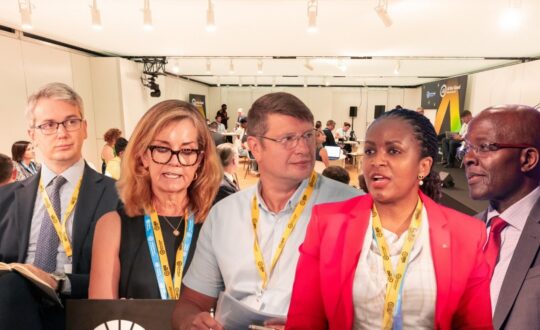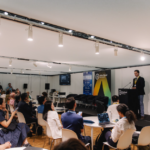



Walk the halls at the AI for Good Global Summit and you notice that the most crowded rooms aren’t the ones with the newest innovations to show, but the ones where people who don’t normally share a stage were trying to work something out together. Standards bodies sat with startup founders and climate scientists in a session on scaling sustainable AI across its lifecycle. Down the corridor, engineers and policymakers were arguing about how to make data centres more energy efficient.
None of this is surprising when you look at the numbers. The World Bank says AI depends on four things: connectivity, compute, data and skills. No single organisation, and often no single country, has all four. Meanwhile, governance of AI is still fragmented. If you want AI to work for people, planet and profit, you can’t do it on your own. AI alone doesn’t create value. Value comes from bringing technology together with trusted experience, sector understanding and the people and ecosystems that ultimately shape how it is used.
When people talk about the AI ecosystem, they usually mean the industry: labs, developers, chip makers, energy providers, regulators and start-ups. That ecosystem matters. But there’s a second one that gets less attention, which is the community you’re actually trying to help.
One of our EY colleagues, Gregorio Azocar, built ACUO with farmers rather than for them. Early on he found that some of them judged soil health by tasting it. A lot of technologists would have treated that as a problem to fix. Gregorio treated it as knowledge, and designed the tool to learn from what the farmers already knew. That’s the difference between deploying a solution and building one that people trust and actually use.
Light and shadow
At EY we use a simple idea to think about AI and Sustainability: light and shadow. The light is real: AI can help us understand climate and nature risks, cut through complexity and make expert capabilities available to many more people. But as climate, nature, technology and the economy become more interconnected, the choices we make about AI increasingly have consequences across that wider system. The shadow is just as real: energy and water use, the hardware involved, misinformation, bias and disruption to people’s jobs.
Every light comes with a corresponding shadow. Sometimes it sits in your own organisation and sometimes it lands on someone else’s. A model that helps one company cut emissions may run on a grid another community depends on. The temptation is to pick a side, either optimism or alarm. We think the more useful habit right now, while so much is still being decided, is to keep both in view at the same time and let that tension shape better questions.
That requires both humility and collaboration. AI is evolving quickly, and many of the choices that will determine its impact are still being made. Humility means recognising that no one organisation or discipline has all the answers; collaboration means bringing together the different expertise, experience and perspectives needed to find better ones. So rather than arriving in Geneva with answers, we came ready to listen, learn and work through those choices together.
The EY Ecosystem Exchange at the AI For Good Summit
That’s why we created the Ecosystem Exchange. It’s a simple format that we’ve run throughout the year: 3 cities, 5 events, 25 solutions, 350+ participants across technology, industry, startups, academia, policy and finance. The heart of the Ecosystem Exchange is our carousel of live demos instead of slides, punctuated by short rotations so that the people in the room keep moving and talking. AI for Good, which brings the UN system, governments, industry and innovators together for one week, was the obvious place to bring it.
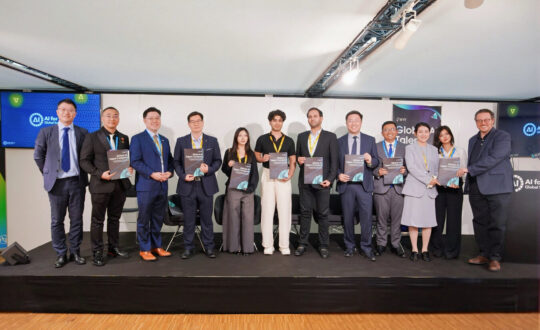
On 9 July we brought together more than 50 invited participants. We started with our light and shadow framing, then showed EY Horizon and ACUO. After that, the room split into groups and rotated through five live demonstrations:
UNFCCC: showcasing the Climate Data Hub and the role of trusted climate data in turning information into insight and action.
Cecil Earth: nature data infrastructure which asks how better environmental data can inform decisions about nature.
Irmos Technologies: AI-first maintenance of physical infrastructure showing how AI can support the resilience and performance of physical assets.
GreenPT: a platform for more sustainable AI models, prompting discussion about the environmental footprint of AI itself.
EY Horizon: using AI to turn sustainability insights built over 25 years of our market-leading practice, into climate and nature action.
Each demo was designed to start a wider conversation rather than be a pitch. That reflects how we think about EY.ai more broadly: technology matters, but technology alone isn’t what creates value. It needs to connect with trusted experience, sector understanding, data and, critically, the people who will shape and use it. One group would leave a demo arguing about data provenance and arrive at the next one already asking about energy. By the end, people were connecting with each other, connecting with the idea behind each demo, and connecting the opportunities between the ideas showcased.
Reflection
We came away with three convictions about how to develop and deploy AI responsibly.
First, responsibility is shared.
Data quality, energy, governance and adoption sit with different people across the system. Optimising one part doesn’t necessarily optimise the whole.
Second, build with people, not just for them.
The people closest to the problem need to be involved from the start. Their knowledge is part of what makes AI useful, trusted and ultimately usable.
Third, value comes from connection.
AI’s benefits and risks rarely sit in the same place. Ecosystems connect technology with experience, data, sector expertise and different perspectives, helping uncover trade-offs and shape better solutions.
The busiest rooms at the AI for Good Global Summit were the ones where nobody had all the answers. I think that’s a good sign. The future of AI won’t be shaped by technology alone. It will be shaped by the people, experience and ecosystems around it.
We’d like to keep building those connections with you.
The views reflected in this article are the views of the author and do not necessarily reflect the views of the global EY organization or its member firms.