

At the AI for Good Global Summit 2026, a portable microscope demonstrated how an AI system could analyze a prepared sample without relying on internet access or a continuous electricity supply. Once the sample was placed beneath the device, its camera captured an image and the system displayed whether the result was positive or negative. The result could then be printed.
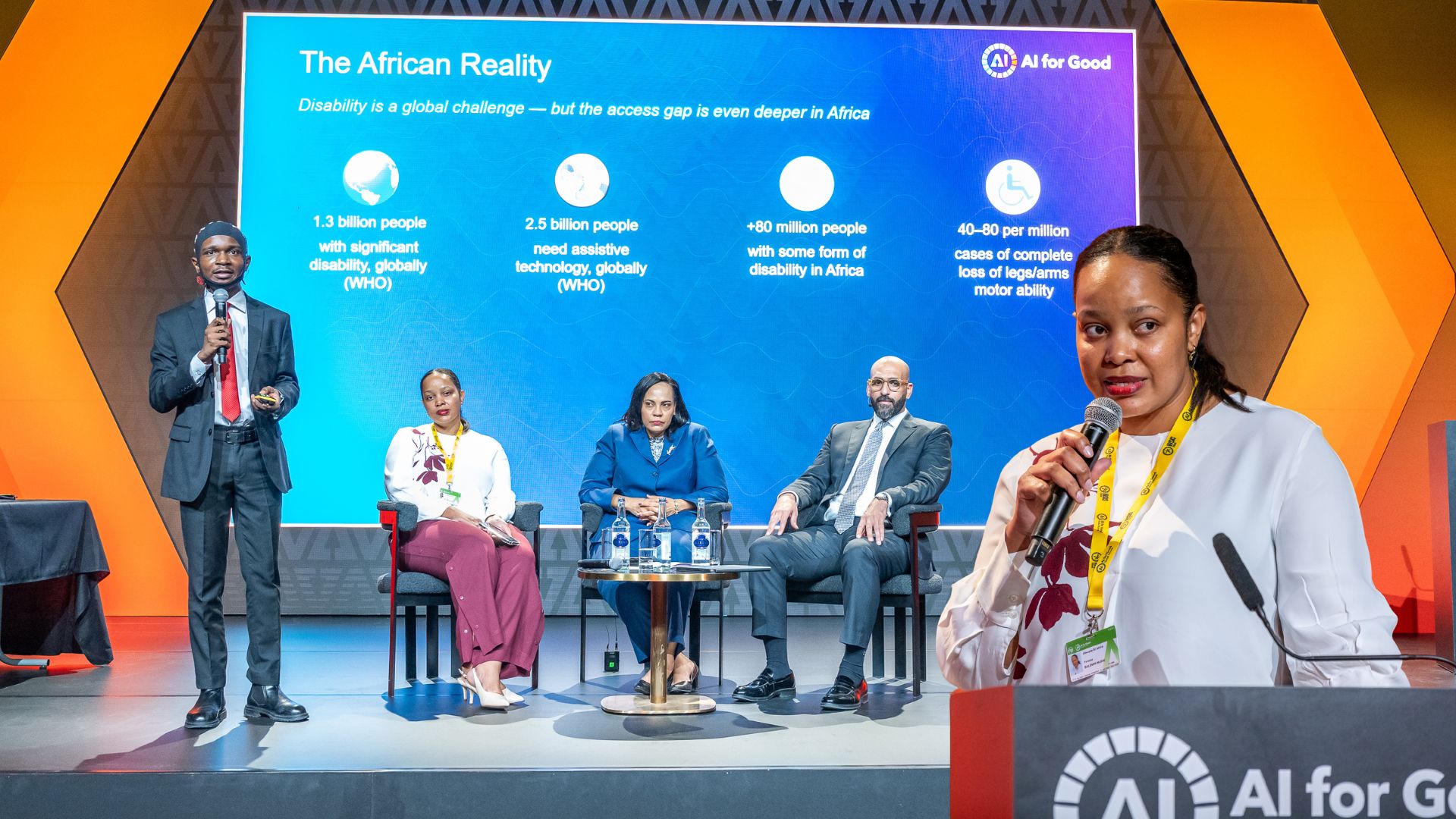
The device, Kolopeno AI, was one of two technologies presented during a session on how young African innovators are applying AI to healthcare and accessibility challenges. Held under the Presidential African Youth in Artificial Intelligence and Robotics Competition, the discussion also examined what governments and other partners can do to help youth-led technologies develop and scale.
Yvonne Baldwin Mushi, CEO of Ele-vate AI Africa and moderator of the session, introduced Kolopeno AI as a portable, solar-chargeable microscope designed to detect malaria and tuberculosis in under two minutes.
Alain Goumou, CTO and founder of Guinea-based TínaanTech, explained that the system was designed to operate without internet access or electricity. He said the team had considered the limitations of digital and electrical infrastructure when developing the device.
During the demonstration, the team showed how a stained sample could be placed beneath the microscope. Its camera captured an image, which the system analyzed before presenting a result. Goumou said the result could also be printed and given to the patient.
The discussion then turned to Tanzania, which hosted the inaugural edition of the Presidential African Youth in Artificial Intelligence and Robotics Competition.
Her Excellency Angellah Jasmine Mbelwa Kairuki, Tanzania’s Minister of Communication and Information Technology, said hosting the competition had allowed the country to present its progress in digital infrastructure, digital public infrastructure and digital skills. It had also provided a setting in which young innovators from across Africa could present technologies addressing social and economic challenges.
According to Kairuki, participants had opportunities to connect with other innovators, global experts and investors. She argued that, with sufficient support, their technologies could be developed further and create practical social and economic effects.
“Africa is ready to play the role, and especially an active role of shaping the technologies that will solve our issues, will solve our social and economic problems, but also our social and economic needs for humanity, for us, developed by us, but also to be used by us. And this will define our future,” Kairuki said.
Watch the full session:
A second demonstration focused on accessibility. Pierre Sedi, an engineer at Tosali Technologies and the competition’s 2024 Presidential Category winner, presented Cerebro, a brain–computer interface designed to allow people with severe motor impairments to control assistive robotic devices.
Sedi said the project followed an encounter near Kinshasa Central Station. He met a man using a wheelchair who was unable to move his arms or legs and depended on another person to take him to and from the station. For him, the encounter reflected some of the barriers faced by people with severe disabilities in Africa. He pointed to limited access to assistive technologies and care that often depends on family members, with consequences including loss of autonomy, social isolation, and poverty.
Cerebro uses a non-invasive electroencephalography headset to capture brain signals in real time. An AI model interprets the user’s intended action before a control interface converts it into a command for a robotic device.
“The goal of this for us is to help people with severe motor impairments to control assistive devices using only the power of their thoughts,” Sedi said.
The team’s design priorities reflect the conditions in which it expects the technology to be used. The system is designed to be low-cost, scalable and adapted to African realities.
Sedi showed videos of participants using the interface to control a small robotic car. One experiment took place in a laboratory, while another moved the system outside the laboratory as the team explored its use in real-world settings. He said the project had developed amid limited funding, frequent power outages, unstable and expensive internet access, and restricted access to scientific publications. Despite these conditions, the team has conducted experiments, worked on its AI models, developed an end-to-end prototype, and published research.
The team is now seeking to conduct hospital pilots at the University Clinics of Kinshasa. The proposed work would enable bedridden patients with complete loss of motor capabilities to control a robotic bed through brain signals.
Sedi said the project would combine Cerebro’s brain–computer interface with a robotic bed developed by other researchers. The beds can move into a standing position, and the team intends to study whether giving patients direct control could improve comfort and rehabilitation and reduce some effects associated with prolonged bed rest.
“We want people when they hear about AI to not be scared about it, but to feel hope,” Sedi said. “We want to promote responsible use of AI. That’s why our slogan is AI for people, AI for Hope.”
The session then moved from the technologies themselves to the support available to young innovators. Egypt will host the competition’s 2026 final ceremony under the Honorary sponsorship of President Abdel Fattah El-Sisi, president of the Arab Republic of Egypt.
Mahmoud Badawi, Assistant Minister for Digital Transformation at Egypt’s Ministry of Communications and Information Technology, said young African entrepreneurs, researchers, engineers and students were already applying technology to challenges in healthcare, agriculture, education and public services.
Their work, he argued, requires opportunity, mentorship, investment, access to wider networks and infrastructure.
“We often say that AI will shape the future, but in reality, it’s people who will shape artificial intelligence,” Badawi said.
He described Egypt’s role as extending beyond the organization of an event. According to Badawi, the aim is to help build a continental platform that identifies, supports and connects a new generation of African AI leaders. He said this would require cooperation among young innovators, governments, universities, industry, investors, and international partners.
Badawi also argued that Africa’s digital future could not be built by one country alone. He invited partners to contribute expertise, mentorship, investment and support ahead of the competition in Egypt.
In their closing remarks, Kairuki and Badawi addressed what would be required for young innovators to continue their work. Kairuki said governments had a role in providing platforms for innovators, helping them scale their technologies and protecting their patents and other creations as they moved towards commercialization.
Badawi encouraged young innovators to remain persistent while also being prepared to reconsider their proposed solutions. A particular response to a problem, he said, may need to be adapted as the work develops.
The session concluded with an invitation to the competition in Egypt 12th-13th October, where the next group of young innovators will present technologies developed in response to challenges across the continent.