

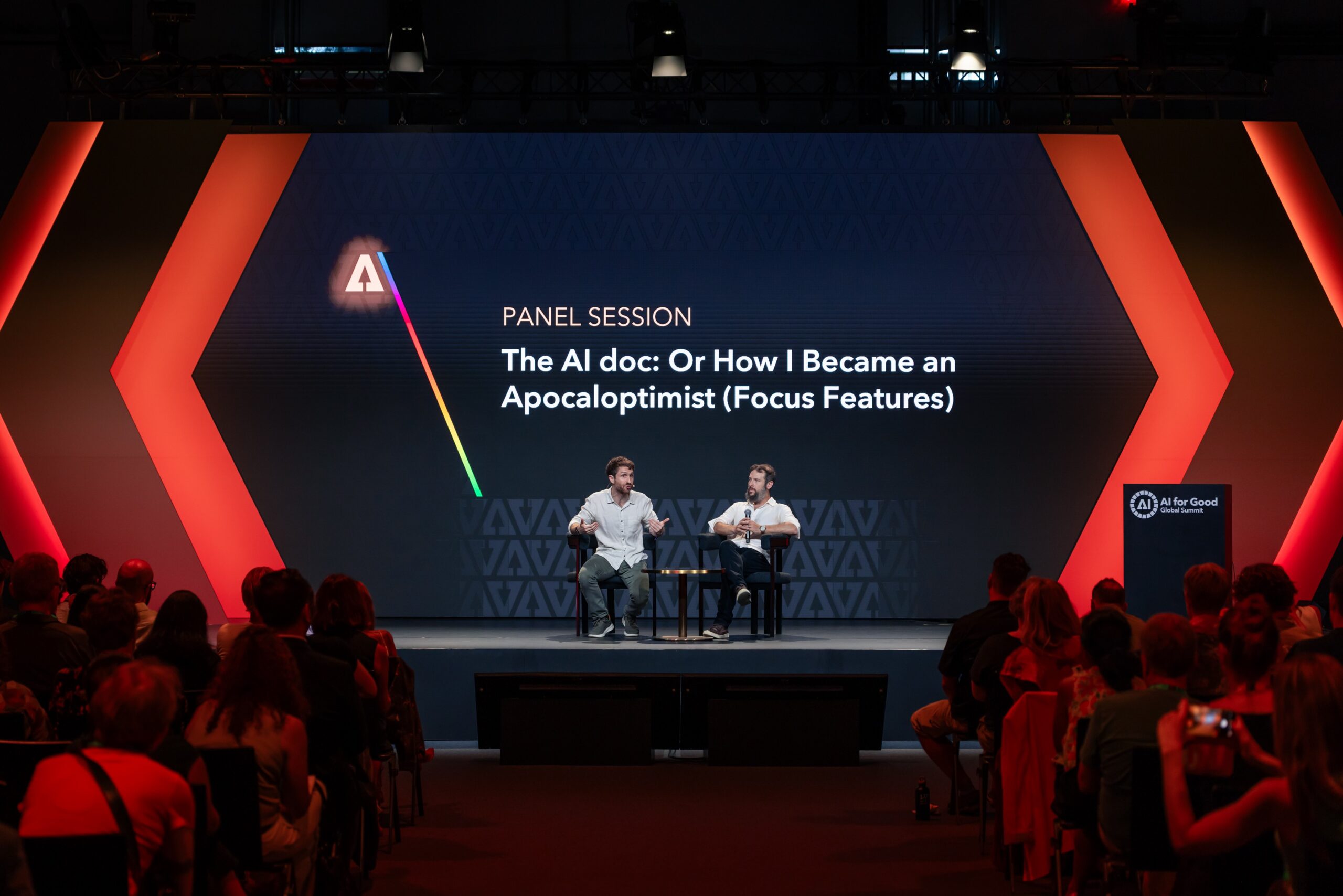
During the AI for Good Global Summit 2026, the session The AI Doc: Or How I Became an Apocaloptimist, screened a new documentary on the pace and stakes of current AI development, co-created by the directors of Everything Everywhere All at Once and the team behind Navalny. Tristan Harris and Aza Raskin, co-founders of the Center for Humane Technology, took audience questions after the screening. Across the Q&A, the two returned to a single question in different forms: what an audience of technologists, regulators and citizens is meant to do after watching.
A reference to The Day After
Harris opened by placing the film in a historical reference. The 1983 US television film The Day After, which depicted the aftermath of a nuclear war between the United States and the Soviet Union, was watched by President Ronald Reagan and has been recorded as having contributed to his commitment to arms control, leading to the talks held in Reykjavík in 1986. The 40th anniversary of those talks, Harris said, is approaching. The intention behind the new documentary, he added, is to open comparable space for collective action on AI, at a moment when he said the dominant fear driving the sector is falling behind competitors rather than where the technology is going for everyone.
The spell of inevitability
Both filmmakers returned to what they described as the spell of inevitability. When people believe a technology is on a fixed trajectory, Harris said, they act as though there is nothing to be done, and others, seeing that, do the same.
“It’s not that we can stop technological progress,” he said, “but which future we end up with in AI is still in our hands.”
Raskin said the sense of powerlessness cuts across positions of formal authority, and cited a recent Q&A where a coach to the CEO of a major AI company reported that the executive had asked what one person could do.
The response they proposed to that question was what they called “reach up and out.” Individual agency, Raskin said, is rarely sufficient in the domain in which any one person operates. A teacher trying to remove smartphones from a classroom will find students routing around the ban; the answer, he said, is to organise at the district level and outward. Harris said the same pattern applies to lawyers, regulators, journalists and to what a single AI company executive can accomplish alone.
Fear as a strategic question
A member of the audience raised a question the filmmakers did not set aside. She said the film had left her more concerned about how people might respond to it than about AI itself, and asked whether they had considered the implications for viewers who concluded the future was closing. Raskin acknowledged the tension directly. The risk a documentary can produce, he said, sits between an anti-human outcome and a chaotic one, and the responsibility of communicators is to present a workable alternative alongside the warning rather than the warning alone. Harris said he would prefer to speak only with a small number of decision-makers, but that the historical record on existential-risk questions, including the nuclear-freeze movement, indicates mass agency has been necessary rather than incidental.
On practical questions from the floor, both filmmakers gave short answers. On deep-fake risks in family communication, they recommended families agree on code words to verify identity, and referenced a case they knew of in California in which a synthesised voice had been used in an attempted kidnap-related scam. On what parents and educators can do, they said toolkits exist across a range of specialist organisations, and that participation from young people is one of the responses they see as under-used.
What has moved before
In closing remarks, Harris and Raskin pointed to their earlier documentary The Social Dilemma, released in 2020, as evidence that public discourse can shift on comparable questions. Harris said several jurisdictions, beginning with Australia and followed by Denmark, Spain, the United Kingdom, Malaysia and India, have since introduced protections restricting children’s access to social media, and that this now covers approximately 10% of the world’s population. He referenced attorneys general who had watched the earlier documentary and have since brought cases against a major social media company with combined damages of approximately USD 1.4 trillion, and the recent addition of AI to the agenda of a US-China leaders’ discussion, which he said several observers had thought unlikely two months earlier.
Raskin said each of these outcomes had at one point looked impossible. Harris added a note from earlier that day: that Halla Tómasdóttir, President of Iceland, who had been on the summit’s main stage that morning, had said she intended to show the documentary throughout her country and host citizen dialogues in response.
The next AI for Good Global Summit will take place in Geneva during the week of 21–25 June 2027. Save the date, register your interest and join our newsletter to stay connected with the AI for Good community. Be among the first to hear about engagement opportunities and receive updates when passes for the 2027 Summit become available.