


GENEVA, 7 July 2026 — The Youth Zone at the AI for Good Global Summit 2026 commences its program today with a robotics competition, a series of hands-on artificial intelligence seminars, and a policy discussion on the skills that classrooms should prioritise as AI becomes more ingrained in daily life. A continuum approach to AI literacy, rather than a single fixed curriculum, is reflected in the participation of children as young as six and young adults.
The Robotics for Good Youth Challenge Grand Finale commences as the primary event of the day, where teams are tasked with the development and programming of robots to solve real-world issues. The competition is structured around STEM disciplines, necessitating that participants integrate technical skills with collaboration and problem-solving as they address challenges related to environmental and social issues.
In conjunction with the competition, a succession of smaller workshops provides participants with structured, hands-on exposure to specific AI concepts. In a session conducted by the Thymio team for the third year in a row at the Summit, young participants engage in direct interaction with Thymio robots to investigate supervised and reinforcement learning, as well as piloting and programming the robots through guided challenges. The cohort of ten participants is anticipated to depart with foundational skills in robotics, AI, and block-based programming by the end of the day, as sessions are divided based on mastery level.
A parallel session, which is organised in conjunction with the École Polytechnique Fédérale de Lausanne (EPFL), provides participants with an introduction to data processing, neural networks, and machine learning. The workshop is accessible to individuals between the ages of 10 and 99 and is conducted in groups of ten without the need for registration, fostering a connection between younger and older generations in relation to the same subject matter.
A session in collaboration with thinqueBytes concentrated on computer vision. Participants acquire an understanding of how algorithms interpret images through concepts such as image processing, colour detection, and masking. Subsequently, they employ straightforward code to generate a green-screen invisibility effect. “Turn your smartphone into an AI robot!” is a distinct session that employs a unique robotics approach. Rather than utilising pre-built platforms, participants transform their own smartphones into functional AI-driven robots, evaluating the devices’ capacity to visualise and interpret their environment by the conclusion of the session.
FuturePitch AI In this event, small teams utilise the micro:bit platform, sensors, and AI tools to transform concepts that are intended to have a positive impact on the community into functional prototypes. The session concludes with a proposal round, during which teams present their solutions and contemplate the significance of responsible, inclusive, and transparent technology use.
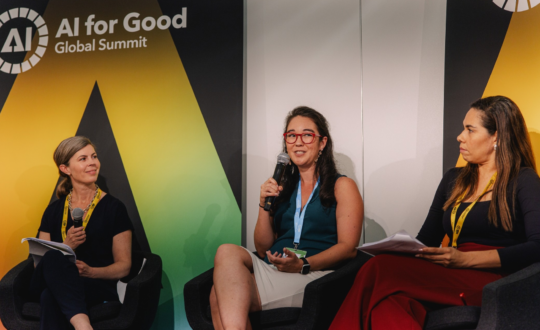
The discussion of the day will unite LEGO Education and the Raspberry Pi Foundation for a panel that explores the definition of the outcomes that are significant in an AI-enabled world. The panel explores how skills such as critical thinking, collaboration, problem-solving, and creativity can be defined, measured, and tested in relation to AI literacy. Philip Colligan, the chief executive of the Raspberry Pi Foundation, and Andrew Sliwinski, the vice president and director of product experience at LEGO Education, engage in a discussion regarding the priorities that educators should prioritise as AI becomes a permanent fixture in classrooms worldwide.
UFOTECH operates its Speed Networking System in Hall 2’s Networking Zone for the duration of the day. This system is a motorised rotating platform that can accommodate sixteen individuals at a time and is intended to facilitate face-to-face interactions among participants without the typical barriers of a conference floor. The carousel rotates through four themed sessions from 9:30 to 16:30, including two Milky Way slots for general networking, a Mercury session that is dedicated to student and entrepreneur connections, and a Titan session that will be centred on robotics and AI discussions. The format is intended to enable participants to concentrate on conversation while the platform manages the logistics of introducing them to new colleagues.
The day’s programming, when considered collectively, is indicative of a Summit-wide theme: that AI education is most effective when technical skill-building is combined with structured reflection on the purpose and design of the technology. That equilibrium will carry into the Summit’s second day, when the Youth Zone’s programming will turn toward the policy and pedagogical questions shaping AI in education, from EdTech procurement standards to how schools balance screen time with hands-on learning.