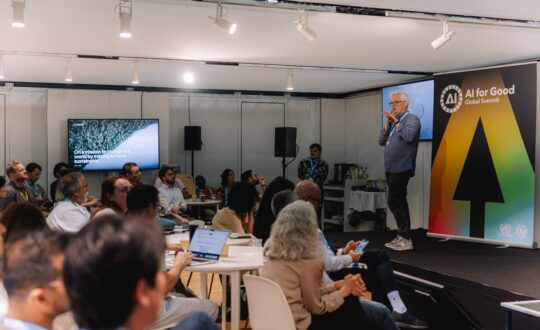


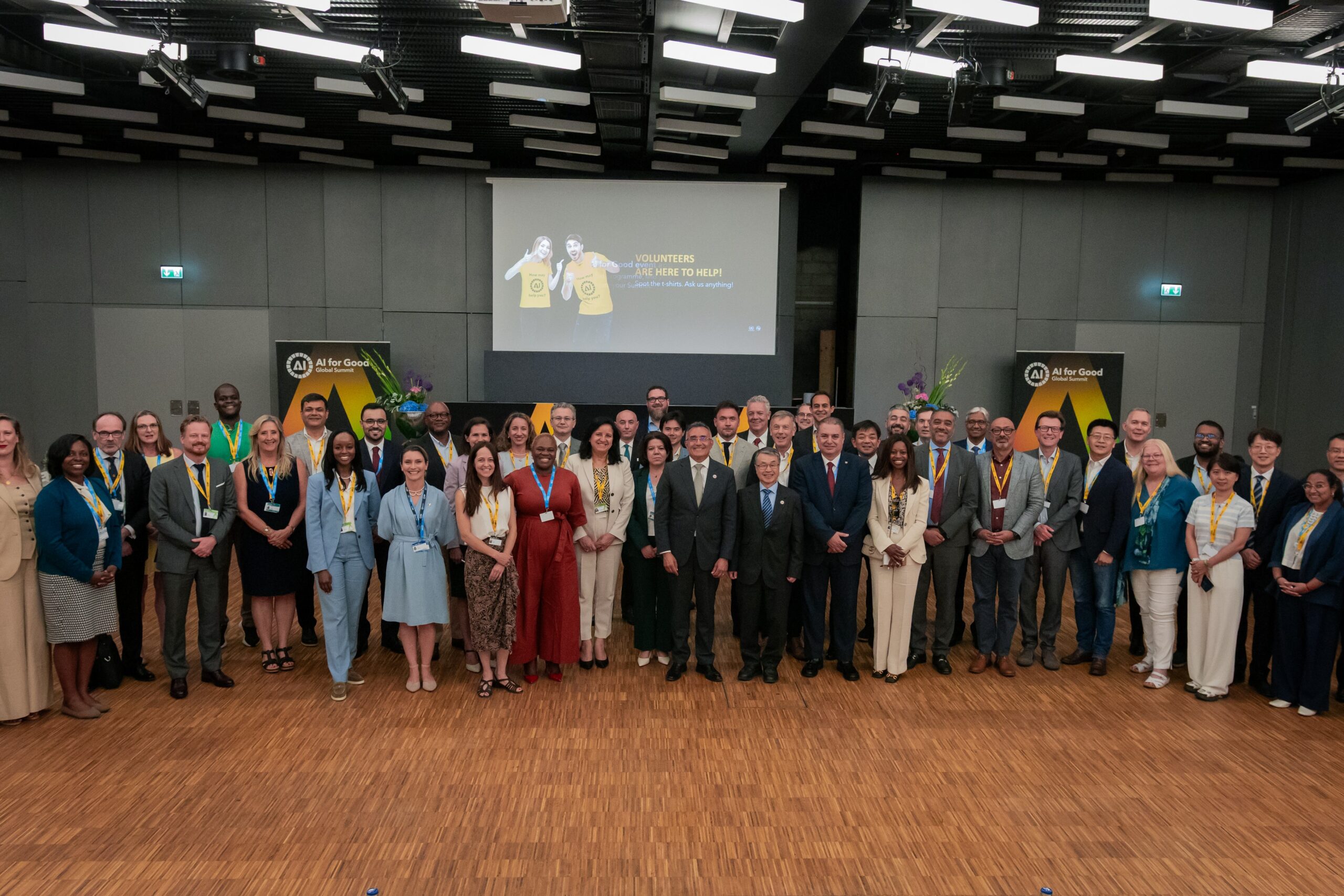
The high-level roundtable “AI foundation: Digital trust and AI infrastructure for all“ brought together more than fifty senior representatives from government, industry, standards bodies and academia on the opening day of the AI for Good Global Summit 2026. Participants included eighteen ministers and senior government representatives, more than twenty-four private-sector companies and twelve international organizations and academic institutions.
The session was held under the Chatham House Rule, allowing its ideas to be reported without identifying individual speakers.
In public opening remarks, Seizo Onoe, Director of the International Telecommunication Union (ITU) Telecommunication Standardization Bureau (TSB), emphasized that innovation should serve the public interest and that every country should have the capacity to benefit from AI, develop domestic innovation and create solutions for local needs. He also announced an ITU standards initiative focused on identity and trust marks for AI.
Moderated by Bilel Jamoussi, ITU TSB Deputy Director, the discussion addressed three themes: AI infrastructure and inclusion, AI standards for industry, and agentic AI and digital trust.
AI sovereignty without isolation
The first discussion focused on who builds, owns and benefits from AI infrastructure.
Figures shared during the roundtable illustrated the current concentration of computing capacity. Participants noted that only sixteen countries have large-scale computing infrastructure, while nearly two billion people remain offline. High-income countries account for 86% of the world’s top 500 high-performance computing systems and 97% of their capacity. Developing economies outside China represent half of global internet users but less than 10% of global data center capacity.
Energy was also identified as a central infrastructure constraint. Participants cited International Energy Agency estimates that data center electricity consumption could reach around 945 terawatt-hours by 2030, approximately double current levels. In Africa, where roughly 90% of data is stored outside the continent, electricity can be a greater limitation than connectivity when determining where infrastructure can be hosted.
Participants discussed different interpretations of AI sovereignty. Several cautioned against defining it as national ownership of every part of the AI stack, which could increase fragmentation and investment costs. Others argued that countries need control over selected layers of infrastructure, data or computing capacity to shape their own AI policies and development priorities.
Regional computing pools, cloud-first policies, shared infrastructure and data embassy frameworks were presented as possible approaches. As the moderator summarized, countries want greater AI sovereignty, but not at the cost of international cooperation.
Participants also differed on how much control countries should retain over AI infrastructure. Some emphasized domestic ownership and localization, while others favored open markets, shared infrastructure, and cross-border collaboration. Concerns were raised about barriers to participation, including limited access to devices, computing capacity, advanced hardware, and locally representative language models.
Examples shared around the table included investments in AI factories, gigafactories, supercomputing centers, cloud infrastructure, national AI laws and subsidized access to computing resources. Participants also described initiatives to expand access to datasets, open-source models and language technologies.
As highlighted during the discussion, inclusion in AI begins with access to connectivity, energy, data, cloud infrastructure, computing power, and skills.
Connecting horizontal and sector-specific standards
The second theme examined fragmentation between horizontal AI standards, which establish requirements across industries, and sector-specific standards for areas such as health care, telecommunications, medical devices and transportation.
Participants agreed that both types are needed. The concern raised was that developing them separately can create overlapping requirements, inconsistent regulatory expectations, duplicated assessments and barriers to trade.
Proposed areas of work included mapping horizontal standards against high-impact sector use cases, improving coordination between AI specialists and sector experts, and developing shared guidance and conformity assessment pathways. These measures could help regulators, manufacturers and users determine which requirements apply and how compliance should be demonstrated. Energy efficiency was also raised as part of the discussion, based on the requirement for reliable power to deploy AI systems and infrastructure.
This work builds on existing cooperation through the World Standards Cooperation, comprising ISO, IEC, and ITU, which has worked with the wider United Nations system on sector-specific AI standards for nine years, including work in health care, education and agriculture.
Trust requirements for AI agents
The final theme focused on agentic AI and the systems required to establish trust when AI agents act across platforms, organizations and jurisdictions. Participants noted that many existing regulatory frameworks were designed for systems whose intended purposes and reasonably foreseeable behavior could be defined in advance. AI agents may instead negotiate, conduct transactions, coordinate with other agents and pursue goals across multiple systems, raising questions about how oversight and accountability should operate.
The discussion identified several trust requirements. Agents need verifiable identities and mechanisms to demonstrate that they are acting for a particular person or institution. Their authority and permissions should be clearly defined, machine-readable and capable of being limited, suspended or revoked.
Participants also called for portable consent, audit trails, provenance and verification mechanisms that allow an agent’s actions and their consequences to be reconstructed. Accountability, they argued, should remain with a human or institutional principal rather than being transferred to the AI system.
These mechanisms cannot be established by model developers alone when agents operate across different vendors, sectors and national systems. Participants therefore emphasized the role of interoperable standards in establishing shared expectations, reducing fragmentation and clarifying accountability across the supply chain.
Other issues included the need to distinguish between agents operating within an organization and agents acting on the open internet. Participants also discussed whether existing regulation should evolve as AI systems gain autonomy, while preserving the accountability functions currently assigned to people and institutions.
Continuing the standards discussion
Across the three themes, the roundtable connected access to infrastructure with the standards and trust mechanisms required for AI systems to operate across sectors and borders. Its discussions identified areas of convergence, including the need for interoperability, shared infrastructure, clear accountability and international cooperation, while also recording continuing differences over sovereignty, localization and regulation.
Watch the full session: