


Artificial intelligence is advancing at extraordinary speed. Yet the pace at which organizations and nations adopt it will increasingly be determined by trust.
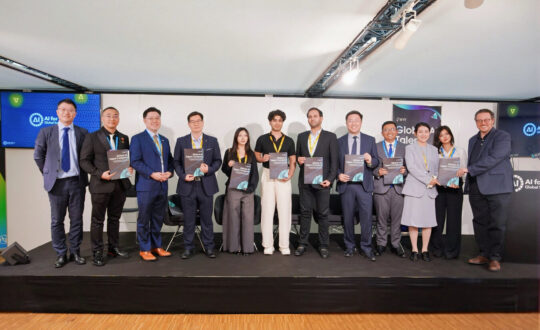
At the AI for Good Global Summit in Geneva, I moderated a panel on what it takes to scale AI and realize its exponential value. The conversation brought together Magan Naidoo, Chief Data Officer of the United Nations World Food Programme; Calista Redmond, Vice President of Global AI Initiatives at NVIDIA; and Howie Wachtel, Senior Director and Head of UN and International Organizations Policy at Microsoft.
Each approached the challenge from a different vantage point, but one message united them: trust cannot simply be coded into an AI model or added once a solution is ready to deploy.
It must be designed from the outset – human-centered, governed and embedded in an ecosystem capable of turning data into value and innovation into sustained adoption.
Trust is becoming the defining constraint
When asked about where the bottlenecks arise in scaling AI, our panellists identified a range of constraints: fragmented data, inconsistent governance, limited access to compute power and skills, and an absence of oversight across the wider system.
Underpinning them all was the issue of trust.
Poor-quality or poorly governed data can undermine the reliability of AI outputs. Limited transparency over how information is used creates understandable apprehension, particularly where organizations hold sensitive personal or humanitarian data. Meanwhile, fragmented regulation, cybersecurity risks and uneven access to compute and talent all affect whether institutions and communities have confidence in the ecosystem around the technology.
Trust, therefore, is not a single control or technical safeguard. It is the outcome of how the whole system operates.
Start with value – then build the data foundations
Data is the bedrock of AI. But as the panel discussed, beginning the conversation with data quality alone does not always inspire people to act.
The World Food Programme has taken a more outcome-led approach: they started with the problems AI could help solve, then connected those ambitions to the work needed to make the organization’s data ready.
That work remains fundamental. Data needs to be accurate, standardized and placed in the right context. Without these foundations, poor outputs can quickly undermine trust in both the solution and the underlying technology.
For institutions serving vulnerable communities, trust has to be visible in everyday operating decisions.
That means being transparent about what data is collected and why. It means securing appropriate consent, applying ethical and privacy oversight and establishing clear accountability for decisions and outcomes.
“We have a Chief Ethics Officer who cuts across the use of data in the organization and acts as a guardrail in terms of our practices. Then we also have a global privacy office, which runs across the usage of data and keeps us all honest,” Magan Naidoo, said.
It also means making deliberate technical choices. Magan described the World Food Programme’s principle of taking AI to the data, rather than moving sensitive data unnecessarily. This can reduce exposure, respect geographic and access requirements, and give stakeholders greater clarity over how their information is being used.
Partnerships are how trust scales
Trust isn’t just essential within organizations; it also must be established across an entire ecosystem.
No single organization, government or technology company possesses every capability needed to scale AI responsibly. Governments bring policy, legitimacy and public purpose. International organizations bring deep knowledge of the communities they serve. Technology companies provide platforms, infrastructure and technical expertise. Academia contributes research, scrutiny and new ideas. Professional services organizations can help connect strategy, governance, implementation and long-term transformation.
But ecosystem collaboration must go beyond combining products or funding individual pilots.
Microsoft, working with the UN Office for the Coordination of Humanitarian Affairs, has provided a technology dashboard designed to improve transparency, accountability and the targeting of aid.
Howie explained that international organizations increasingly expect technology partners to demonstrate a wider commitment to skills, security, policy and effective AI governance. A meaningful partnership should build enduring capability.
“It’s not just about providing AI or a service. Organizations want to see a commitment across the entire ecosystem; beyond selling a product, towards a meaningful and lasting relationship,” Howie Wachtel explained.
Partnerships can also create common foundations once, rather than forcing every institution to recreate them independently. Shared standards, interoperable infrastructure and proven safeguards can help organizations move beyond isolated proofs of concept towards coordinated and trusted deployment.
Think nationally, build locally, engage globally
The same ecosystem challenge becomes even more complex at a national level.
AI is increasingly becoming a form of national infrastructure. Building a trusted national capability requires governments to connect strategic priorities and policy with talent, applications, models, data and compute.
“To transform a country, AI must be national infrastructure – not piecemeal, but holistically,” Calista Redmond said.
Talent is central to that equation. Countries need broad AI literacy so that specialists across fields, from education and healthcare to agriculture, law and public administration, can apply AI within their own disciplines. They also need local engineers and developers who can build, adapt and sustain the ecosystem over time.
Localization is equally important. Language is not simply a user-interface decision. It influences who can participate, how accurately context is understood and whether the benefits of AI are distributed inclusively.
Calista argued that countries need a portfolio of locally trained and fine-tuned, open and commercial models, supported by trusted local data and infrastructure. These models should reflect national languages, cultural context, sector needs and legal requirements, while open models can help connect local innovators with the global developer community.
Trust also depends on whether societies can see themselves reflected in the technology.
Howie reinforced the point that local languages are therefore not a peripheral consideration. They can contribute to inclusion, reduce bias in datasets and help build confidence that AI is being developed with – rather than simply delivered to – the communities it is intended to serve.
Four priorities for leaders
Taken together, these insights point to four priorities for leaders seeking to move from AI experimentation to trusted adoption:
Make trust a design principle, not an aspiration. Define accountability, governance, security, monitoring and human intervention before moving to scale.
Connect AI ambition to data readiness. Start with the outcomes that matter, then address the quality, standards, context and access needed to deliver them reliably.
Invest in people and local capability. Build broad AI literacy alongside specialist talent, relevant language resources and infrastructure suited to the local context.
Design the ecosystem deliberately. Decide what should be shared, what must remain local and how each partner will contribute to lasting capability and value.
From experimentation to trusted adoption
Experience can be one of the strongest builders of trust.
When people see AI addressing real challenges, improving services and producing outcomes they can understand and question, confidence grows. The conversation begins to move from fear of the technology towards the opportunities it can create.
But that confidence will not emerge automatically.
Trust emerges when data, people, infrastructure, oversight, local context and partnerships reinforce one another. The organizations and nations that advance most effectively will be those that recognize trust as a system capability that enables AI to scale responsibly.