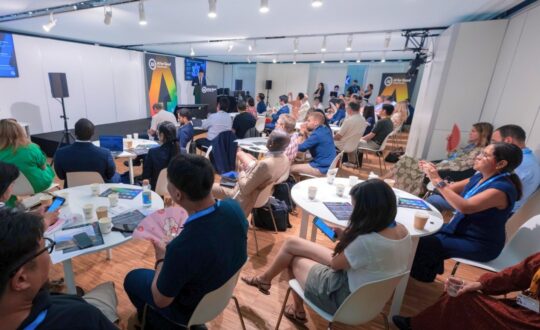


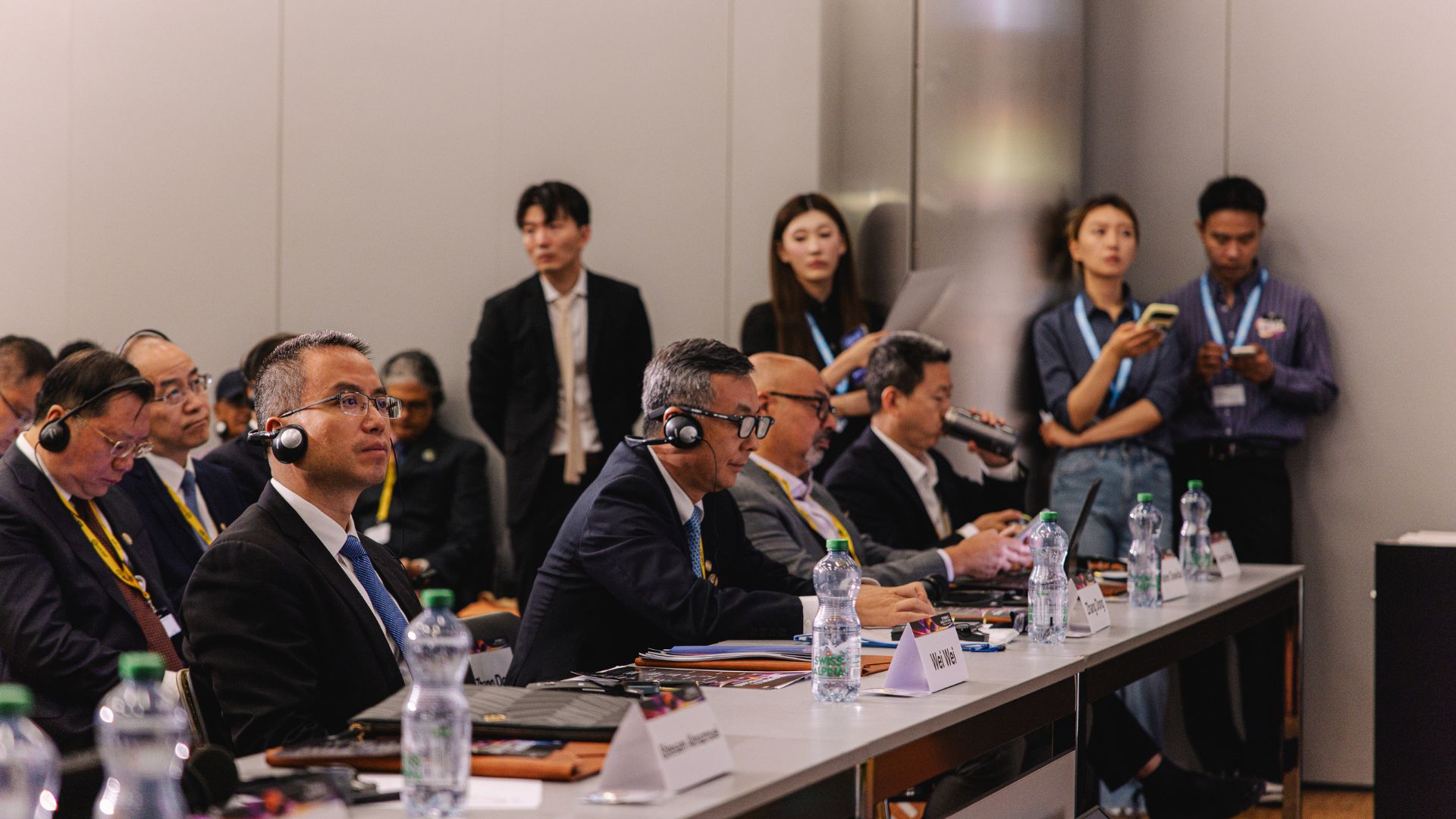
Despite the rapid expansion of mobile connectivity, significant gaps in access remain. Closing those gaps and ensuring that advances in AI reach people more widely was a central focus of the workshop “Mobile AI for Good: Ubiquitous, Open, Accountable, Inclusive,” organized in partnership with GTI at the AI for Good Global Summit 2026. Moderating the session, Mathias Gabrysch, Senior Advisor for Ecosystem Development at GTI, opened by framing mobile networks as the primary channel through which AI reaches most of the world’s population.
“Open, accountable, inclusive AI for good will only be truly for good if it’s available to all,” Gabrysch said.
Bringing together speakers from International Telecommunication Union (ITU), GTI and China Mobile, a founding member of GTI, the session moved across three parts: opening remarks and keynotes on network intelligence, the launch of a global initiative on AI security governance, and a panel on open source AI.
From connectivity to intelligence
Opening speakers described a shift already underway: networks that once simply connected people are now expected to carry intelligence itself. Wei Wei, Director General of the Department of Science and Technology at China’s Ministry of Industry and Information Technology, cited figures including 4.958 million 5G base stations nationwide and 188.2 EFLOPS of intelligent computing capacity, framing network-AI integration as requiring coordinated international standards and security research.
Dr. Ebtesam Almazrouei, Chairperson of the AI for Good Impact Initiative and CEO and founder of AIE3, opened with the story of a mother in coastal Kenya whose newborn was saved after a free text-message health service flagged a symptom report and connected her to a nurse, a service she said now supports more than a million mothers in Kenya. She used it to frame the summit’s central concern.
“This week, this summit has named the divide of our age: the gap between those for whom AI already works and those it has yet to reach. Mobile AI is how we close it, because the phone is already in the hand on the far side of that gap,” Almazrouei said.
Zhang Dong, Executive Vice President of China Mobile, highlighted what he described as the company’s eight open laboratories and its collaboration with ITU on an open 6G experimental platform.
Two further keynotes developed the infrastructure argument. Hatem Dowidar, non-executive director of Vodacom, argued that AI’s usefulness depends on the network beneath it.
“AI for good starts before the AI. It’s being connected, available, affordable, reliable and secure, built on smart, resilient and efficient infrastructure,” Dowidar said.
Ali Taha Koç, CEO of Turkcell, described AI infrastructure as a five-layer value chain running from energy and chips through data centers, models and applications.
“Scaling AI into the real world is not only a technological challenge, it is also a responsibility for all of us to make AI accessible, secure, inclusive and beneficial for society,” Koç said.
Governing AI at network scale
The session’s second part addressed how to govern AI that increasingly acts on its own. Su Li, Director of China Mobile’s Research Center for AI Security and Governance, presented a “1-3-9” AI security governance framework: one vision, three strategic approaches (security rooted into networks, governing AI with intelligence, and shift left and co-governance), and nine development pathways spanning trusted connectivity, secure computing resources, intelligence-based boundary control, governing sources, behaviors and trends with AI, security shift-left, trust chaining and ecosystem co-defense. The framework is designed to support six governance objectives: trustworthy entities, measurable risk, traceable processes, controllable behavior, aligned values and evolving capabilities.
“Nowadays, it is more important for us to govern the behavior of agents than the content they output,” Su Li said.
Khaled Soufi, President of the International Organization for Standardization (ISO), argued that international standards, rather than fragmented national rules, are what make AI governance principles operational across borders, pointing to the ISO/IEC 42001 AI management system standard as an example.
“International standards are the bridge between policy ambition and practical, interoperable and trusted implementation,” Soufi said.
In a one-on-one dialogue, Bilel Jamoussi, Deputy Director of TSB & Chief, Study Groups & Policy Department (SPD) at the ITU, described ITU’s early work on machine learning standards for 5G networks, published in 2019, and pointed to a newly launched focus group on the interplay between AI agent identity and human identity, addressing the absence of any way to verify who or what an AI agent is acting for.
“We can’t wait. I mean, the technology is moving so fast. AI is moving so fast that the standards community needs to run,” Jamoussi said.
The segment closed with Yvonne Baldwin Mushi, founder of Elevate AI Africa, who described MamaMate, an offline maternal health device she built after winning the summit’s innovation competition the previous year. Almazrouei, introducing her, said the device now serves more than a thousand mothers across Tanzania and South Africa. Baldwin Mushi is also co-creator of the Presidential African Youth in Artificial Intelligence & Robotics initiative, part of the African Union’s STISA 2034 strategy, which has reached young innovators across 44 African countries.
“The true value of mobile AI, therefore, will not be measured by how intelligent our models become, but more by whose lives they improve,” Baldwin Mushi said.
Open source as the engine of inclusion
The final part turned to open source as a route to wider participation in AI development. Jianmin Wang, Dean of the School of Software at Tsinghua University, traced China’s rising role in global open source contributions, citing IoTDB, which he described as an open-source database his team donated to the Apache Software Foundation. He also highlighted OpenDigger, an infrastructure tool that, according to Wang, is used by Huawei, Alibaba, Ant Group and the OpenAtom Foundation, and has been officially adopted by China’s Ministry of Industry and Information Technology to track transparency across open-source AI ecosystems.
A panel discussion followed. Wei Wang, of East China Normal University’s School of Data Science and Engineering, argued transparency is what open source adds to AI specifically.
“I believe open source is a good way, especially for AI for good,” Wei Wang said.
Christofer Dutz, Director of the Apache Software Foundation, described the strain AI-generated contributions are putting on volunteer maintainers, citing the Apache Airflow project receiving some 170 pull requests a day.
“We’re currently facing a real big threat that these people, with all the skills and all the history of the project in their heads, are going away because they’re just annoyed that they don’t get to work on the project that they love. They just get to gate keep thousands and thousands of requests from AI,” Dutz said.
Yue Gao, Chair Professor and Dean of the Institute of Space Internet at Fudan University, pointed to open data and open models as a way to draw more researchers into emerging fields such as space-based AI.
“The open model and the open data are one of the ways to go further,” Yue Gao said.
A shared test
Across the session, speakers returned to the same four words used in its title. Whether the subject was network infrastructure, governance frameworks or open source code, the underlying question was the same: not whether AI is powerful, but whether it reaches, and serves, the people furthest from it.