


During MWC26, Barcelona brought together a focused snapshot of how AI is being applied to healthcare challenges at the AI for Good Innovation Factory Catalonia: AI for Health session.
Organized in partnership with the Government of Catalonia – through the Secretariat for Digital Policy of the Department of Business and Labour– and coordinated by the Centre of Innovation for Data Tech and Artificial Intelligence (CIDAI) and the Digital Catalonia Alliance (DCA), within the Catalonia AI 2030 Strategy, the session featured five Catalan startups developing AI-driven solutions to address pressing health challenges. As part of the global AI for Good Innovation Factory initiative led by the International Telecommunication Union, the event connected local innovation with an international platform designed to support startups in scaling their impact.
“For Catalonia, this project is very important because it allows us to share our vision of how artificial intelligence can have a very positive impact in key areas such as health. It also allows us to continue collaborating with an international organization such as the ITU of the United Nations and to project our very strong ecosystem of AI startups and companies to the world”, stated Maria Galindo, Secretary for Digital Policy of the Government of Catalonia.
Among the startups featured during the session, the winner was Emily.AI, a Barcelona-based company developing an intelligent system to transform how oxygen therapy is delivered in clinical and home-care environments.
“More than 5 billion people still lack access to safe medical oxygen. If we have the tools to change that – and we do – then building AI solutions is not just an opportunity, it’s a responsibility,” said Daniel Oliva, Founder and CEO of Emily.AI.
An intelligent system for oxygen therapy
Emily.AI addresses a critical and often overlooked aspect of healthcare delivery: the administration of medical oxygen. Despite being an essential treatment, oxygen therapy is still largely managed manually in many healthcare settings. Clinicians must adjust oxygen flow based on intermittent measurements, making it difficult to maintain patients within optimal oxygen saturation levels.
This can lead to significant risks. Insufficient oxygen levels can result in organ dysfunction and increased complications, while excessive oxygen exposure is associated with lung injury and other adverse outcomes. Maintaining the right balance requires continuous monitoring and rapid adjustments, tasks that place a considerable burden on healthcare professionals.
Emily.AI introduces a fully integrated approach that combines medical-grade hardware, continuous monitoring, and explainable AI. The system connects to standard oxygen sources and wearable sensors to capture real-time physiological data, including oxygen saturation and respiratory patterns. Based on this data, the platform dynamically adjusts oxygen flow in real time, ensuring that each patient receives the appropriate level of oxygen at every moment.
From real-time monitoring to predictive care
Beyond automation, the system incorporates predictive capabilities designed to support earlier clinical intervention. By analyzing patient trends over time, Emily.AI can identify signs of respiratory deterioration hours or even days in advance, enabling healthcare providers to respond before conditions worsen.
This shift from reactive to proactive care has implications for patient outcomes and healthcare system efficiency. Clinically, it helps patients remain within their optimal oxygen range for longer periods, reducing the risks associated with hypoxia and hyperoxia. Operationally, it reduces the need for continuous manual adjustments, allowing healthcare professionals to focus on higher-value tasks.
The platform is designed to be hardware-agnostic and adaptable, enabling integration into a wide range of healthcare environments, from advanced hospital systems to resource-constrained settings. This flexibility supports its ambition to scale globally and address disparities in access to quality respiratory care.
Scaling beyond Barcelona
Founded in Barcelona, Emily.AI is rooted in one of Europe’s leading digital health ecosystems, working closely with hospitals, clinicians, and research institutions to validate its solution in hospital and home-care settings. These collaborations support the development of a system that meets high standards of safety, performance, and regulatory compliance.
At the same time, the company’s focus extends beyond Europe. Access to safe and effective oxygen therapy remains a major challenge in many parts of the world, particularly in low- and middle-income countries where healthcare infrastructure and resources are limited. By designing a solution that is scalable and adaptable, Emily.AI aims to support deployment across diverse contexts and contribute to reducing inequalities in respiratory care.
Expanding into new markets brings its own set of challenges. Clinical validation, regulatory approval, and integration into existing healthcare systems require time, resources, and close collaboration with local stakeholders. Ensuring that AI-driven medical technologies are both safe and trusted remains a central priority as the company grows.
Five AI-based solutions with an impact on the healthcare sector
At the AI for Good Innovation Factory Catalonia held in MWC26, five startups competed live with AI solutions impacting the healthcare field:
- Biosfer Teslab: Advanced metabolic analytics and lipoprotein profiling to identify hidden cardiovascular risks that standard cholesterol tests do not detect.
- Doctomatic: Patented AI software that converts images from medical devices into validated clinical data in under 2 seconds. It offers a truly device-agnostic solution for remote monitoring.
- Elna Health: A clinical intelligence platform that transforms medical research and fragmented guidelines into actionable, real-time decision support. It bridges the gap between complex evidence and consistent clinical practice at the patient’s side to reduce medical errors.
- Emily.AI: An intelligent respiratory care system that combines medical equipment with explainable AI to predict and prevent desaturation events.
- Ephion Health: A patient functional capacity monitoring system using biomechanical gait analysis with wearable devices and AI.
The session featured a panel of leading experts as jury members: Albert Sabater, Director of the Observatory for Ethics in Artificial Intelligence of Catalonia (OEIAC); Cindy E. Frias, PhD in Nursing Science and WHO Consultant on Wellbeing and Duty of Care Policy; Jonathan Cylus, Senior Health Economist at the WHO Barcelona Office for Health Systems Financing; Miquel Martí, CEO of Tech Barcelona; and Petia Radeva, Professor at the University of Barcelona (UB).
Catalonia’s role in advancing AI for health
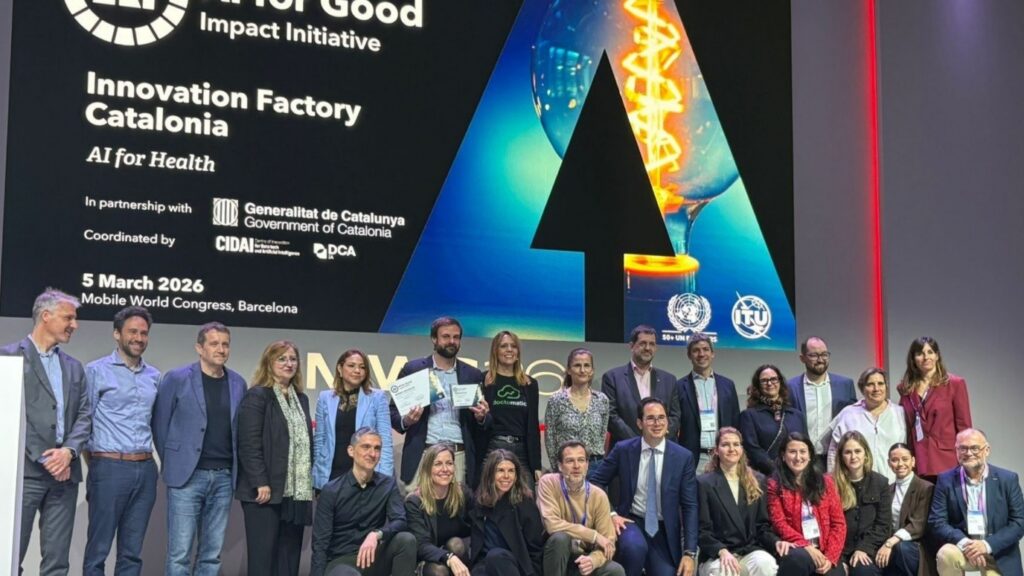
The Innovation Factory Catalonia session reflects a broader regional effort to position AI as a driver of social and economic development. Through the Catalonia AI 2030 Strategy, the Government of Catalonia is promoting the deployment of AI technologies that support public well-being while strengthening the competitiveness of the local ecosystem.
By bringing together startups, public institutions, and international platforms such as AI for Good, the initiative contributes to building connections between local innovation and global challenges. Events such as the Innovation Factory session create opportunities for emerging companies to gain visibility, access mentorship, and engage with partners who can support their growth and impact.
Following its selection as the winner in Barcelona, Emily.AI will advance to the AI for Good Innovation Factory Grand Finale at the AI for Good Global Summit 2026 in Geneva. There, it will join startups from around the world to present its solution on a global stage and connect with investors, policymakers, and industry leaders.
As the Innovation Factory continues to expand across regions, it highlights the role of local ecosystems in shaping globally relevant solutions. In the case of Emily.AI, the focus on intelligent oxygen therapy illustrates how targeted applications of AI can address critical gaps in healthcare delivery, while supporting more precise, efficient, and accessible care for patients worldwide.