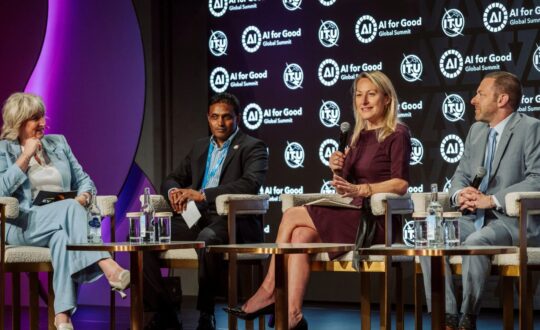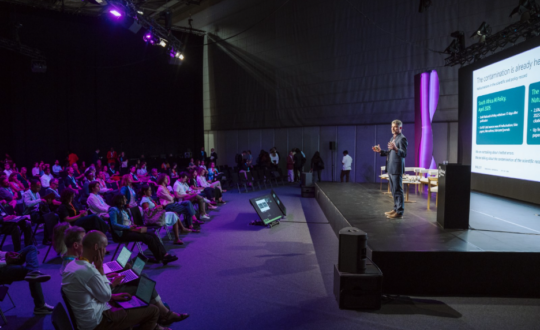


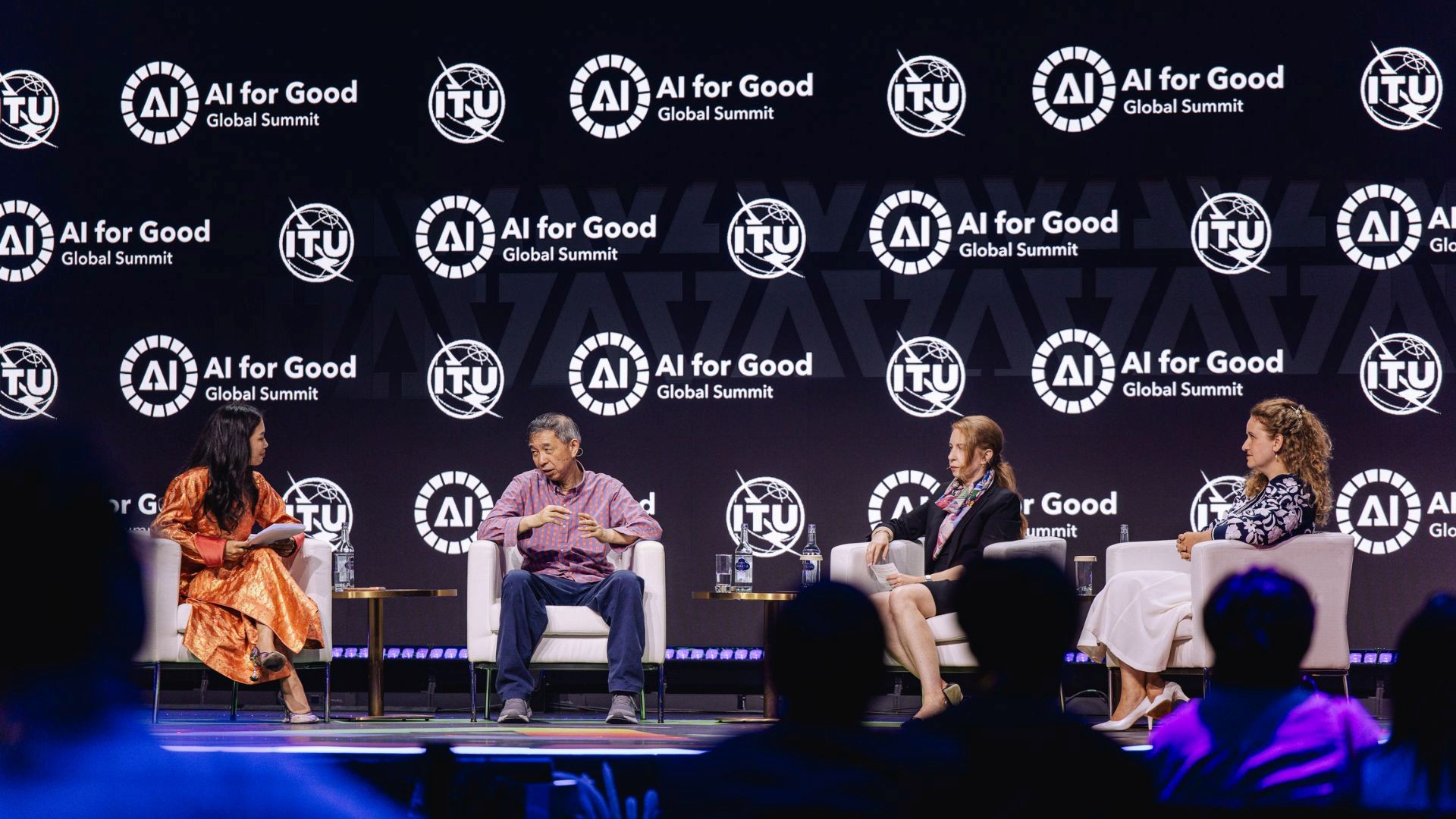
In 1859, the Northern Lights were visible as far as Hawaii and across the equator. The cause, according to Bilge Demirköz , astro-particle physics professor at Middle East Technical University and member of the UN Scientific Panel on AI, was the Sun itself: a “fusion reactor” that flips its magnetic field roughly every 11 years, sending disturbances across space that only rarely strike the Earth directly. That year was one of the rare direct hits. Demirköz said the only technology on Earth vulnerable to the resulting electromagnetic surge was the telegraph network – and telegraph lines caught fire. She raised the episode during a session at the AI for Good Global Summit 2026, “Beyond Earth: AI, Space Computing and Humanity’s Next Frontier,” noting that it became part of ITU’s own history.
Breakthroughs in the future
Moderating the session, Bolor Erdene Battsengel, founder and CEO of AI Academy Asia, opened by asking the panelists what single breakthrough could change the future of humanity. Wang Jian, founder of Alibaba Cloud and director of Zhejiang Lab, said AI would above all help save people time, giving them more room to think. Turning to space, he argued that deploying AI there could help address challenges facing Earth, pointing to the large amount of data already collected from orbit.
Asked to explain his Three-Body Project, Wang said it rests on three elements he sees as still missing from most satellite systems: genuine computing power in orbit, rather than isolated chips; direct communication between satellites via laser links, rather than each one reporting only to the ground; and complete AI models, pre-loaded before launch, rather than simplified algorithms uploaded afterward – something he said is difficult to do once a satellite is already in space.
“It’s not an algorithm in the space,” he said. “It’s really an AI model as you have on the ground in the space.”
For Stephanie Bednarek, vice president of Commercial Sales at SpaceX, the arrival of AI has raised the stakes of her company’s own mission:
“As we are looking at AI, that’s only going to continue to expand. Our mission as a company is to build the systems and the technologies that are needed to make life multi planetary. And that sounds like a big audacious goal, but that is what space does.”
Demirköz took the question in a different direction, describing an experiment aboard the International Space Station called the Alpha Magnetic Spectrometer. Comparable to the large particle detectors at CERN, it collects cosmic rays, with AI used to identify the particles; researchers then use the data to study questions including the nature of dark matter and how atoms were created in the universe.
AI in space
The discussion turned next to what changes when AI moves from processing data on the ground to making decisions in orbit. Erdene Battsengel noted that Wang had described space as computing infrastructure rather than an observation platform and asked what difference that would make. Wang cited two advantages. First, satellites already collect large amounts of data, but more than 90% of it cannot be sent back to Earth for lack of bandwidth. The second advantage is speed: in a disaster, he said, data could be processed in orbit far faster than if it were sent to Earth first, where processing could take hours or even days.
Put to Bednarek, the same question of feasibility became whether computing infrastructure and data centres in orbit are still science fiction. She said it makes sense: current AI development depends on terrestrial data centres that require power and cooling Earth cannot supply without straining the environment and communities, whereas solar energy in orbit removes the need for water or land. She pointed to Starship, SpaceX’s next-generation rocket, as the missing piece. Space-based data centres, she said, would require launching large amounts of mass, and no earlier rocket had that capacity. Combined with reusability, satellite manufacturing at scale and SpaceX’s operational experience, Starship could enable rapid, cost-effective deployment of AI-computing satellite constellations, potentially numbering in the millions, she said.
Erdene Battsengel then turned the conversation toward resilience, asking Demirköz what happens when something goes wrong in space, where no technician can be sent and a satellite cannot simply be rebooted. Demirköz returned to the Carrington Event of 1859, explaining that such solar strikes are stochastic. They do not occur at fixed intervals, though records suggest an average recurrence of roughly 200 to 300 years. We cannot protect the Earth or satellites from an event of this kind, she said, and the consequences could include not only the loss of satellites but collisions between them, since it would no longer be possible to communicate with or control them.
Space computing
Erdene Battsengel noted that the AI and Space Computing Challenge, organized by AI for Good and supported by Zhejiang Lab, had drawn participants from 36 countries, focused on water security, food security and disaster response, and asked whether the field is mature yet. Wang said it is far from mature. He explained that the initiative is named after the “three-body problem,” a concept first proposed by Isaac Newton: two objects in space have a mathematical solution describing their relationship, but adding a third makes an analytical solution impossible – illustrating, he said, the difficulty of getting multiple parties to work together.
That difficulty, he said, shaped the project’s second goal: a protocol built on trust and governance, so that data from one satellite could be processed using another’s computing power. The aim, he said, is infrastructure that benefits all participants, since not every institution can afford to launch thousands of satellites on its own. For Earth observation, Wang said the target is 1,000 satellites, chosen so the constellation could pass over any point on Earth roughly every three minutes, allowing disasters to be detected quickly.
Space in ten years
Bednarek predicted substantial AI-driven infrastructure on the Moon and Mars within a decade. For Demirköz, robots made more sense than humans: in another storm like the one that struck Earth in 1859, she said, only machines would be lost, since Mars has no magnetic field to protect them.
“I really wouldn’t want to put humans up there on Mars. I would rather put robots, which are expandable,” she said.
Watch the session: