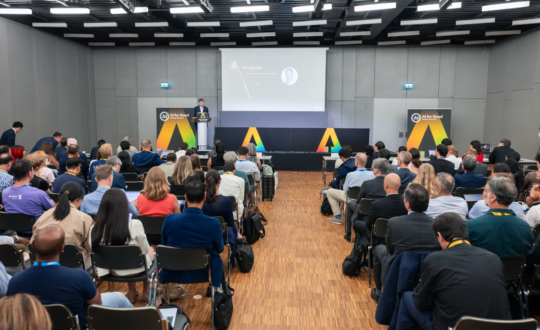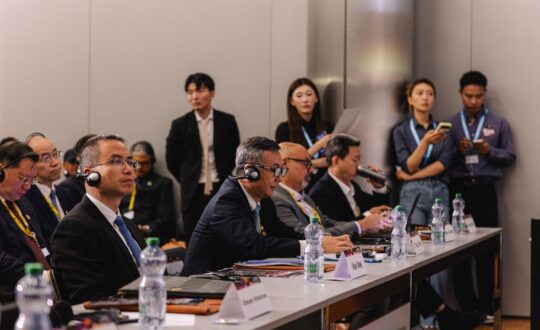


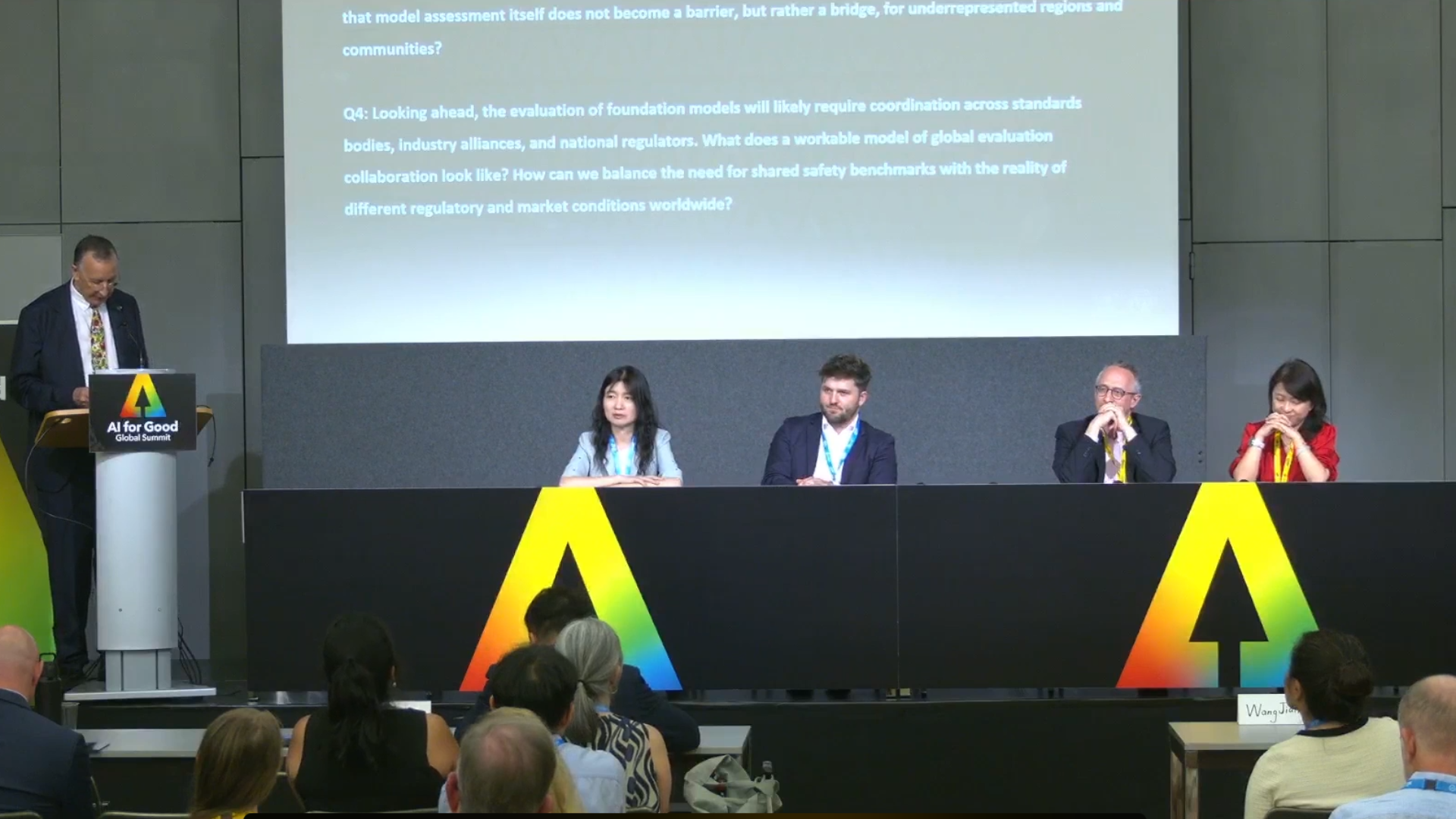
As foundation models become more capable and increasingly embedded across industries and public services, evaluating them is becoming both more difficult and more important. The workshop AI Foundation Model Evaluation and Standards, organized in partnership with the China Academy of Information and Communications Technology (CAICT) during the AI for Good Global Summit 2026, moderated by Wang Yuntao, rapporteur of the Q5/21 on AI-Enabled Multimedia Applications, brought together researchers, technology companies, civil society and international standards organizations to examine how evaluation methods can keep pace.
Discussions moved beyond conventional performance rankings to consider model reasoning, agents, embodied AI, child safety, cybersecurity and real-world deployment. Across the workshop, speakers called for evaluation systems that are dynamic, transparent and internationally interoperable.
Creating a shared evaluation ecosystem
Opening the workshop, Bilel Jamoussi, Deputy Director of ITU’s Telecommunication Standardization Bureau, argued that international standards provide a common language through which governments, industry and society can compare and build confidence in AI systems. He highlighted ITU-T Recommendation F.748.44, the first international standard specifically dedicated to foundation model benchmarking. Work is continuing on evaluation standards covering multimodal models, code generation and AI agents.
“Standards provide the common language and the shared benchmark that allows governments, industry and society to assess, compare and trust AI systems,” Jamoussi said.
He described standards as a practical entry point for international cooperation, capable of supporting mutual recognition and deeper trust across countries, industries and standards bodies.
Yu Xiaohui, President of CAICT, warned that evaluation systems must evolve as quickly as the technologies they assess. Static datasets can become outdated, be incorporated into model training or encourage benchmark gaming. Evaluation should instead become continuous, adaptive and capable of testing how systems behave in open-ended environments.
“Evaluation should be a calibration tool for values, not merely a capability ranking,” Yu said.
He called for greater emphasis on safety, fairness and controllability, alongside international coordination and broader access to shared datasets and evaluation methods. He also proposed connecting evaluation with the UN Sustainable Development Goals and strengthening capacity building for developing countries, so as to help bridge the intelligence divide.
Yu also launched the International Initiative on Co-building Foundation Model Evaluation Ecosystems for AI for Good. The initiative invites organizations worldwide to jointly shape evaluation standards, develop benchmarking resources, share methodologies and support mutual trust in evaluation results. It sets out ten areas of action, ranging from open collaboration, transparency and evaluation integrity to multilingual data foundations and the mutual recognition of evaluation standards. According to CAICT, the initiative builds on its foundation model evaluation system, FactTesting, which covers language, multimodal, coding and agent capabilities and has supported more than 1,500 model assessments.
From static benchmarks to real-world evaluation
The first discussion examined how evaluation must change as AI moves from individual models towards complex systems operating in digital and physical environments.
Wang Jian, Founder of Alibaba Cloud and Director of Zhejiang Lab, argued that foundation models are too complex to be assessed only through functional tests. Even their developers may not fully understand their capabilities or boundaries. Evaluation should therefore examine how models work with people and other models, and whether they display forms of machine intelligence that conventional benchmarks fail to capture.
“It is more than just scoring the model. Evaluation helps us understand what it is and how we can advance the technology,” Wang said.
Yonghua Lin, Vice President and Chief Engineer at the Beijing Academy of Artificial Intelligence (BAAI), traced the evolution from evaluating question-answering models to testing reasoning, agents and embodied AI. BAAI’s FlagEval work examines not only whether a system reaches the correct answer, but whether its reasoning is consistent and efficient. For AI agents and robotics, evaluation must also determine whether systems can complete tasks, follow constraints and operate safely in physical environments. Her examples showed why simulation alone is insufficient, particularly when hardware, real-world environments and the cost of post-training can substantially affect performance.
Stéphie Herlin, Co-founder of Kora,introduced an open-source benchmark evaluating how generative AI systems respond to child safety risks. According to Herlin, Kora had tested models through more than 100,000 multi-turn conversations covering risks including emotional grooming, cognitive dependency and academic misuse. She presented the benchmark as an initial, collaborative effort rather than a definitive solution. Its findings suggested that child safety varies considerably between models and does not necessarily improve as general capabilities increase.
Shivagami Gugan, Chief Technologist for the Middle East and Africa at Amazon Web Services (AWS), shifted attention from the model to the wider production environment. In real deployments, systems interact with external tools, memory, agents and third-party services, creating risks that cannot be measured through isolated model testing. She advocated continuous evaluation across the operational lifecycle, with guardrails, observability and security controls aligned to specific regulations, users and cultural contexts.
The panel that followed reinforced the limits of static benchmarks. Participants called for testing systems within compound workflows and real-world environments, while also ensuring that evaluation does not become a barrier to innovation. They emphasized interoperability, privacy, continuous monitoring and shared approaches that remain applicable across companies and jurisdictions.
From evaluation methods to international standards
The second discussion focused on the institutional and technical foundations needed to make evaluation credible across borders.
Adrianna Tan, Founder of Future Ethics Lab, argued that claims about responsible AI must be supported by concrete practices such as testing, evaluation, verification and validation. She also warned that evaluation remains concentrated among developers and a small number of specialist organizations. She called for participatory evaluations involving affected communities, public authorities, workers, young people and speakers of underrepresented languages. Governments could also require raw benchmark and red-teaming results as part of AI procurement.
Nicolas Miailhe, Co-founder of AI Safety Connect, identified a missing “metrology” for AI: reproducible methods for measuring model behaviour under pressure. Without common tools and taxonomies, organizations cannot reliably compare how easily systems can be manipulated or bypassed. He described dynamic stress testing in which adversarial prompts adapt to previous responses, producing repeatable vulnerability measurements rather than relying on fixed datasets.
Wei Kai, Director of CAICT’s Artificial Intelligence Institute, presented evaluation as public infrastructure linking innovation, applications and governance.
“Standards are not the opposite of innovation. They are a launchpad for it,” Wei said.
He argued that standards create shared definitions, metrics and methodologies so that improvements claimed by different organizations can be compared using common evidence. Evaluation should cover the full lifecycle of a system rather than a single model-development stage.
The final panel called for standards organizations to coordinate much earlier, before overlapping projects reach their final stages. They also stressed the need for common definitions of terms such as “foundation model” and “AI agent,” without which evaluation results may remain difficult to compare. Participants observed that existing liaison mechanisms allow information to be exchanged but not standards to be drafted jointly, and suggested pairing stable standards frameworks with tools, metrics and datasets that evolve through open-source collaboration, so that standardization can better keep pace with technology.
The workshop’s central message was clear: as AI advances, evaluation cannot remain a collection of isolated leaderboards. It must become a shared, continually evolving infrastructure, grounded in technical evidence, open participation and international cooperation. Closing the workshop, Noah Luo, Chairman of ITU-T Study Group 21, invited experts and organizations to bring their evaluation methods, testing data and industry practice into ITU-T.