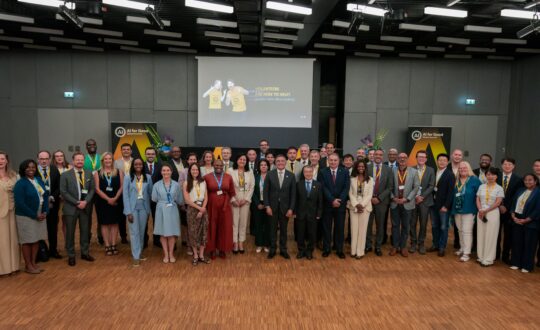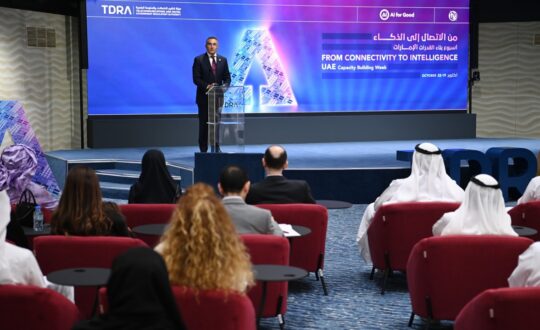



GENEVA, 9 July 2026 – International Girls in ICT Day 2026 was marked today by the Youth Zone at the AI for Good Global Summit 2026, under the theme “AI for Development.” Jointly organised by the International Telecommunication Union and the United Kingdom, the event brought together up to 60 Geneva-based girls for a day woven of inspiration and exchange.
Among the featured contributors were Flavia Donno, co-founder and vice president of Girls Can Code, and Tanvi Singh, CEO and co-founder of Ekta and treasurer of Girls Can Code, alongside other youth and tech leaders.
Mariette Awad, director of the Humans and Machines Lab, led the AIcademy workshop, “Build AI for your community,” which took a highly hands-on approach from the morning onwards. Participants worked in teams to identify a real-world challenge that affected daily life and used AI to help solve it directly.
Young people also took part in a more reflective discussion during the session, which ran three times throughout the day. The session, “What’s next in AI? Youth perspectives on global trends,” featured a rotating “popcorn-style” panel where youth stakeholders exchanged views on generative AI, education, ethics, and the future of work.
Questions about responsibility and design were the focus of the afternoon program. In “Privacy, trust, and responsible AI in education,” Andrew Sliwinski of LEGO Education and Ayah Bdeir, CEO of Current AI, investigated how schools, families, and technology providers could establish trust while safeguarding learners as AI became integrated into educational environments. In a related session, “Designing AI learning experiences for every learner,” Bo Stjerne Thomsen of LEGO Education and Dr. Joelyn de Lima of EPFL came together to investigate how the principles of designing for all learners could ensure that AI-literacy experiences were accessible, flexible, and meaningful across a variety of abilities and backgrounds.
The final Youth Zone panel of the day, “Guardrails and incentives: governing AI in public education without sacrificing learning,” concluded in a similar manner. Kieron John Kelly, global legal director at LEGO Education, and Ashley Carr, a partner at DLA Piper, deliberated on the minimum safeguards that should be regulated, the areas in which incentives should be implemented to promote innovation beyond conformance, and the ways in which AI could improve student learning and agency rather than supplant it.