

Artificial intelligence (AI) has the potential to transform telecommunications, from helping engineers solve complex network problems to making technical standards easier to navigate and apply. But realising this potential requires AI systems that can do more than generate answers: they must understand technical requirements, reason through engineering challenges and deliver reliable, verifiable results.
This is particularly important in telecommunications, where standards are fragmented across multiple organisations, span millions of pages and are continuously updated across releases. Answering a technical question correctly requires more than surface-level keyword matching by a large language model (LLM). It requires retrieving the right information from the right specification and release and generating an answer that remains faithful to the source. In an industry where a misinterpretation of a technical specification can compromise interoperability, trust is as important as accuracy.
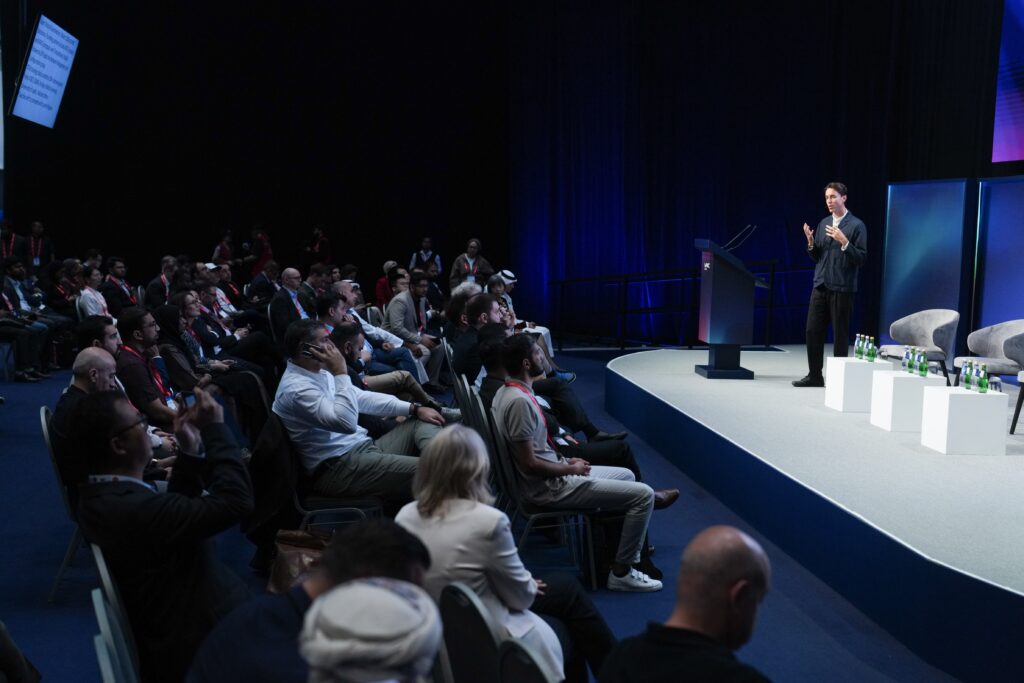
Louis Powell Director of AI Technologies at the GSMA
Against this backdrop at Mobile World Congress (MWC) Doha, the GSMA’s Open Telco AI initiative has announced two international competitions inviting telecom operators, AI researchers, developers and startups to advance the capabilities of AI for telecommunications.
Developed in collaboration with GSMA, ETSI, IEEE, ITU and Huawei, the challenges aim to accelerate the development of reliable, efficient and practical AI solutions that can help transform how telecommunications networks are designed, operated and managed.
Telco-Retrieve: Making telecommunications standards accessible to AI
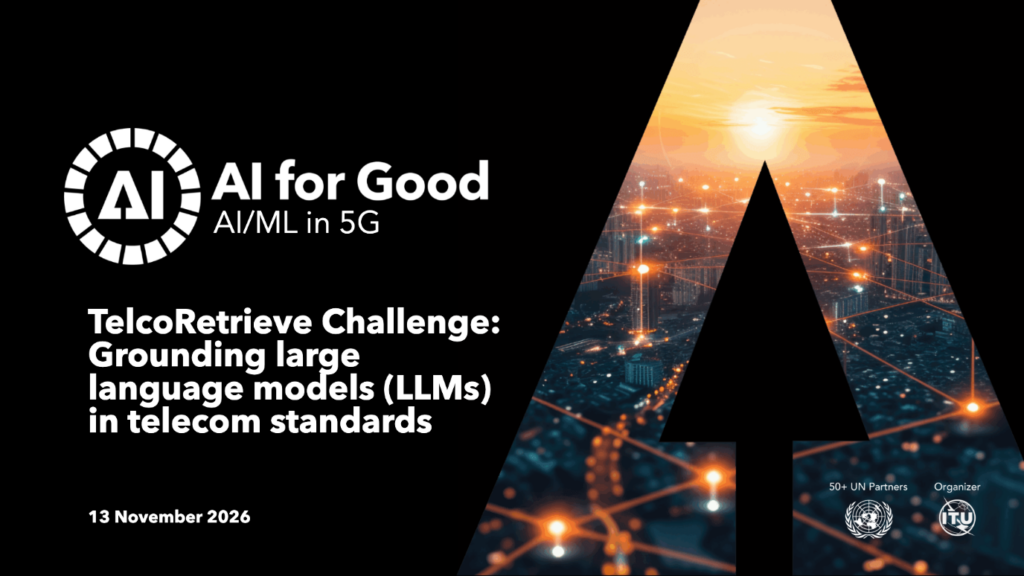
The GSMA-led Telco-Retrieve Challenge focuses on improving how AI systems find, retrieve and use information from technical specifications, white papers and industry reports.
Telecommunications knowledge is distributed across a broad ecosystem of standards organisations, including 3GPP, CAMARA, ETSI, GSMA, ITU, O-RAN and TM Forum. For engineers, locating the right information across these extensive and frequently updated document collections can be a time-consuming and challenging process.
Telco-Retrieve seeks to address this challenge through an open, vendor-neutral retrieval-augmented generation (RAG) pipeline that connects AI-generated answers to relevant technical source documents, with a particular focus on 3GPP specifications.
Participants will develop and evaluate their approaches using provided document collections, question sets and supporting resources. The objective is to advance systems that can retrieve relevant technical information accurately, generate reliable answers and trace those answers back to their original sources.
By making telecom standards easier to access and use, the challenge aims to help engineers and operators save time, reduce errors and accelerate the development and deployment of new products and services. Participants will compete for a €25,000 prize pool, with the opportunity to present their solutions at MWC27 Barcelona.
Watch the Telco-Retrieve Challenge challenge here.
AI Agents for RAN: Moving towards more autonomous network operations
While Telco-Retrieve focuses on making technical knowledge more accessible and reliable, the AI Agents for RAN Challenge explores how AI agents can apply reasoning and problem-solving capabilities to real-world radio access network (RAN) engineering tasks.
The challenge invites participants to build intelligent agents that can reason, use tools and investigate complex network scenarios through Giulia, an open-source radio network simulator developed by Universitat Politècnica de València (UPV).
Participants will tackle a range of practical engineering tasks, including Fault diagnosis and troubleshooting, Outage impact analysis, Radio coverage and configuration optimisation, Network site placement, Energy management.
Rather than simply generating recommendations, agents must investigate network conditions, test potential interventions and assess how proposed changes affect performance across the wider network.
This approach is an important step towards more autonomous radio network operations. By developing AI agents capable of reasoning through engineering problems and evaluating the consequences of their decisions, the challenge aims to help operators improve service reliability, reduce operating costs and deliver better customer experiences.
Discover the AI Agents for RAN Challenge, and ahead of the competition, GSMA, ITU and IEEE will host a dedicated webinar on 18 November 2026.
The session will introduce the challenge, demonstrate how participants can use the Giulia simulator to investigate network scenarios and test interventions, and explain how solutions will be evaluated. Participants will compete for a €30,000 prize pool, recognising innovative approaches to AI-driven network engineering and optimisation.
Join the AI agents for RAN challenge here.
Building trustworthy AI for the future of telecommunications

Louis Powell Director of AI Technologies at the GSMA
Both challenges reflect a growing need to move beyond experimental AI applications towards systems that can deliver measurable value in complex telecommunications environments.
For AI to be trusted in critical engineering workflows, it must demonstrate more than the ability to produce plausible answers. It must retrieve information accurately, reason effectively, operate efficiently and account for security considerations.
The judging criteria for both competitions will therefore assess participants’ solutions across key dimensions, including accuracy, efficiency, reasoning capabilities and security.
By providing shared resources, practical engineering use cases and verifiable evaluation frameworks, the challenges will help advance the development of reliable and efficient AI for telecommunications. They will also create opportunities for collaboration between operators, researchers, developers, standards organisations and technology providers.
Both competitions offer significant cash prizes and a platform for innovators from across the global telecom and AI communities to demonstrate their work. Winners will be recognised at a dedicated awards ceremony at MWC27 Barcelona, bringing together industry leaders, researchers and innovators to celebrate progress in telecom AI and explore opportunities for future collaboration.
As telecommunications networks become increasingly complex, AI will play an increasingly important role in how they are designed, optimised and operated. Ensuring that these systems are accurate, transparent and trustworthy will be essential to unlocking their full potential.
Through the Telco-Retrieve and AI Agents for RAN Challenges, the global telecommunications community has an opportunity to help shape that future.