
 Register here
At the India AI Impact Summit 2026, the International Telecommunication Union (ITU) convened governments, industry, civil society and multilateral partners to explore how artificial intelligence can be governed responsibly and deployed to deliver tangible benefits. Across the week, discussions centred on the standards, skills and partnerships required to turn technological progress into measurable public value.
A recurring outcome from the week was the growing importance of Edge AI, bringing intelligence closer to where data is generated and decisions are made. By moving compute from centralised cloud systems to devices, sensors and local infrastructure, Edge AI reduces latency, lowers energy consumption, strengthens privacy and enables faster, more resilient decision-making. For countries in the Global South in particular, it offers a pathway to deploy AI solutions even where connectivity is limited.
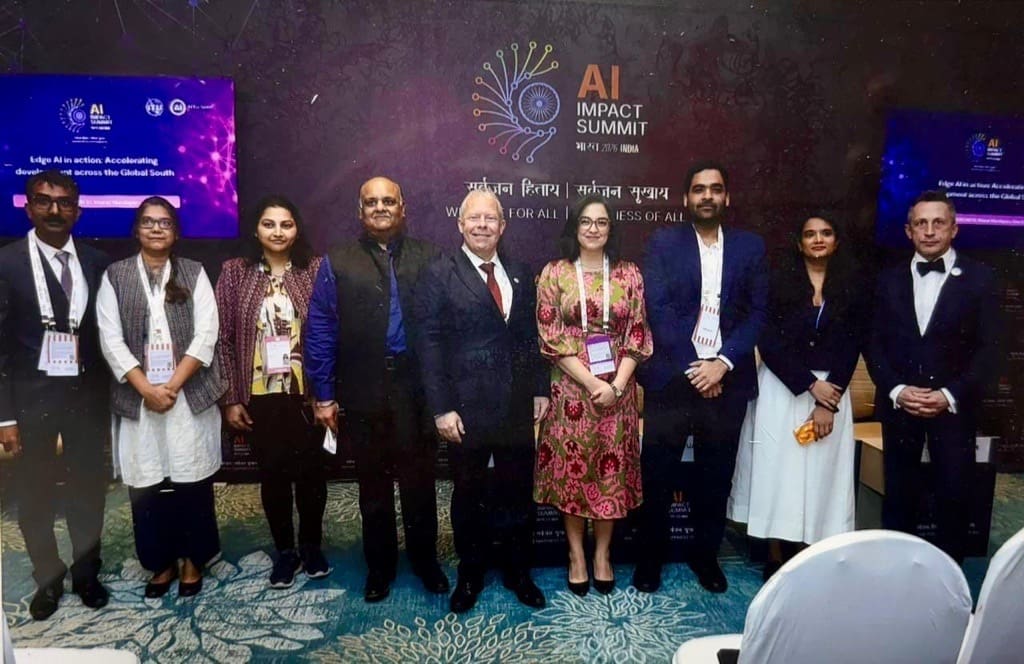
One of ITU’s official contribution to the Summit was its AI for Good session, “Edge AI in action: Accelerating development across the Global South”, which opened with remarks from Fred Werner. “What if the last thing that humans ever invent is invention itself? […] what if AI is the last thing that humans ever invent?” they began. “We need to make sure that AI, if it’s going to be for Good, it is indeed for good.”
Since the launch of AI for Good in 2017, the physical embodiment of AI has become increasingly visible: robotics, embodied AI, brain-computer interfaces, and even space computing. Yet the core question remains unchanged: “How can we unlock AI potential to serve humanity?” Through collaboration with more than 50 UN sister agencies, ITU continues to advance standards, strengthen cooperation around AI governance, and support practical applications of AI that respond to real societal needs.
In India, these ambitions were translated into action. A dedicated Edge AI build-a-thon brought together developers and researchers to design solutions for AI-enabled smart broadcasting and AI-native networks, contributing directly to the ITU Focus Group on AI Native Networks. The emphasis throughout was on practical deployment: how AI systems can function reliably, efficiently and responsibly in real-world conditions.
Technical perspectives reinforced this shift. Brejesh Lall, Professor in the Department of Electrical Engineering at Indian Institute of Technology, Delhi (IIIT Delhi), emphasised that “it’s important that the Global South focuses on building its strength in the area of Edge [AI].” They described Edge AI not simply as a deployment choice, but as a new paradigm for system design, one that requires coordination, robustness and predictable behaviour across distributed components operating at scale.
“Now AI is no longer a peripheral layer, but it is coming into the RAN […] enabled by the O-RAN ALLIANCE,” said Ranjitha Prasad, Assistant Professor at IIIT Delhi, outlining how federated edge learning architectures for 6G networks can enable scalable, low-latency and privacy-aware systems. Applications such as adaptive radio resource management, intelligent network slicing and collaborative security illustrate how distributed intelligence can reshape next-generation infrastructure.
The discussion moved quickly from architecture to application. In healthcare, Rathinamala Vijay presented ARTPARK, which demonstrated XR-assisted emergency response systems powered by 5G and Edge AI, allowing real-time transmission of patient vitals to medical experts during cardiac emergencies. This enables clinicians to guide first responders remotely, improving outcomes in time-critical situations.
In agriculture, Rootcode by Alagan Mahalingam showed how Edge AI can support small-scale farmers facing climate volatility and unpredictable yields. Its system combines hardware, software and AI models to analyse soil nutrients and monitor plant health locally. When deployed in regions of Sri Lanka with limited connectivity, the solution was redesigned using Edge AI, ensuring that farmers without reliable internet access could still benefit from the same intelligence available in more connected environments.
Across these examples, a common pattern emerged: Edge AI enables real-time, localised, energy-efficient intelligence, making it particularly suited to underconnected regions and resource-constrained environments.
Sakshi Gupta highlighted Qualcomm’s growing involvement in Edge AI across the Global South. The company is developing technologies that apply Edge AI to mobility and automotive systems, while increasingly extending these capabilities to IoT devices and smart glasses. “Latency, security, privacy, personalisation, low cost, low power are all very important factors for why Edge AI has become important for the Global South,” they said. Through its Tech for Good programme, Qualcomm partners with startups and small businesses worldwide, supporting the development of locally relevant Edge AI solutions.
Alongside technology, governance remains critical. H.E. Ms. Egriselda López of the Permanent Mission of the Republic of El Salvador to the United Nations Office, and co-chair of the Global Dialogue on AI Governance taking place this July in Geneva, stressed that “Edge AI means simply using AI closer to where things happen.” They underscored three priorities: keeping people at the centre of AI development, ensuring sustained support to close digital divides, and strengthening cooperation across national and regional frameworks to avoid fragmentation.
“The United Nations General Assembly has decided to convene a global dialogue on AI governance in Geneva, in direct connection with AI for Good,” explains Dr. Bilel Jamoussi, Deputy Director of TSB, ITU, to Swiss media channel Léman Bleu TV.
H.E. Mr. Rein Tammsaar, Permanent Representative of the Permanent Mission of the Republic of Estonia to the United Nations Office and co-chair of the Global Dialogue on AI Governance, highlighted the Dialogue’s role as a platform to align governments and stakeholders around practical outcomes. Held back-to-back with the ITU AI for Good Global Summit in July in Geneva, it will focus on actionable insights, alignment with existing UN processes, and clear thematic priorities, ensuring that global cooperation on AI translates into implementable results.
The week’s discussions point to a broader shift in how AI is conceived and deployed. Rather than concentrating intelligence in a few large, centralised systems, the future is increasingly distributed, local and problem-driven, designed around the needs of communities and the realities of their environments.
Discover the announcement made yesterday by Switzerland’s President Guy Parmelin that Switzerland will host the next World Summit on Artificial Intelligence in Geneva in 2027.