
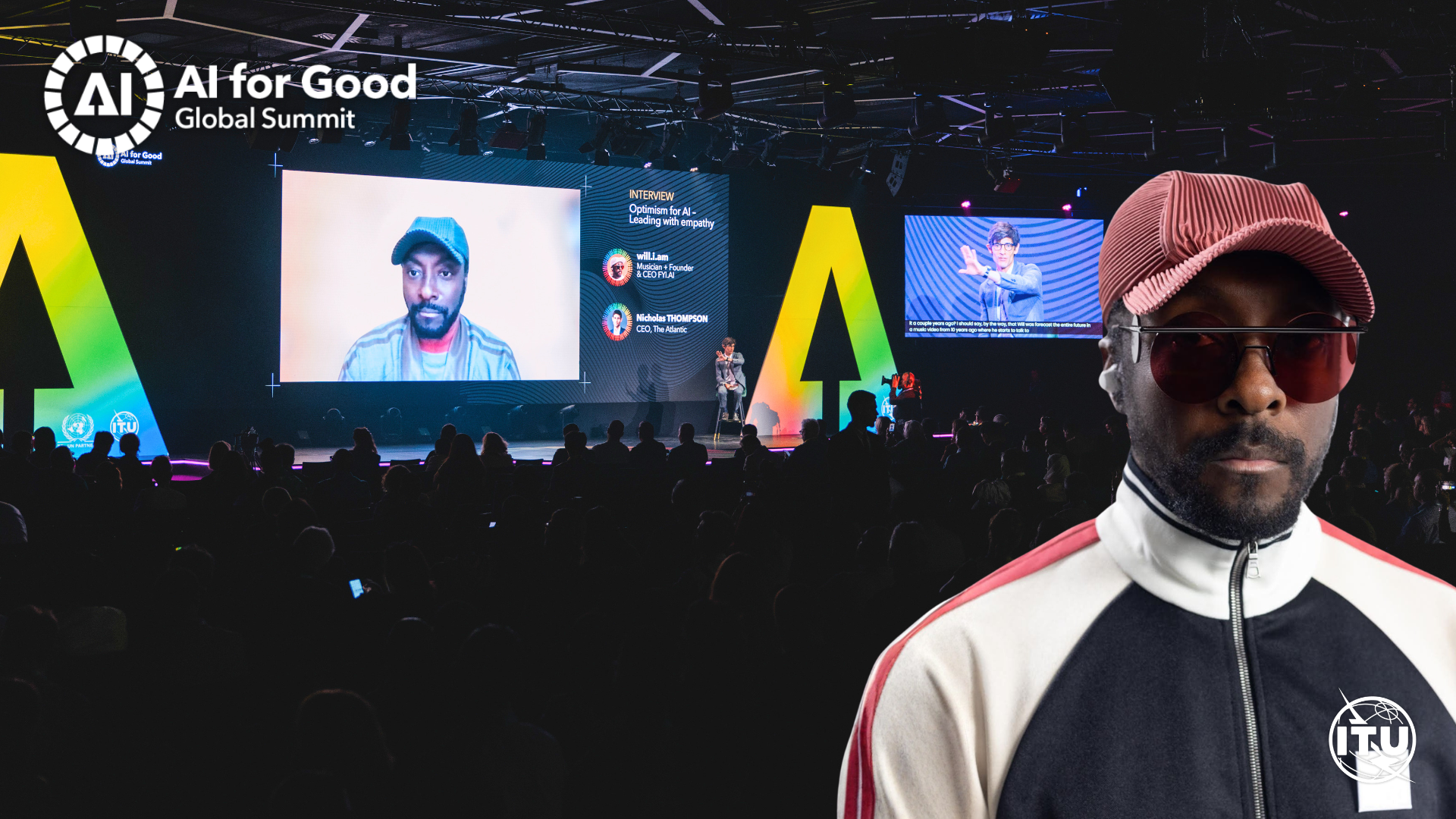
Discover how will.i.am is advancing AI education through the ITU’s AI Skills Coalition—and why he’s headed to the AI for Good Global Summit in Geneva this July.
Since stepping into his role as Goodwill Ambassador for the AI for Good AI Skills Coalition in 2025, will.i.am has been championing a simple but powerful idea: the future of AI shouldn’t be shaped by a select few, it should be open to everyone.
His role focuses on building momentum around one of the biggest challenges of our time: making sure people everywhere have the skills to participate in an AI-driven world. That means moving beyond conversation and into action. At the AI for Good Global Summit in Geneva this July, will.i.am is taking the centre stage to spotlight his work on AI education and the value of building key skills outside of traditional classrooms.
This work sits at the heart of the broader mission of AI for Good: ensuring that AI development benefits people everywhere, not just those already at the centre of the tech ecosystem.
What makes this especially important is the ripple effect AI education can have. When young people gain even a basic understanding of AI, it changes how they see their future. They move from simply using technology to shaping it, from consumers to creators. That shift can unlock new pathways into careers, entrepreneurship, and local innovation, giving communities the ability to solve their own challenges with tools that once felt out of reach.
With will.i.am as the Goodwill Ambassador of the International Telecommunication Union (ITU)’s AI for Good AI Skills Coalition, the programme is reaching tens of thousands of learners across the globe.
One of the clearest examples of this is the AI Skills Coalition’s work across Africa, supported by a $1 million grant from Google.org. The initiative is bringing AI and robotics training to young people in countries such as Ghana, Kenya, Nigeria, and South Africa, often in communities where access to digital tools is still emerging.
The future of AI and Mobility
Alongside skills, will.i.am’s work is increasingly intersecting with applied AI systems for the future of mobility. His three-wheeled ‘TRINITY’ demonstrates how AI can be embedded directly into mobility systems. The concept goes beyond traditional vehicle automation: it integrates conversational AI, real-time contextual awareness, and adaptive decision-making to create a more intuitive human–machine driving experience.
This aligns closely with the AI for Good mobility track, where AI-driven systems are being explored for safer and more adaptive urban transport, for intelligent routing and congestion reduction, human-centric in-vehicle AI assistants, and the broader transition toward AI-enabled mobility ecosystems. The AI for Good Global Summit “Mobility” track will feature Future Networked Car Symposium to explores how AI can reshape transportation, logistics, and intelligent systems in the physical world.
AI leadership and education
By connecting his leadership with applied AI systems, will.i.am’s involvement helps bridge a critical gap in the AI for Good ecosystem: moving from AI literacy and skills development into real-world deployment scenarios where AI interacts directly with physical infrastructure and daily life.
Alongside his global efforts, will.i.am is also helping rethink how AI is taught at the university level. At Arizona State University, he serves as a Professor of Practice within the ASU GAME School.
The GAME School — short for Global Arts, Media and Engineering — is designed around the idea that innovation happens at the intersection of disciplines. It brings together storytelling, design, engineering, and emerging technologies, giving students a space to experiment, build, and collaborate across traditional boundaries.
Students are leading their agent design process through the lens of ethics and inclusion. Every class session features conversations about ethical operations, how to establish guardrails, and eliminating bias.
His course, “The Agentic Self,” reflects that same forward-looking mindset. Instead of treating AI as a distant concept, students learn how to build and interact with their own AI agents, systems that can support creativity, decision-making, and productivity. It’s a practical way of understanding not just how AI works, but how it can be shaped and applied in everyday life.
This partnership also connects back to the wider Coalition: Arizona State University (ASU) was the first university to formally join the AI Skills Coalition, reinforcing the role that higher education can play in scaling AI skills globally.
will.i.am’s involvement doesn’t stop in the classroom or the lab. Through AI for Good events, he continues to contribute to conversations about the future of AI. His perspective stands out because it connects technology with creativity, culture, and human potential.
That perspective has been shaped by a career that spans music, entrepreneurship, and technology. From founding AI ventures to supporting STEAM education through his foundation, he has consistently focused on expanding access to opportunity. Now, through his work with the ITU and the AI Skills Coalition, that focus has taken on a global dimension and will be spotlighted during the AI for Good Global Summit this July.
At its core, this is about more than technology. It’s about access, inclusion, and who gets to help shape what comes next. As AI becomes a defining force in economies and societies, the question is no longer whether it will have an impact, but who will be prepared to take part.
Through initiatives like the AI Skills Coalition, and with voices like will.i.am helping to drive it forward, there is a growing sense that the future of AI can be more inclusive, more representative, and ultimately more empowering for people everywhere.