
 Register here
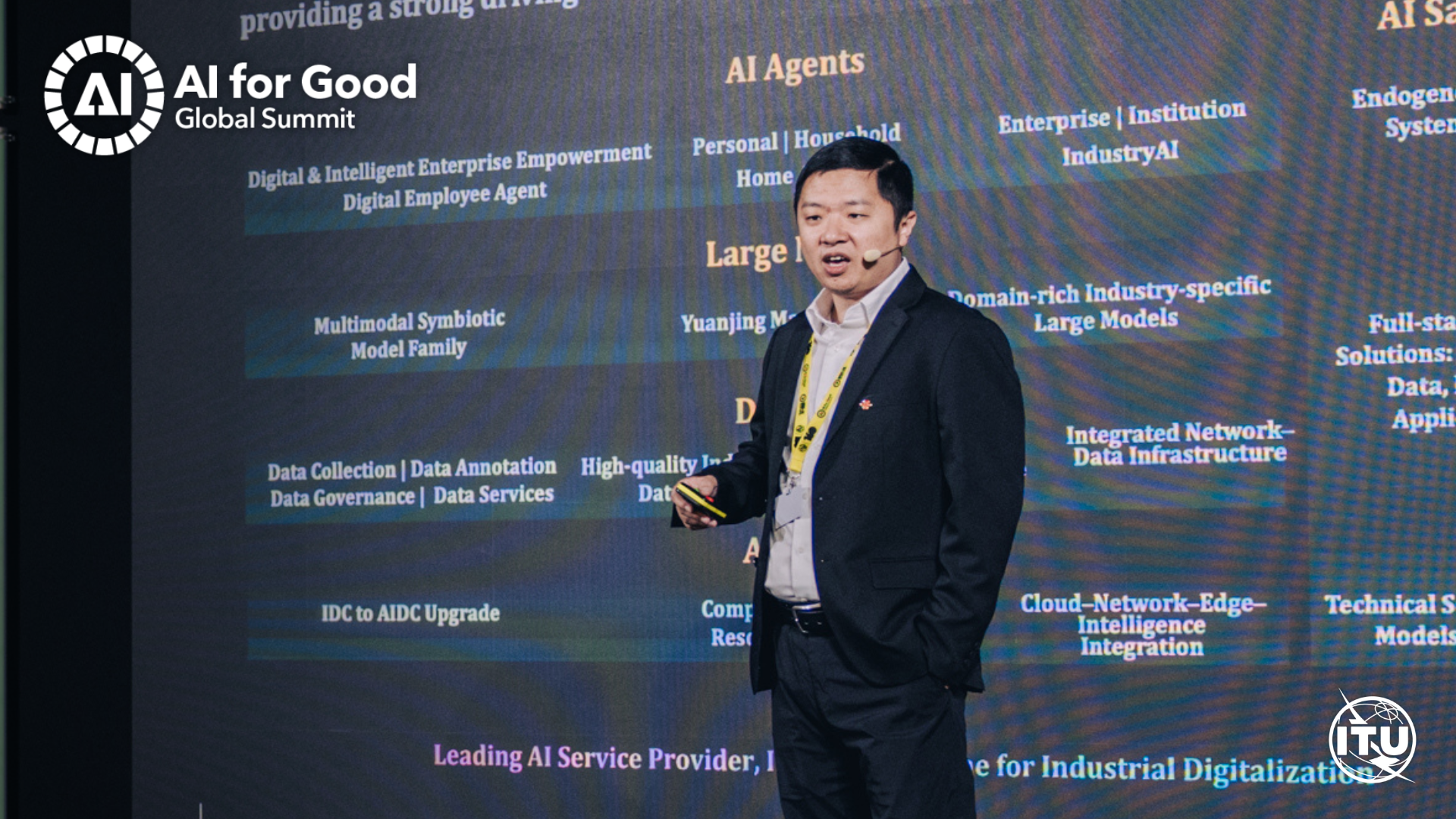
In a comprehensive presentation at the 2025 AI for Good Global Summit, Wang Kai, Vice Manager at China Unicom Data Intelligence Co., Ltd., outlined how the Yuanjing Large Model is fueling industrial digitalization across China. With a five-part AI framework and a growing portfolio of applications, the model is helping to streamline workflows, enhance public services, and power innovation in sectors from manufacturing to education.
Building an AI-powered ecosystem
As one of China’s top telecommunications operators, China Unicom is playing a central role in national efforts to build a digital economy. According to Wang, the company has established a “five-in-one” AI ecosystem. At its base is the AI infrastructure layer, which includes the AIDC, internal GPU resources, and a dedicated network for large model training and inference.
On top of this is a robust data layer, featuring over 400GB of data and a trusted data space designed to improve data trading and circulation. Then comes the model layer, with China Unicom’s proprietary Yuanjing Large Model at the core. The Yuanjing model family includes foundational and multi-modal models, supported by a MaaS (Model-as-a-Service) platform that enables users to adapt and deploy these models for practical use.
Wang also described three types of AI agents integrated into the system: digital employee agents for enterprise tasks, personal agents for household use, and industrial agents for sector-specific applications such as manufacturing, healthcare, or public services. A dedicated AI safety layer rounds out the ecosystem, incorporating safeguards such as internal protections and external guardrails to ensure safe deployment.
Making models usable, safe, and efficient
One of the system’s unique strengths lies in how it helps users interact with complex AI models. “The selection of the models is very critical for every application,” Wang explained, noting that many users are unsure which model best suits their goal, especially when faced with hardware constraints.
To address this, the team developed a model capability quantification method, essentially a selection guide that helps users match their needs to appropriate models. “It works just like the user manual,” he said.
Yuanjing also incorporates a technique called “difficult adaptive slow thinking” to improve computational efficiency. This approach enables models to give short, simple answers to simple questions, avoiding overthinking, while still preserving a full reasoning process for more complex queries.
“On average we have reduced the inference cost by 30%,” Wang reported.
To further support secure deployment, China Unicom created a safety enhancement and evaluation method for large models, offering an open-source benchmark and dedicated dataset to evaluate and improve real-world performance.
The MaaS platform includes tools for model selection, modification, and deployment, as well as “rack and agent” toolkits to help customize applications. Wang emphasized the open nature of the project, noting that users can download the open-source version from GitHub free of charge and without any restrictions.
Watch the full session here:
Real-world industrial applications
Wang then shared how Yuanjing is being applied across a wide range of sectors.
In telecom operations, the model is used to identify fraud in SMS messages. Although humans at China Unicom do not access message content, the model can detect potential fraud and send alerts to users, enhancing security while protecting privacy. Internally, the company also built an employee-facing app for easy access to company regulations, and tools to generate and edit documents and slides using AI.
Public service applications are equally diverse. For example, China’s well-known “12345” citizen hotline uses Yuanjing to automate the recording and routing of public complaints or requests. Previously, human agents had to manually record and dispatch each call; now, the large model handles both steps, reducing average processing time from 186 to 133 seconds.
In Sichuan province, a mobile app lets citizens take photos of emergency events and send them directly to authorities, thanks to an image-to-text function powered by Yuanjing. This has cut average response times from four working days to two.
In government planning, the model is already proving effective in predictive analytics. Wang cited an instance where Yuanjing successfully predicted the GDP figure for Beijing two months before the official announcement. The team shared the forecast with government officials, who were reportedly surprised when the final figure matched the prediction exactly.
In manufacturing, Yuanjing supports technicians working with large equipment. Instead of manually searching repair guides, workers can now describe a problem in plain language and receive troubleshooting help from the model. According to Wang, the system has achieved a recall rate exceeding 90 percent.
In the fashion industry, AI-generated clothing design is gaining traction. Designers can use prompts to generate visual concepts and modify them in real time, significantly reducing the time needed to bring ideas to life. The model is also used for quality inspection, precision measurement (like predicting the weight of rice kernels), and dynamic counting of products such as eggs or livestock. Over 200 enterprise clients are currently using Yuanjing for these types of industrial applications.
AI in education and culture
The Yuanjing model is also being deployed in academic environments. In one example, a university student used a prompt injection attack on the DeepSeek model embedded in a school app and managed to extract sensitive system keys. After this, the university replaced the system with the more secure Yuanjing model.
“With this Yuanjing model, we are able to provide a safer solution to the students,” Wang explained.
In cultural preservation, Yuanjing is being used to reimagine traditional Chinese heritage in more accessible and engaging ways. One exhibit at the China Unicom booth allowed visitors to generate images or videos of themselves in traditional attire or stylized historical settings. According to Wang, the model was used to transform cultural references into visual characters that resonate with a modern audience.
Toward collaborative digital transformation
In closing, Wang emphasized that the model is more than a technical tool, it’s a collaborative platform for building the future of digital infrastructure. Yuanjing is being used to enhance customer apps, facilitate smart government services, assist design and decision-making, and ultimately, to “boost the industrial digitalization with large models.”
“We at China Unicom would like to collaborate with our partners, to boost the industrial digitalization with large models” Wang concluded.