
 Register here
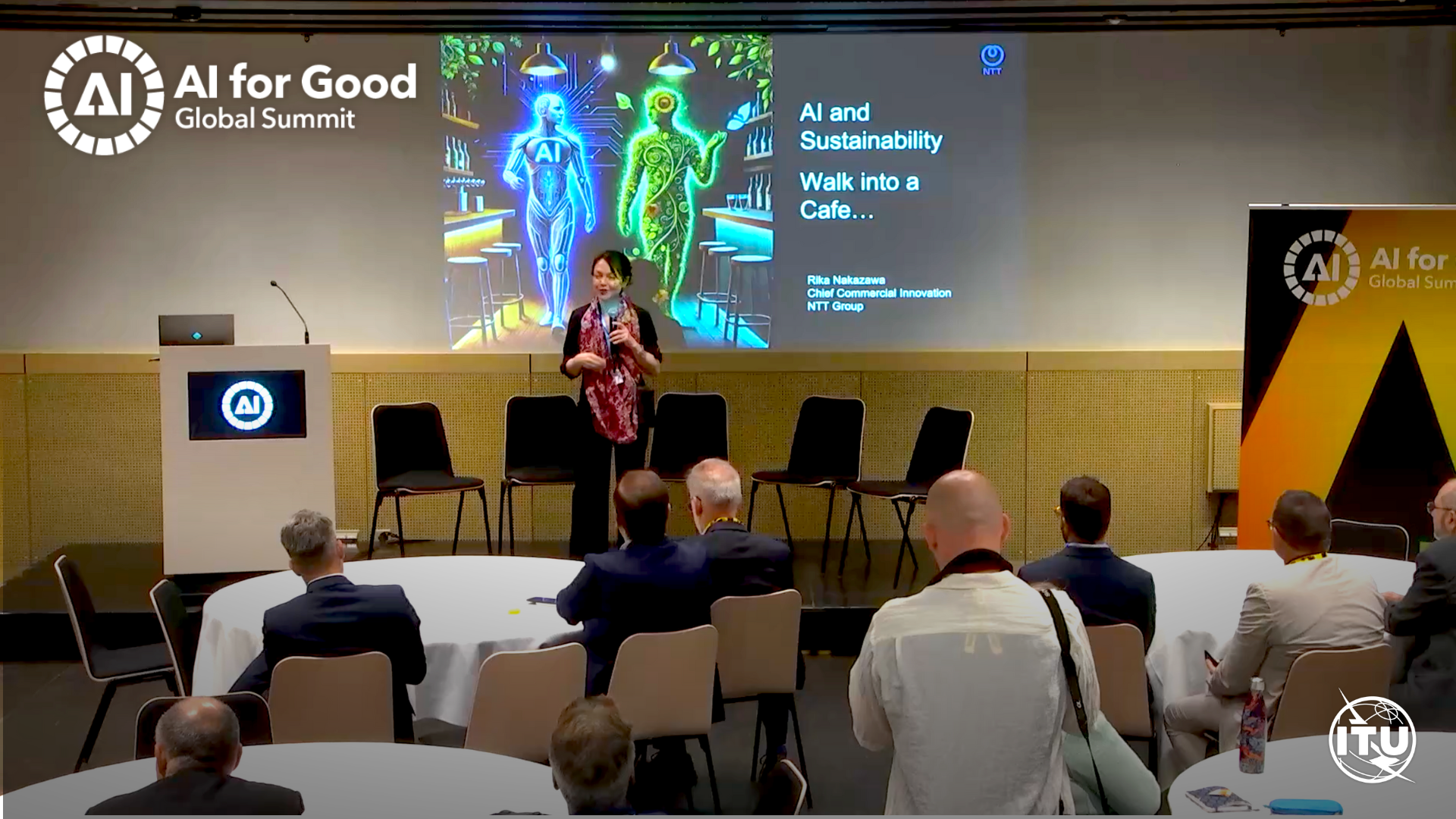
At the 2025 AI for Good Global Summit, a panel of experts gathered to explore the evolving relationship between AI and sustainability during a session organized in partnership with NTT DATA. The workshop brought together representatives from the International Telecommunication Union (ITU), NTT DATA, the Green Software Foundation, the UNFCCC, and UNV. Speakers shared insights on how AI technologies, network innovation, and space-based systems are shaping a future where environmental stewardship and digital transformation can progress hand in hand.
Seizo Onoe, Director of the Telecommunication Standardization Bureau at ITU, opened the discussion by underscoring the role of AI in tackling global sustainability challenges. He explained that AI enables the analysis of vast amounts of data in real time, particularly satellite imagery, which has become a crucial resource for understanding Earth’s processes. He also highlighted the importance of AI in improving energy efficiency and optimizing renewable energy use. Onoe emphasized the ITU’s role in developing standards that guide these efforts.
“Our standards also provide climate impact metrics and measurement methods to keep us on the right track for more transparent reporting,” he said.
Mario García, Global Head of UN Accounts at NTT DATA, outlined the session’s flow noting that the workshop would address satellites, photonics, and space-based data centers, as well as case studies from UN agencies.
Exploring AI, photonics, and space-based innovation
Rika Nakazawa, Chief of Commercial Innovation at NTT, examined the intersections of AI, sustainability, and advanced infrastructure. Drawing on her experience in the technology sector, she connected the acceleration of digitalization during the pandemic with a heightened awareness of sustainability. She described how data centers are increasingly recognized as critical infrastructure, essential for advancing AI yet also major consumers of energy. Addressing this tension, she outlined NTT’s efforts in photonic computing through the Innovative Optical and Wireless Network (IOWN) initiative, which aims to reduce energy consumption by replacing electronic systems with optical systems. “We expect that the energy consumption will be one hundredth of what it is today,” she said, pointing to a roadmap of developments expected by 2032.
Nakazawa also highlighted NTT’s work in space, particularly through Earth observation satellites and the creation of high-resolution digital twins for climate resilience. She noted the importance of partnerships in the satellite ecosystem and described new approaches for distributing computation in orbit to reduce the burden on terrestrial infrastructure. In closing, she reflected on the symbolic framing of the session title:
“I think one of the things that we have to think about is can AI and sustainability coexist, can they be copacetic, can they walk into a café and not get into a fist fight and actually sit down, maybe fall in love?”
Sustainable IT and measuring impact
Gadhu Sundaram, Chairman of the Green Software Foundation, shifted the conversation from space back to Earth, focusing on the sustainability of AI itself. He outlined NTT DATA’s approach to integrating sustainability into all aspects of its operations, from applications and cloud services to hardware and data centers. Central to this effort is the ICT carbon calculator, a tool designed to provide near real-time feedback on the environmental impact of digital services. Sundaram stressed that leadership accountability is embedded across the organization through sustainability KPIs for all executives. “We treat ourselves as client zero,” he explained, noting that by implementing sustainability at scale internally, NTT DATA can better support its clients.
He also highlighted initiatives such as liquid immersion cooling in data centers, remote GPU services to reduce energy consumption, and the development of Suzumi, a large language model designed with low energy use in mind.
“The greenest application is the one that you did not build,” Sundaram said, emphasizing the importance of efficiency in software design.
Watch the full session here:
Data and diplomacy at the UNFCCC
The session then turned to concrete use cases from the United Nations. Joaquim Barris, Data Lead in the Mitigation Division of the UNFCCC, described how AI is being applied to manage the vast amount of political, diplomatic, and climate-related data handled by the organization. From transcribing negotiations to generating scenarios, AI tools are helping to structure and analyze information more effectively.
“What we are doing is to extract information, typify this information, and then start to analyze, creating databases of information,” Barris said.
James Grabert, Director of the Mitigation Division at the UNFCCC, added that AI has the potential to make global climate negotiations more efficient and inclusive. He emphasized the importance of supporting developing countries, which often lack the capacity to process information as quickly as wealthier nations.
“We can’t afford to have that kind of loss in time going forward, these processes have to be much more efficient,” Gravit explained.
Harnessing AI for volunteer management
Frederic Le Maistre, Chief Information Officer at United Nations Volunteers (UNV), shared how AI is being used to improve volunteer coordination. With thousands of volunteers working worldwide, AI systems help match individuals with opportunities and streamline management. He pointed out that this enhances the ability of UNV to respond to global challenges and also highlighted that “we need to ensure that our volunteers are placed in the right roles at the right time.”
Strategic directions for AI and sustainability
The discussion then shifted back to NTT DATA, where Abhishek Sakhuja, Chief AI and Data Officer, spoke about the company’s broader AI strategy. He described efforts to align technological innovation with sustainability goals, including the development of AI systems that prioritize efficiency and resilience, looking at how AI can both optimize internal operations and support clients in their sustainability journeys. Alfonso Medrano, Head of Global Sustainability Business Development Strategy at NTT DATA, reinforced this message by pointing to the company’s partnerships and ecosystem approach. He noted that collaboration across industries and institutions is essential to scale solutions effectively; and that sustainability is not something that one company can achieve alone, but that it requires a collective effort.
The session concluded with a recognition that AI and sustainability are not opposing forces but interdependent elements of future progress. Covering the topics of satellite-based Earth observation and photonic networks to responsible software practices and inclusive diplomacy, the panel illustrated a wide spectrum of innovation. As Nakazawa observed, quoting Albert Einstein, “We still do not know one thousandth of one percent of what nature has revealed to us.” The sentiment captured the panel’s central message: that AI must evolve not only as a technological breakthrough but as a partner in humanity’s stewardship of the planet.