



Delivered in partnership with the Microsoft AI for Good Lab, this session will provide an update on the Early Warning Connectivity Map (EWCM) jointly developed by ITU, Microsoft, Planet Labs, and IHME. It will present an impact-driven narrative grounded in real-world implementation, drawing on experiences from Ethiopia and/or Liberia to demonstrate how the tool is translating data into tangible outcomes on the ground. The discussion will combine country-level perspectives with key partnerships – including the telecom and GSMA connectivity perspective – to link connectivity insights to broader challenges related to population growth, planning, and resilience, with a strong emphasis on measurable and demonstrated impact. Hosted by the AI Sub-Group of the EW4All initiative, this 20-minute panel will bring together policymakers, technologists, humanitarian actors stakeholders to explore how AI-driven connectivity intelligence and partnerships can strengthen people-centred early warning systems. The session will highlight the EWCM as a practical, scalable solution that transforms complex datasets into actionable insights for governments and partners, showing how AI, cross-sector collaboration, and national capacity-building are expanding early warning reach and helping ensure that no one is left behind. Session objectives: Showcase innovation: Present the Early Warning Connectivity Map as a concrete example of how AI and geospatial data can close critical gaps in early warning systems. Demonstrate impact: Highlight tangible, country-level outcomes from EWCM implementation, including regulatory engagement, capacity building, and decision-making informed by the data. Strengthen partnerships: Illustrate the value of cross-sector collaboration between the UN, private sector, governments, and the research community. Inspire scale-up: Encourage replication and expansion of AI-enabled connectivity mapping to support EW4All objectives and broader policy, development and planning use cases.




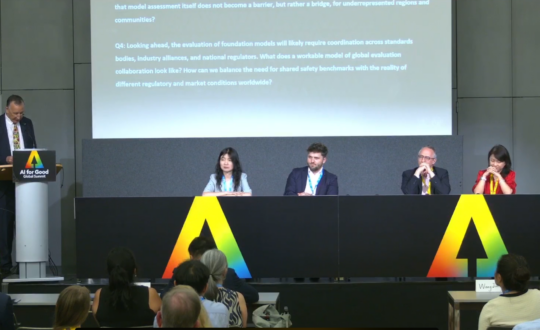
Building shared standards for foundation model evaluation
As foundation models become more capable and increasingly embedded across industries and public services, evaluating them is becoming both more...
AI for Good | Global Summit
Brain-computer interface: Toward Shared Standards for a Global Industry
During the AI for Good Global Summit 2026, the workshop "Brain-Computer Interface: Technology for Good and Application Cooperation" gathered scholars,...
AI for Good | Global Summit
Ubiquitous, Open, Accountable, Inclusive: What It Will Take to Bring...
Despite the rapid expansion of mobile connectivity, significant gaps in access remain. Closing those gaps and ensuring that advances in...
AI for Good