
 Register here
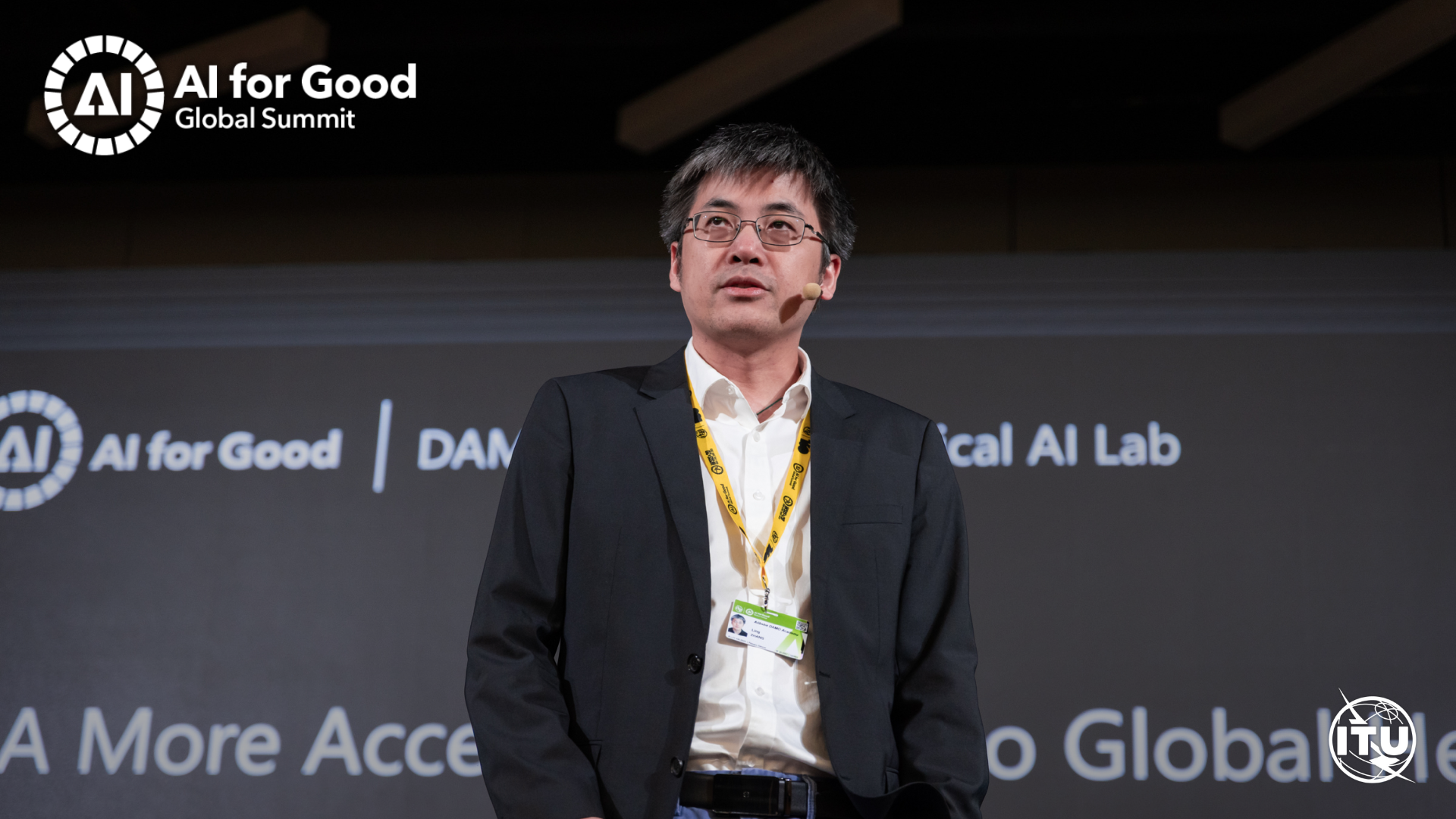
At the 2025 AI for Good Global Summit, Ling Zhang, Senior Technical Expert and Lead of Multi-Cancer Screening Technology at Alibaba DAMO Academy Medical AI Lab, shared a detailed presentation on the lab’s recent advancements in AI-powered medical imaging. The focus: using non-contrast computed tomography (CT) scans and deep learning to enable large-scale, accurate, and accessible screening for multiple diseases.
Addressing the limitations of traditional screening
Zhang opened with a sobering observation: while mortality rates for heart disease are falling, cancer mortality remains stubbornly high. Early detection is one of the most effective ways to improve outcomes, yet many cancers lack widely recommended screening protocols.
Zhang noted that only four types of cancer currently benefit from guideline-supported screening, even though nearly 70 percent of cancer-related deaths stem from cancers that lack such protocols. These include gastric, liver, esophageal, and pancreatic cancers. In this context, DAMO Academy’s AI research seeks to extend diagnostic coverage to underserved cancer types through scalable, non-invasive tools.
DAMO PANDA: AI screening for pancreatic cancer
A major breakthrough came with the development of DAMO PANDA, a deep learning model trained to detect pancreatic cancer using non-contrast CT scans. The model was introduced in a 2023 Nature Medicine paper and later received the FDA’s breakthrough device designation.
Pancreatic cancer is notorious for its poor prognosis. It has a five-year survival rate of less than 10 percent and a surgical resection rate under 20 percent. Its low prevalence – only 11 cases per 100,000 people – makes population-wide screening extremely difficult. Effective tools require exceptionally high specificity to avoid large numbers of false positives.
Researchers at DAMO Academy validated DAMO PANDA on a dataset of 30,000 patients and a real-world cohort of 20,000 individuals across four clinical scenarios: physical examination centers, emergency departments, inpatient settings, and outpatient visits. DAMO PANDA achieved a sensitivity of 92.9 percent and a specificity of 99.9 percent. Zhang emphasized the significance of this metric:
“Among 1000 tests of healthy individuals, only one would be a false positive,” he explained.
The model has already been deployed in hospitals across China, where over 70,000 patients have been screened. In one case, a 75-year-old woman underwent a routine CT scan during a physical exam. Her tumor markers were only slightly elevated, and most were within normal range. DAMO PANDA identified a 76 percent probability of pancreatic cancer. Follow-up contrast-enhanced imaging confirmed a tumor in the pancreatic head. Surgical resection revealed a malignant portion measuring only one millimeter, an exceptionally early-stage detection.
Watch the full session here:
Another case involved a 33-year-old woman who was alerted by DAMO PANDA during an emergency department visit for pneumonia. The model flagged a 100 percent probability of cancer. Imaging confirmed a 38 mm tumor and subsequent surgery identified carcinoma in situ. Zhang highlighted this case as an example of life-altering early detection made possible by AI.
DAMO GRAPE: Extending screening to gastric cancer
DAMO Academy also developed DAMO GRAPE (Gastric Risk Assessment Procedure with AI), a model for gastric cancer screening using non-contrast CT scans, a domain traditionally reserved for endoscopy. Zhang acknowledged that CT imaging for gastric cancer had long been considered ineffective. Nevertheless, DAMO GRAPE challenged this assumption and demonstrated meaningful results.
The model was trained on a dataset of 100,000 patients from 20 medical centers, including 10,000 confirmed gastric cancer cases. DAMO GRAPE segments gastric cancer regions and assesses cancer probability with a sensitivity above 80 percent and specificity of 97 percent.
In retrospective validation at one hospital, DAMO GRAPE classified 6 percent of patients as high risk. Of those, 24 percent were ultimately diagnosed with gastric cancer. Zhang also presented a case where DAMO GRAPE flagged a 67 percent risk six months prior to clinical diagnosis, which later rose to 99 percent, demonstrating the model’s ability to detect cancer before it becomes symptomatic.
DAMO iAorta: Rapid diagnosis for acute aortic syndrome
Beyond cancer, DAMO Academy developed DAMO iAorta, an AI model designed to detect acute aortic syndrome (AAS) from non-contrast CT scans. While contrast CT is already the gold standard for AAS detection, it is typically used only when there is a high index of clinical suspicion. DAMO iAorta aims to integrate screening into broader clinical workflows.
In a prospective clinical trial, 15,584 patients presenting with chest pain received non-contrast CT scans. DAMO iAorta helped radiologists identify 21 AAS cases, achieving a sensitivity of 95 percent and a negative predictive value of 99.9 percent.
One example involved a patient admitted with abdominal pain. DAMO iAorta flagged a potential issue, prompting further tests that confirmed a Stanford type B aortic dissection. The diagnosis was made just 94 minutes after hospital admission, an instance of AI accelerating care delivery in acute settings.
Toward multi-disease detection
Building on these case-specific advances, Zhang outlined the lab’s broader vision: expanding AI detection capabilities across six cancers, three acute conditions, and four chronic diseases, all through a single non-contrast chest or abdominal CT scan.
“Our solution enables non-invasive, accessible and highly accurate detection of various diseases through a single, non-contrasted chest or abdominal city scan,” Zhang explained.
DAMO Academy is also working with partners globally to pilot and scale these technologies. Collaborations are underway in Singapore, Japan, Saudi Arabia, New Zealand, the United States, and Antigua and Barbuda.
He concluded by emphasizing the lab’s mission to bring AI-powered medical imaging into real-world healthcare systems.
“We hope that these innovative medical AI technologies can benefit all of humanity,” Zhang said.
A pathway to broader impact
Through models like DAMO PANDA, DAMO GRAPE, and DAMO iAorta, Alibaba DAMO Academy demonstrates how targeted deep learning applications can transform disease detection, improve health outcomes, and expand access to care. The ability to screen for multiple diseases in a fast, cost-effective, and non-invasive way has significant implications for global health systems, especially in areas with limited resources.
By lowering the technical and clinical barriers to high-accuracy diagnostics, DAMO Academy’s work paves the way for broader adoption of AI in routine screening and acute care. Its focus on real-world deployment – validated through clinical trials, regulatory recognition, and cross-border collaboration – suggests a maturing AI ecosystem ready for scale.
As Zhang’s presentation made clear, the convergence of AI, imaging, and global health goals is no longer speculative. It is happening now, and its potential impact is just beginning to unfold.