
 Register here
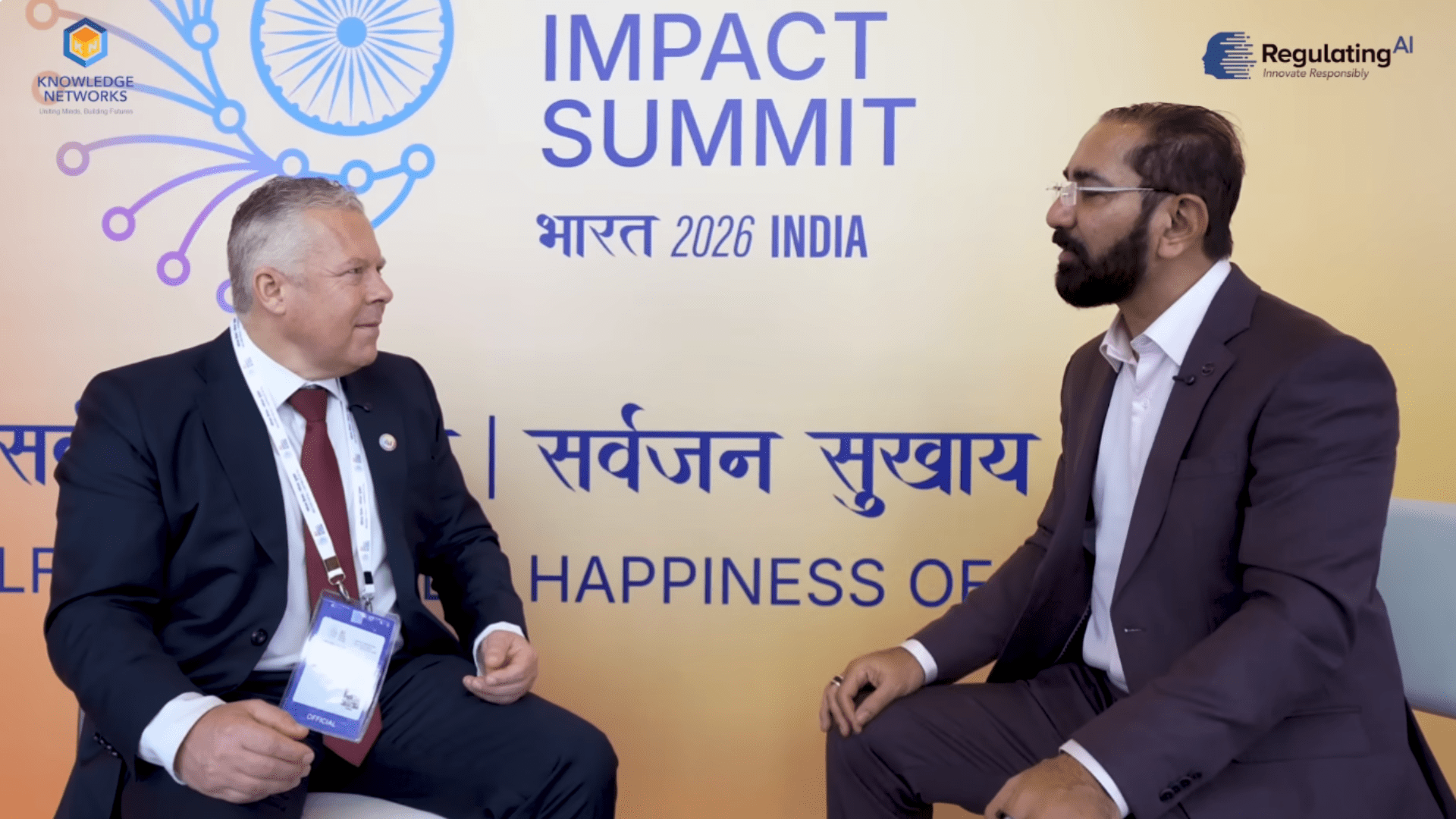
As Artificial Intelligence accelerates from research labs into daily life, the question is no longer whether AI will transform society, but how. Few people sit at the intersection of technology, policy, and global development quite like Fred Werner, Chief of Strategic Engagement at the International Telecommunication Union (ITU). As the driving force behind the United Nations’ AI for Good Global Summit, Werner has also helped build a global network and community of more than 55,000 members across 180 countries, all focused on harnessing AI to serve humanity. He sat down with Sanjay Puri at the India AI Impact Summit 2026 in New Delhi for the Regulating AI podcast to talk about why the Global South’s participation in AI for Good is vital to ensure AI drives innovation, equity, and societal benefit.
AI is evolving at breakneck speed. What began as traditional machine learning for predictions and recommendations has rapidly expanded into generative AI, AI agents, robotics, brain-computer interfaces, embodied AI, and even space-based AI computing. In what many now call “AI years,” nearly a decade can feel like a lifetime.
Against this backdrop of relentless innovation, one message is becoming clear: AI is too important to leave to the experts alone.
That’s the core philosophy behind the AI for Good movement led by the ITU, the United Nations agency for digital technologies. Through its AI for Good platform, the ITU brings together governments, private companies, academics, UN agencies, and civil society to ensure AI is developed and deployed responsibly, and in ways that advance sustainable development.
From safety to impact: The global AI conversation evolves
Since its launch in 2017, AI for Good has tracked the evolution of AI from early machine learning systems to the explosion of generative AI in 2023 and the recent rise of AI agents. Alongside these advances, global summits have reflected shifting priorities in the AI debate.
“In the early days, the conversation was dominated by safety concerns,” says Werner. “At gatherings such as the AI Safety Summit in the UK, governments focused heavily on existential risks and guardrails. In subsequent meetings in Korea and France, the emphasis shifted toward innovation, investment, and competitiveness. Now, at major summits in the Global South, such as recent events in India and Africa, the conversation is pivoting toward impact. The pendulum swings between optimism and caution, between innovation and regulation. But AI for Good has tried to remain steady in its mission: focus on practical solutions that address real-world challenges, especially in underserved regions.”
Why the Global South matters
For years, AI policy discussions have largely centred on the United States, China, and the European Union. Yet emerging economies are increasingly asserting their voice.
Countries in Africa, South Asia, and Latin America are not just passive recipients of AI technologies, they have the opportunity to chart their own paths. In fact, history shows they can leapfrog legacy systems entirely.
“Consider the mobile payment revolution in East Africa. Without building decades of expensive financial infrastructure, countries like Kenya created world-leading mobile money systems that transformed access to financial services. The lesson? When local ingenuity meets accessible technology, transformative change can happen fast. AI could follow a similar trajectory – if deployed thoughtfully. But it won’t happen automatically. Simply putting powerful AI tools into people’s hands does not guarantee positive outcomes. Access must be paired with skills, standards, and safeguards,” says Werner.
AI is too important to leave to experts
One of the most striking ideas emerging from global AI discussions is that AI governance must be inclusive. Even AI experts themselves acknowledge that the technology’s societal impact is too vast to be decided in technical silos.
The ITU model reflects this inclusivity. It is the only UN agency with a public-private membership structure. Its ecosystem includes 194 member states, over 1,000 private sector companies (from telecoms to AI developers), more than 150 academic institutions and more than 50 UN sister agencies.
“This multi-stakeholder model matters because AI is no longer just a technical issue. It is geopolitical, economic, cultural, and deeply human,” Werner comments. “Bringing diverse voices to the table, especially from the Global South, ensures that AI standards and policies reflect a wider set of realities and priorities.”
Closing the AI skills gap
If there is one issue that leaders across regions agree on, it is the urgent need to address the AI skills gap. While countries may disagree on how to balance regulation and innovation, few dispute that education systems are unprepared for the AI era.
Through the AI Skills Coalition, AI for Good has partnered with over 70 organisations to offer nearly 200 online AI courses in 13 languages. These programs target everyone, from schoolchildren to diplomats to PhDs.
The message is clear: in the age of AI, everyone must become a lifelong learner, and be taught how to use AI tools responsibly, understanding ethics, safety, inclusivity, sustainability, and human rights implications. These values are not “default settings.” They must be learned and embedded into practice. Without this educational transformation, AI risks deepening inequality rather than reducing it.
Jobs, disruption, and the dual nature of AI
AI’s impact on jobs is one of the most contentious issues in global debates.
On the optimistic side, AI can serve as a creative multiplier. Instead of using AI to produce more of the same, more emails, more reports, more repetitive outputs, individuals and organizations can use it to create entirely new products, services, and industries.
This echoes a broader challenge: will we use AI as a crutch to scale existing routines, or as a catalyst to invent what never existed before?
On the more cautious side, early labour data shows troubling signs. New graduates in some sectors are facing fewer job opportunities. Some analysts attribute this to post-pandemic hiring corrections. Others believe AI automation is already playing a role.
Even more concerning are findings from the International Labour Organization (ILO), which suggest that in developing countries, women’s jobs may be disproportionately affected by AI-driven automation.
This duality, opportunity and disruption, defines the AI era. The transition will likely be uneven and bumpy. Policymakers must anticipate both the upside and the social shocks.
The case for sovereign AI
As AI becomes central to national security, economic growth, and cultural identity, many countries are exploring the concept of “sovereign AI.”
Sovereign AI refers to the ability of nations to control their own data, develop localised AI systems, and avoid total dependence on foreign proprietary models.
For developing countries, this is both a strategic and economic question. Relying solely on a handful of expensive, proprietary AI systems may not be sustainable, or aligned with local values and needs.
This is where open-source AI enters the discussion.
Open-source models can democratise access, accelerate innovation, and increase transparency. They allow more developers to inspect, improve, and adapt systems to local contexts. For the Global South, cost and accessibility make open source particularly attractive.
Yet open systems carry risks. If anyone can use the code, it can be misused. Security vulnerabilities, malicious applications, and ethical blind spots are real concerns.
The solution likely lies in balance: combining open collaboration with strong international standards and multistakeholder collaboration.
The power of standards
Standards may not grab headlines, but they are foundational to global technology ecosystems.
Technical standards ensure interoperability across devices, borders, and platforms. They embed safety and security requirements directly into system design. They provide common reference points for governments and industry.
In a fragmented world, shared standards can prevent digital divides from widening further.
For emerging economies, participating in standard-setting processes is critical. If they are not at the table, their needs may not be reflected in global norms.
A message to global leaders
With heads of state and ministers increasingly attending AI summits, political attention on AI is unmistakable.
The central takeaway for leaders is not simply to regulate or to innovate faster. It is to invest deeply in human capital.
If AI is going to reshape economies, education systems must be reimagined. If automation will displace certain roles, reskilling must be proactive, not reactive. If AI will become embedded in daily life, digital literacy must extend across generations.
The AI skills gap is not a technical issue, it is a societal one.
In the coming years, the countries that thrive will not necessarily be those with the largest models or the fastest chips. They will be those that empower their people to understand, shape, and responsibly deploy AI.
AI is moving too fast for any single actor to control. But through collaboration, inclusive governance, and a relentless focus on education and impact, it can be steered toward serving humanity.
The future of AI will not be decided solely in Silicon Valley, Beijing, or Brussels. It will also be shaped in Nairobi, New Delhi, São Paulo, and beyond.
And whether AI becomes a force that widens divides or bridges them will depend less on the technology itself, and more on the collective choices we make today.