

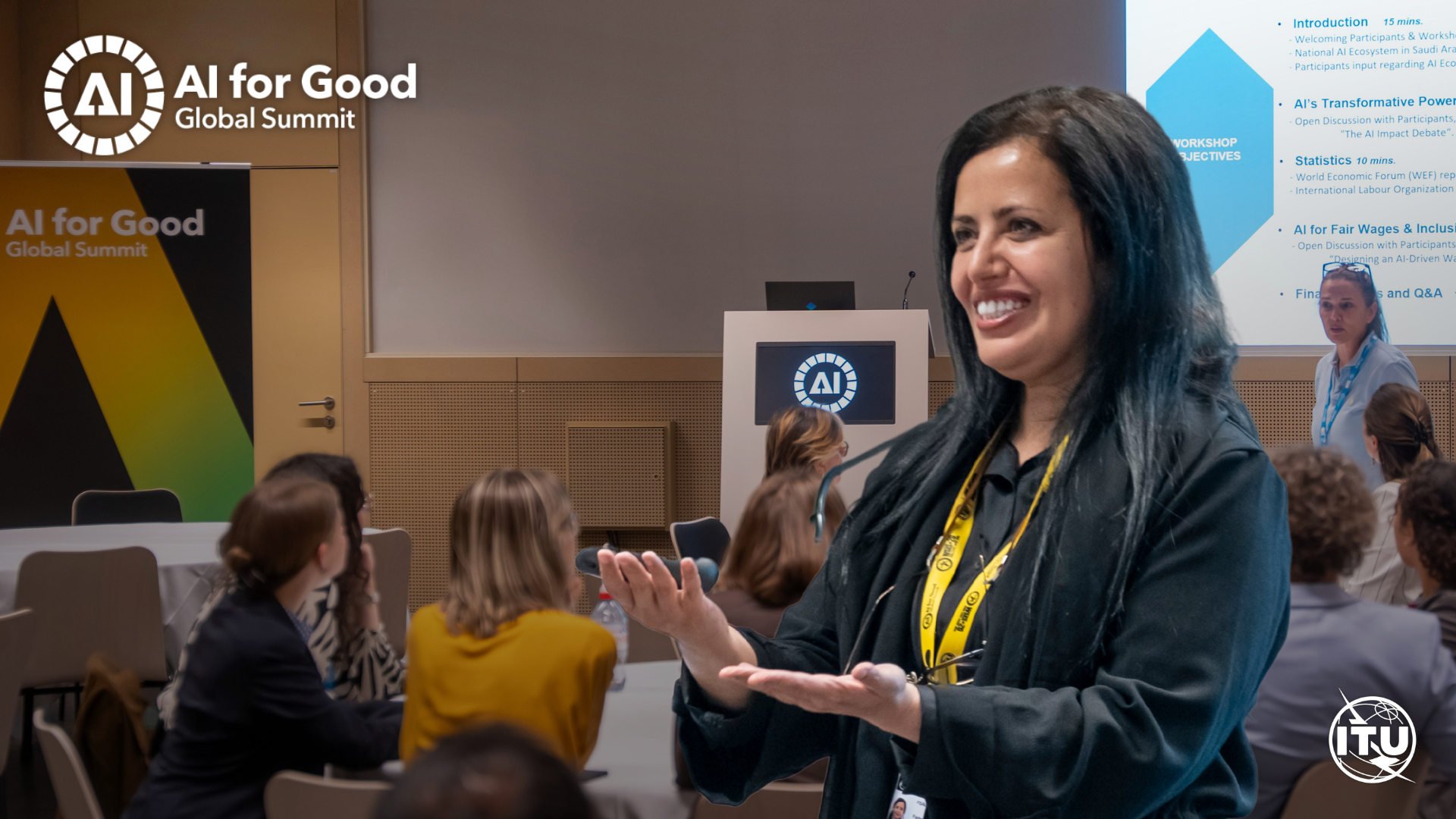
At the 2025 AI for Good Global Summit, the workshop From data to decisions: using AI to boost productivity and fair wages, organized in partnership with Fadwa AlBawardi Consulting Office (FSAB), explored how AI can raise productivity and improve working conditions while promoting fair compensation. Led by Fadwa Saad AlBawardi, Founder and CEO of the Fadwa AlBawardi Consulting Office (FSAB), the session combined framing remarks with a structured debate and a policy simulation to turn data into decisions for wage equity and inclusive growth.
As AI reshapes industries worldwide, ensuring its benefits extend to fair wages and inclusive growth remains a pressing challenge. Therefore, AlBawardi set the aim plainly: use AI to create new job opportunities, support economic stability, and enhance job quality, while facing the challenges automation brings. Throughout the session, the emphasis was on practical choices leaders can make now, grounded in data strategy, credible measurement, and accountable follow-through.
Data strategy first
AlBawardi opened with a national lens, outlining how Saudi Arabia approaches AI as an ecosystem of connected enablers: leadership and regulation, skills and research, industry and startups, SME support, global technology partnerships, national initiatives and events, funding, and community connectors. She pointed to examples such as smart city projects and digitized public services to show how coordination helps translate ambition into outcomes.
Her core message was unambiguous: “Data and AI are very much interconnected. We cannot have an AI strategy without having a data strategy.”
She stressed data Policy and quality as fundamental prerequisites for credible analytics. To make the point concrete, she described a large-scale multi-month national project during the pandemic that forecasted COVID-19 cases and ICU occupancy rates for demand across all regions, noting that the hardest aspect of the project was ensuring accurate, complete and sufficient data, to feed the AI algorithms so that the predictions could be trusted.
In practice, that means sequencing work in the right order: align with the relevant ministries, agencies and delivery partners on data strategy and Policy before choosing tools, and treat skills development, partnerships and funding as enabling pillars rather than afterthoughts so implementation doesn’t outrun data readiness.
AI’s transformative power and its risks
AlBawardi then framed AI as both a driver of productivity and a source of disruption, stressing the need to weigh opportunities against risks. On the upside, AI can automate repetitive tasks, speed up analysis, and let people focus on judgment and higher-value work when implementations are well managed. On the downside, certain task types are vulnerable to displacement and there is a real risk that benefits concentrate among higher-skilled workers and capital-intensive organizations, widening inequality.
Sectors frequently cited as exposed included manufacturing, retail, logistics and transport, customer service, administrative support, finance and banking, agriculture, and some media functions, as well as other sectors. Alongside economic risks, she flagged operational risks that affect decision quality, including data poisoning and prompt injection. She defined data poisoning as the malicious insertion of wrong records into otherwise clean datasets, which skews analytics and misleads decisions. Outlier checks can help, but, detection is hard at big-data scale.
The room tested both sides through a short debate focused on jobs, wages, and adoption realities. Participants ultimately converged on a pragmatic view: AI can deliver meaningful productivity improvements, however, without organizational guardrails and public policy it risks amplifying wage gaps. Inside organizations, success looks like security-first deployments, clearly scoped use cases, continuous upskilling and an MVP mindset with tight feedback loops. On the policy side, AI literacy, security nets and targeted support for lower-income and marginalized workers were highlighted as necessary complements to ensure that gains do not bypass those most at risk.
Watch the full session here:
Grounding the conversation in numbers
To size the change, AlBawardi pointed to two in-session references: the World Economic Forum’s Future of Jobs 2025, which estimates the creation of roles equivalent to about 14% of current employment and the displacement of about 8%, for a net increase of roughly 7% driven by automation and AI; and an International Labour Organization brief dated May 20, 2025, which finds AI more likely to transform jobs than eliminate them, with about 2.3% of employment at high risk of automation due to exposure to generative AI and roughly one in four jobs at risk of being transformed. She added that there are two levels to AI: while AI can analyze, assess and predict, at the prediction level, the judgment layer remains human.
For planning, the message was to look deeper than job titles. Assess exposure at the task level, plan for transformation rather than elimination as the dominant case, and invest early in judgment-intensive capabilities so people remain central where decisions carry consequences.
Using AI for fair wages and inclusive growth
AlBawardi moved from diagnosis to design. She outlined how AI can analyze wage data across sectors and regions, surface disparities by gender and other demographics, and forecast the likely impacts of different policy options. AI tools can support fair-wage negotiations and monitor compliance with labor standards where data is available. She repeatedly raised the accountability question: insights alone do not change outcomes unless a responsible actor acts on them.
She also highlighted the vital role of personalized, AI-supported training to improve employability for groups at risk of displacement and to redirect workers toward roles with better wage trajectories. Strategically, the audience’s takeaway was to pair analytics with clear ownership: assign who acts on the findings and by when, and build worker-oriented reskilling pathways so productivity gains are visibly translated into better jobs and pay, rather than remaining abstract efficiency wins.
Designing policy with AI
The second half of the workshop translated principles into proposals through a policy simulation that asked groups to design AI-enabled wage-equity initiatives. Rather than cataloging every idea, the session distilled a set of recurring elements leaders can adapt.
Teams converged on worker-level, multilingual data collection using accessible channels such as mobile surveys, OCR of paper records and conversational interfaces, with regular feedback loops to validate outcomes and catch unintended effects early. There was support for using AI to speed up audit and certification cycles tied to wage fairness and working conditions, lowering costs and increasing frequency so more organizations participate; some proposals linked verified improvements to incentives such as tax benefits to encourage adoption. Transparency and comparable metrics emerged as essential, with calls for basic, comparable reporting on workforce composition, pay bands and progression to close information gaps.
One strand focused on women’s participation and progression in manufacturing, combining university–industry programs with equal lengths of parental leave and long-term tracking of career and health outcomes. Another envisioned an open, privacy-respecting map of working conditions, with AI agents that help workers contribute safely and authorities checking alignment with on-the-ground reality. Across proposals, a need for stronger public-private coordination was the through-line.
On implementation, participants argued for starting small and measuring rigorously: begin in a single sector or region, define the dataset and the worker feedback loop up front, choose a verification mechanism that can operate at low cost and high frequency, and tie measured improvements to clear benefits for both workers and employers.
From principles to practice:
AlBawardi closed with a practical checklist for balancing innovation with equity:
- Establish ethics guidelines and policies that prioritize fairness, transparency and accountability in AI deployment;
- Use inclusive datasets to minimize bias and ensure benefits reach all demographic groups;
- Engage stakeholders, including communities and ethics experts, in Policy and decision-making;
- Invest in upskilling and reskilling so productivity gains translate into better jobs and wages for people most at risk;
- Adopt policies that ensure AI-driven productivity improvements are reflected in compensation and benefits;
- Monitor and audit impacts regularly, drawing on independent reporting where helpful, and adjust based on evidence;
- Communicate clearly about where AI is used, its effects on work processes and wages, and how people can raise concerns.
AlBawardi also highlighted that researchers, international representatives, tech community, policymakers and economists, are all leaders in their areas, and their leadership will shape how AI transforms societies for the better: boosting productivity and presenting fair wages.
Her final emphasis was human-centered:
“Human value is quite the core of everything that we should be doing and for technology,” AlBawardi said.
The workshop’s through-line reflected that stance. With sound data foundations, thoughtful adoption programs, and shared accountability for outcomes, AI can support productivity and fair wages together, turning insights into decisions that improve work and expand opportunity.