

 Register here
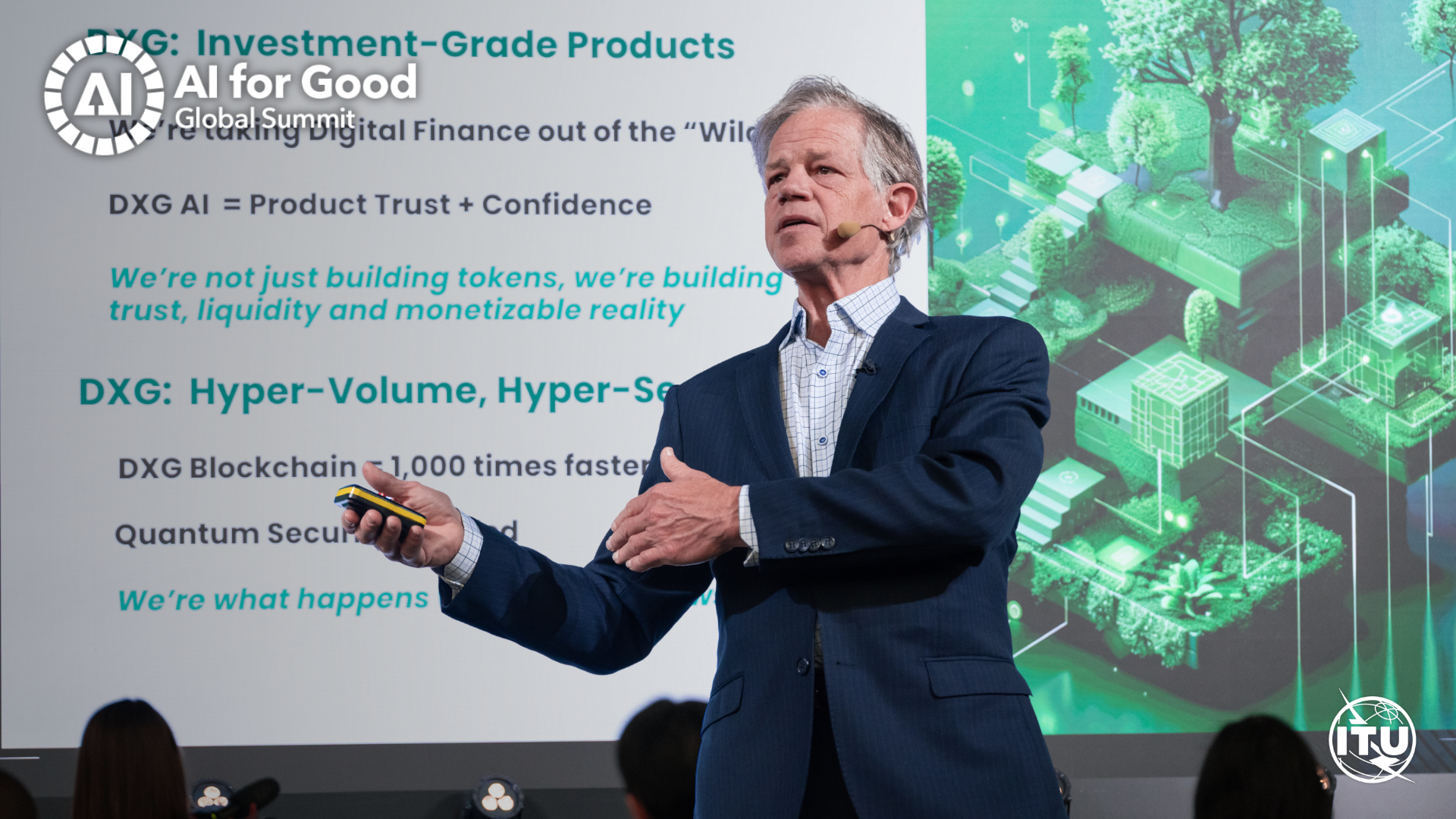
Barclay Knapp, CEO of DeepGreenX, opened his keynote at the 2025 AI for Good Summit by acknowledging the role of the International Telecommunication Union as “a true force for good in the world,” and expressing appreciation for its engagement in AI. With a long career in technology and telecommunications, Knapp introduced the audience to two key topics: the emergence of digital finance, and the work of his company, DeepGreenX.
A new model for finance
Knapp defined digital finance as a transformative force built on AI, blockchain, and tokenization. According to him, this new model enables enterprises, regions, and even nations to raise and form capital more inclusively and efficiently.
“What we really are witnessing is the transformation through AI and blockchain and tokenization of traditional finance to a new form of finance that is both inclusive, democratic, more global, and more open,” Knapp explained.
DeepGreenX operates as a digital “factory,” leveraging technology to convert various types of assets, whether natural, digital, or industrial, into investment-grade financial instruments. Unlike many players in the crypto world, Knapp emphasized a rigorous approach: “The current financial system is not broken. And what we do in terms of evaluating projects, doing due diligence, establishing who owns what is very important.”
Tokenizing assets at scale
Knapp described a global opportunity for tokenization, noting that as much as $900 trillion in assets could potentially be digitized. He explained that virtually any type of asset could be represented on the blockchain, turned into a financial instrument or token, and then exchanged or monetized in ways similar to traditional stock or bond certificates.
He pointed to the dual benefits of this shift: generating new sources of capital and improving the efficiency of transactions. He explained that tokens could be used to represent physical goods, such as a ton of soybeans, and tracked more reliably through the supply chain using blockchain than with conventional documentation methods.
Watch the full session here:
Supporting emerging industries and regions
Knapp highlighted how digital finance could empower both traditional and emerging sectors, from commodities to AI and green energy.
“We’re actually going to be enabling the newer emerging industries like AI, data centers, computing centers, and green energy, which is vitally important for us,” Knapp said.
He shared a case study from Maluku, a province in Indonesia, where DeepGreenX secured a concession covering 71 million hectares of land to protect its natural resources and simultaneously develop infrastructure through tokenization.
Knapp explained that DeepGreenX had secured a concession from the province of Maluku with the primary goal of protecting the environment. This included reforestation and enhancing green assets, which he noted could generate financial value. The resulting capital would then be used to support infrastructure development such as roads, ports, and airports.
Accelerating capital for development
According to Knapp, one of the key advantages of DeepGreenX’s digital finance model is speed. The company moved from rights to capital in just a few months, supporting a region that it aims to preserve for future generations while also helping it develop sustainably.
This rapid turnaround, he argued, is particularly beneficial for underserved regions that traditionally lacked access to private capital. The model is designed to be repeatable and scalable.
Meeting AI’s infrastructure demands
Shifting to the broader AI landscape, Knapp addressed the infrastructure limitations faced by AI development.
“There’s just not enough power […]; AI has been blockaded. There’s a lot of international hand wringing about the regulation of AI […] and finally, there’s just not enough computing power,” Knapp noted.
He proposed that digital finance could help democratize access to AI infrastructure. Through tokenization, resources such as energy or data center capacity could be made tradable across borders. These tokenized resources could then be traded globally, allowing, for instance, a community in Poland to purchase computing power hosted in Texas.
Enabling cross-border trade
Knapp then shifted to the topic of trade, highlighting the vast scale of global financial transactions and the inefficiencies that persist due to outdated systems. He described trade as encompassing virtually every monetary exchange and noted that the total global transaction volume exceeds one quadrillion US dollars.
He proposed that digital finance can help streamline these transactions.
“We can change those kinds of systems from being dependent on paper […] to an integrated system,” Knapp said.
But he stressed the need for stability, introducing the idea of a “universal super stable coin” to facilitate global, multi-currency trade.
Towards a more sustainable future
Throughout the session, Knapp returned to the link between digital finance and sustainability. “By definition, if you can do things faster, you’re going to burn less fuel doing it. You’re going to waste fewer resources doing it.”
He argued that financial systems should not depend solely on subsidies, emphasizing that sustainability must ultimately be economically viable to be truly effective. In his view, digital finance provides not only access to capital but also a market-driven rationale for advancing green development.
Replacing the crypto wild west
While DeepGreenX relies on blockchain technology, Knapp emphasized that its approach differs significantly from the early crypto landscape. He characterized digital finance as investment-grade and contrasted it with the unregulated, chaotic environment of early crypto, which he likened to the Wild West, full of activity but lacking oversight.
Instead, DeepGreenX is focused on trust and regulatory compliance.
“We’re not just building tokens. We’re building confidence, trust, and reality backed by real assets, backed by real data, backed by real things like forests,” Knapp explained.
He also highlighted the need to upgrade infrastructure in line with rising transaction volumes, noting that any thousandfold increase in activity would require a corresponding increase in processing capacity.
Preparing for quantum security
The final point addressed future-proofing the digital financial system. Knapp warned that current blockchain technologies are not ready for future security threats.
“Quantum security is going to be a necessity and only with the new forms of technology can you get there and DeepGreenX is bringing that technology forward.”
Concluding his session, Knapp reflected on the human dimension of technology adoption.
“The ultimate edge is the human. We need to embrace technology that improves our lives not for some other goals or some economic goals,” he stressed.
He emphasized that DeepGreenX’s core mission is to create value, support planetary sustainability, and benefit individuals, an approach he described as a genuine example of AI for Good.