

 Register here
This AI for Good Innovate for Impact Interim Report showcases practical AI solutions across sectors such as healthcare, climate resilience, education, and digital inclusion. It curates 160 use cases submitted from 32 countries, evaluated by a Technical Advisory Committee of global experts and edited by a team of handpicked AIforGood Scholars. The initiative fosters collaboration across industry, academia, government, civil society, and UN entities, promoting inclusive and responsible AI deployment. Covering eleven key domains, the report highlights regional innovation, lessons learned, and real-world applications, offering a comprehensive view of AI’s impact and a strategic outlook for future work.

This document is the final report of the ITU/WHO Focus Group on Artificial Intelligence for Health (FG-AI4H), detailing its activities from 2018 to 2023 to develop a standardized assessment framework for AI in health. The report covers the group’s structure, including various working and topic groups focused on specific governance and health areas, and lists its numerous deliverables, which provide guidance and best practices on ethical, regulatory, technical, and (clinical) evaluation aspects of AI for health as well as use case specific benchmarking procedures. It also highlights the Open Code Initiative (OCI) as a platform for testing AI assessment concepts and concludes by announcing a successor Global Initiative on AI for Health (GI-AI4H) to continue this important work.
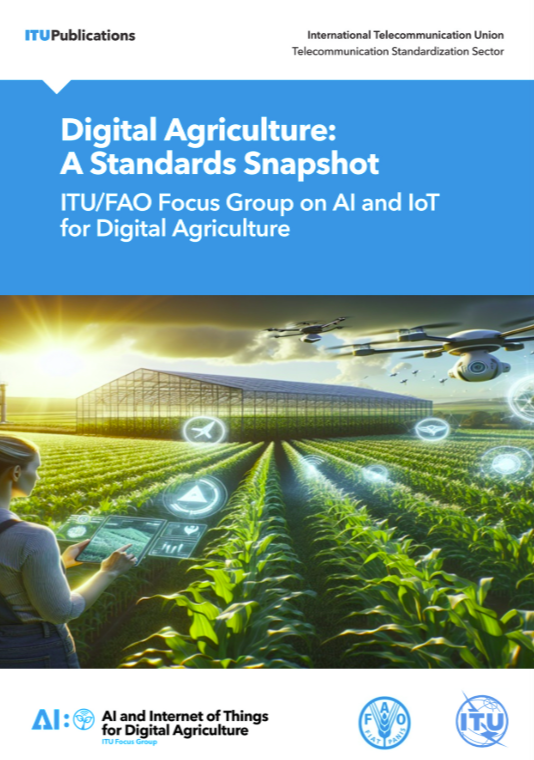
This report details the progress and milestones of the ITU/FAO Focus Group on AI and IoT for Digital Agriculture (FG-AI4A), an open platform for discussing the integration of AI and IoT technologies in agriculture, laying the groundwork for technical standardization. Key achievements include developing a comprehensive glossary of digital agriculture terminology, mapping the current landscape of standardization, formulating best practices and guidelines, and data modelling framework for digital agriculture. By addressing standardization gaps, promoting for the ethical use of technology, and prioritizing data quality and integration, these efforts are geared towards enhancing agricultural production practices, overall productivity and efficiency while ensuring sustainability and resilience.
This report was launched at the Paris AI Action Summit to ensure the efficient use of resources, enhance clarity, promote consistency in AI environmental sustainability standardization, and facilitate the widespread adoption of best practices. The intention of its contributors is to work towards non-conflicting standards and to foster collaboration between international standardization bodies. This document is intended for policymakers, scientists, AI developers, and industry leaders working on or interested in AI environmental sustainability, providing them with visibility into the progress made by standardization organizations and the work that still lies ahead.
The AI for Good Innovation factory has since its launch in 2020 emerged as a key pitching and acceleration platform for AI startups from all corners of the world. These ventures address critical challenges of society, cross-cutting across all sectors. The selection of the finalist startups is a rigorous process that ensures the highest quality of innovations. With a growing startup community over the years, the Innovation Factory’s ambition is to identify practical solutions using AI, scale those solutions for global impact, and advance the SDGs.
This AI for Good Impact Report examines the key role of AI in accelerating progress towards the Sustainable Development Goals (SDGs). Analysis of each SDG includes current progress towards the targets and practical examples of the real-world impact of AI solutions. It provides an overview of AI trends, governance, and opportunities to support informed decision-making across sectors. Additionally, the report offers recommendations for policymakers, government officials, policymakers, NGOs, international development organizations (IDOs), and industry leaders to guide the adoption and scaling of safe, responsible and ethical AI initiatives.
This report explores how Artificial Intelligence (AI) can enhance global disaster preparedness and response. It presents an overview of the activities of the ITU/WMO/UNEP Focus Group on AI for Natural Disaster Management (FG-AI4NDM), underscoring how AI can revolutionize the disaster management cycle, from early warning systems, disaster prediction to recovery, leveraging real-time data analysis and emerging technologies. The report is a must-read for anyone interested in the future of international standardization related to the use of AI in disaster risk reduction.
The first ever “AI Governance Day” subtitled “From Principles to Implementation” was held in Geneva, Switzerland, on 29 May 2024. Convened by the United Nations’ International Telecommunication Union (ITU), the event brought together a kaleidoscope of participants from around the world. This included government leaders, policymakers, researchers, and technologists from both developed and developing countries. The event’s multistakeholder composition aligned with ITU’s mission to provide an inclusive, neutral, and globally representative platform for artificial intelligence (AI). The day was marked by vibrant discussions and collaborations aimed at transforming AI governance principles into actionable frameworks. In the area of AI, the transition from principles to actionable governance is a challenge. These principles, while vital, have remained at a high level, often too abstract in their application for direct application in the ever-evolving AI landscape.
Since 2017, the International Telecommunication Union (ITU) has been dedicated to establishing a platform and ecosystem for the advancement of artificial intelligence (AI) tools and technologies in support of the UN Sustainable Development Goals (SDGs) through its AI for Good Platform and its AI for Good Global Summit. The 2024 edition of the AI for Good Global Summit took place on May 30th and 31st and was organized by ITU in collaboration with over 40 sister UN agencies and co-convened with the government of Switzerland.
The roundtable, “Harmonizing Global Collaborations in the AI Industry: A roundtable on the future of AI standardization, regulation and industry development”, organized by the International Telecommunication Union (ITU) at its AI for Good Global Summit on 30 May 2024 provided a platform for dialogue and collaboration among all stakeholders in artificial intelligence (AI). The discussions underscored the necessity of continuous collaboration to navigate the rapid advancements in AI and their wide-ranging implications for various economic sectors and regions of the world. Participants recognized the importance of adaptive and dynamic AI governance to the sustainable and inclusive growth of AI.