

 Register here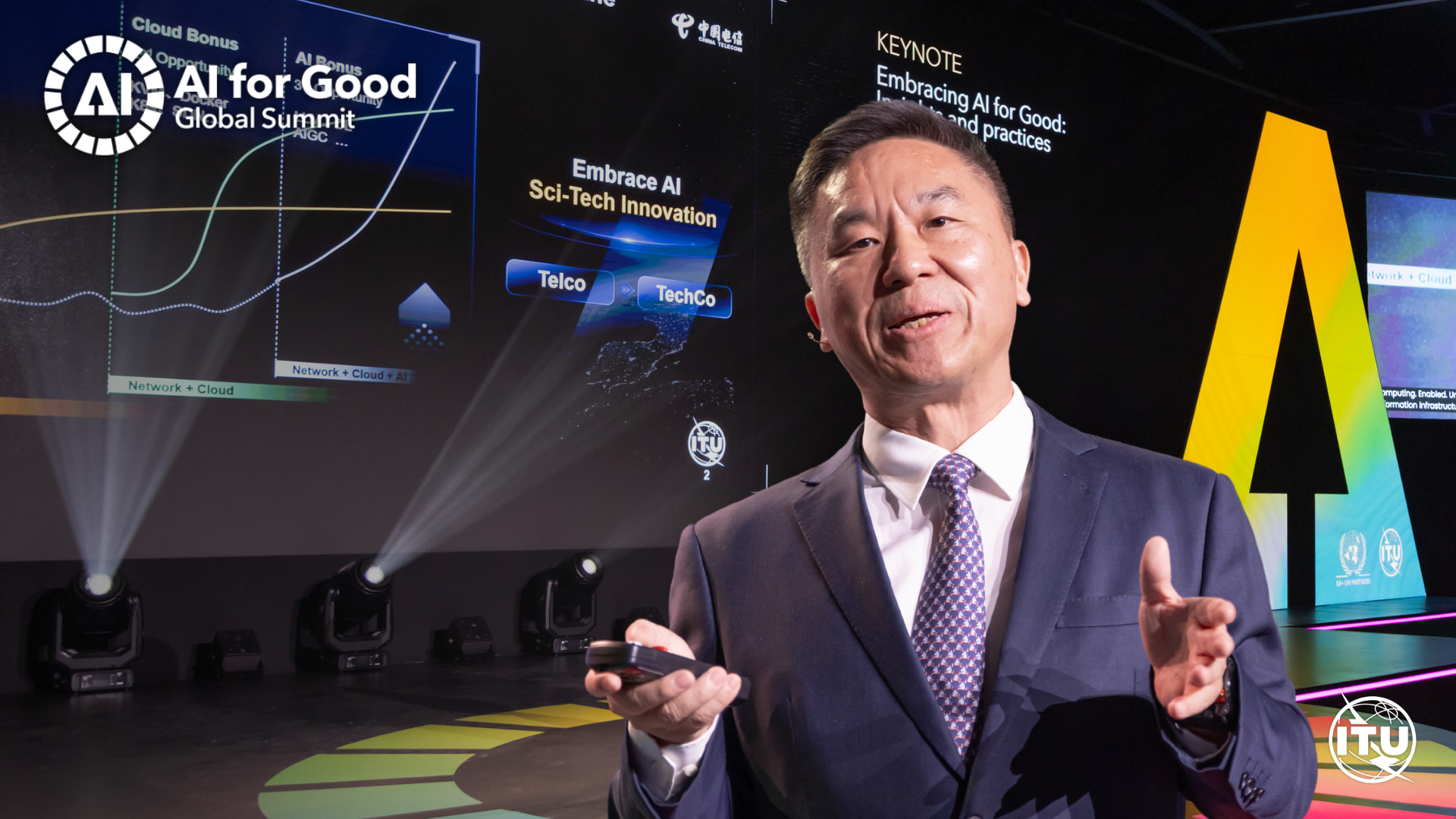
At the 2025 AI for Good Global Summit, Liu Guiqing, Executive Director, President and Chief Operating Officer of China Telecom, shared the company’s strategic approach to AI, highlighting how it is redefining communication, infrastructure, industry, and society. His presentation outlined key principles guiding the development of AI for Good and introduced China Telecom’s platforms, models, and partnerships designed to support inclusive, secure, and sustainable AI deployment.
A new wave of transformation driven by AI
Liu opened by reflecting on how past waves of technological change – from the internet to cloud computing – reshaped communication, industry, and human interaction. Each stage created new infrastructure demands and business models, and now AI is ushering in the next phase.
“AI as a strategic driver of the next wave of technological revolution and industrial transformation is profoundly changing how we live and work while redefining communication network architectures, business products and operational models,” Liu said.
China Telecom is aligning itself with this transformation by focusing on digitization, networking, AI advancement, and sustainability. The company is evolving from a traditional telecom provider into a technology-driven enterprise, with four strategic priorities: network-cloud convergence, AI integration, quantum technologies, and cybersecurity.
Building an intelligent foundation with cloud-network integration
The company’s smart infrastructure strategy centers on the XiRang integrated intelligent computing service platform. This system is structured across five coordinated layers: Infrastructure as a Service (IaaS), Platform as a Service (PaaS), Data as a Service (DaaS), Model as a Service (MaaS), and Application as a Service (SaaS). Each layer is designed to address fragmentation in computing and data access, creating a unified foundation for AI deployment.
“We currently have data silos and the computing powers are dispersed. So it is difficult for people to actually get computing power through these five layers,” Lui explained. With the XiRang platform, both corporate and private users can access AI services through a single, coordinated system.
China Telecom operates more than 6,000 edge data centers and 900 large-scale data centers. These are connected via a network characterized by high bandwidth, low latency, and low cost, enabling effective coordination between centralized and edge-based AI computing.
Decoupling platforms and scaling data
At the platform level, Triless architecture has been introduced, decoupled from specific computing hardware, training frameworks, and development tools, giving customers a one-stop shop for AI services.
Supporting this is the Xinghai intelligent data platform, which brings together proprietary, open-source, and third-party datasets. It includes more than 10 trillion tokens of communication data and over 350 terabytes of cross-sector information spanning 14 industries.
Developing the Xingchen model and expanding AI applications
On the model layer, China Telecom has built out its own large-scale model ecosystem under the Xingchen brand. It incorporates general-purpose models, industry-specific solutions, and integrations with third-party open-source models. “It covers a full range of models,” said Liu, including video, language, and semantic understanding.
These models are being embedded into a wide array of services, from cloud computers to AI-enhanced smartphones, with the goal of scaling access to intelligent tools across industries and user groups.
Watch the full session here:
Addressing risks and barriers
While the opportunities are considerable, the risks cannot be ignored.
“AI has brought a lot of development opportunities. At the same time, we must address its emerging challenges including the widening intelligence divide, escalating security risks and also uncertainties,” Liu stressed.
China Telecom’s response is organized around four guiding values for AI for good: inclusivity, security, sustainability, and universal benefit. These principles inform the design of platforms, services, and partnerships across all parts of the company’s AI strategy.
Ensuring inclusivity through infrastructure and accessibility
Treating AI as a basic utility is central to China Telecom’s inclusivity strategy. The goal is to make intelligent services as universally accessible as electricity or clean water. Infrastructure plays a key role in achieving this. A distributed computing model described as “2 + 4 + 31 + X + O” brings computing power closer to users through a combination of national nodes, regional centers, and flexible edge deployment.
The company’s high-speed, low-latency network infrastructure supports real-time applications like smart driving, while its platform ecosystem includes over 100 digital platforms and more than 45,000 industrial AI application projects.
AI design is also being tailored to reduce barriers for vulnerable populations, particularly the elderly and children. To support more accessible user experiences, voice-driven features such as language navigation models have been introduced, allowing users to interact with services more intuitively, for example, by speaking into an app to request a cab.
Making security a foundation, not an afterthought
“Security is a top concern of all AI experts in the world and it’s a key for ensuring AI for good,” Liu explained.
To address this, China Telecom developed the XingChen large language model focused specifically on security. It covers domains such as data protection, software integrity, operational risk, and threat detection.
AI-assisted fraud has emerged as a particular concern. “AI has made fraud more believable,” Liu warned. New tools developed by China Telecom include deepfake video detection with over 90 percent accuracy and scam call identification with over 80 percent accuracy, technologies that contribute to global anti-fraud efforts and responsible AI use.
Aligning AI with sustainability goals
China Telecom is also applying AI to reduce environmental impact. In Qinghai Province, the company launched the first zero-carbon big data center powered entirely by clean energy. These technologies are now being scaled and implemented more broadly.
Energy efficiency upgrades at telecom infrastructure sites have also delivered measurable benefits, with base stations achieving reductions of over 500,000 tons in carbon dioxide emissions.
Designing for universal benefit
Beyond technical deployment, AI must be designed to serve society as a whole. For China Telecom, this means eliminating barriers to access, ensuring safety, and directing innovation toward outcomes that enhance quality of life across all segments of society.
“Artificial intelligence is driving unprecedented transformation across the globe and it is a global responsibility to promote the development of AI,” Liu stated.
The company sees its role as not only building intelligent systems but also shaping how they are used, governed, and shared.
A call for coordinated global action
Liu closed his remarks with three proposals aimed at supporting international cooperation and responsible AI development.
The first is a call to establish a standardized framework for AI infrastructure, built on the contributions of multiple stakeholders.
“By harnessing expertise from all stakeholders, we can jointly chart the revolutionary path of AI, advance research on next generation digital infrastructure standards and facilitate the development of such infrastructure that integrates cloud network and AI.”
The second is to advance AI safety governance through strategic planning, risk mitigation, and lifecycle oversight. Liu proposed improving risk evaluation mechanisms, strengthening top-level design, and raising safety thresholds to ensure that AI evolves within clear and enforceable boundaries. The aim is to guide progress in “a secure, well-regulated and controlled manner.”
The third proposal is to foster a collaborative global AI ecosystem. Through open and inclusive industrial partnerships, the goal is to accelerate progress on shared challenges and broaden the benefits of AI development. “We can collectively accelerate the realization of AI for good.”
Liu concluded with a reaffirmation of China Telecom’s commitment to ethical AI development and global cooperation.
“China Telecom, as a committed practitioner of AI for good, seeks to deepen collaboration with global partners, closely track technological and industry trends, to bridge the intelligence divide and relentlessly advance AI for good,” Liu stated.