

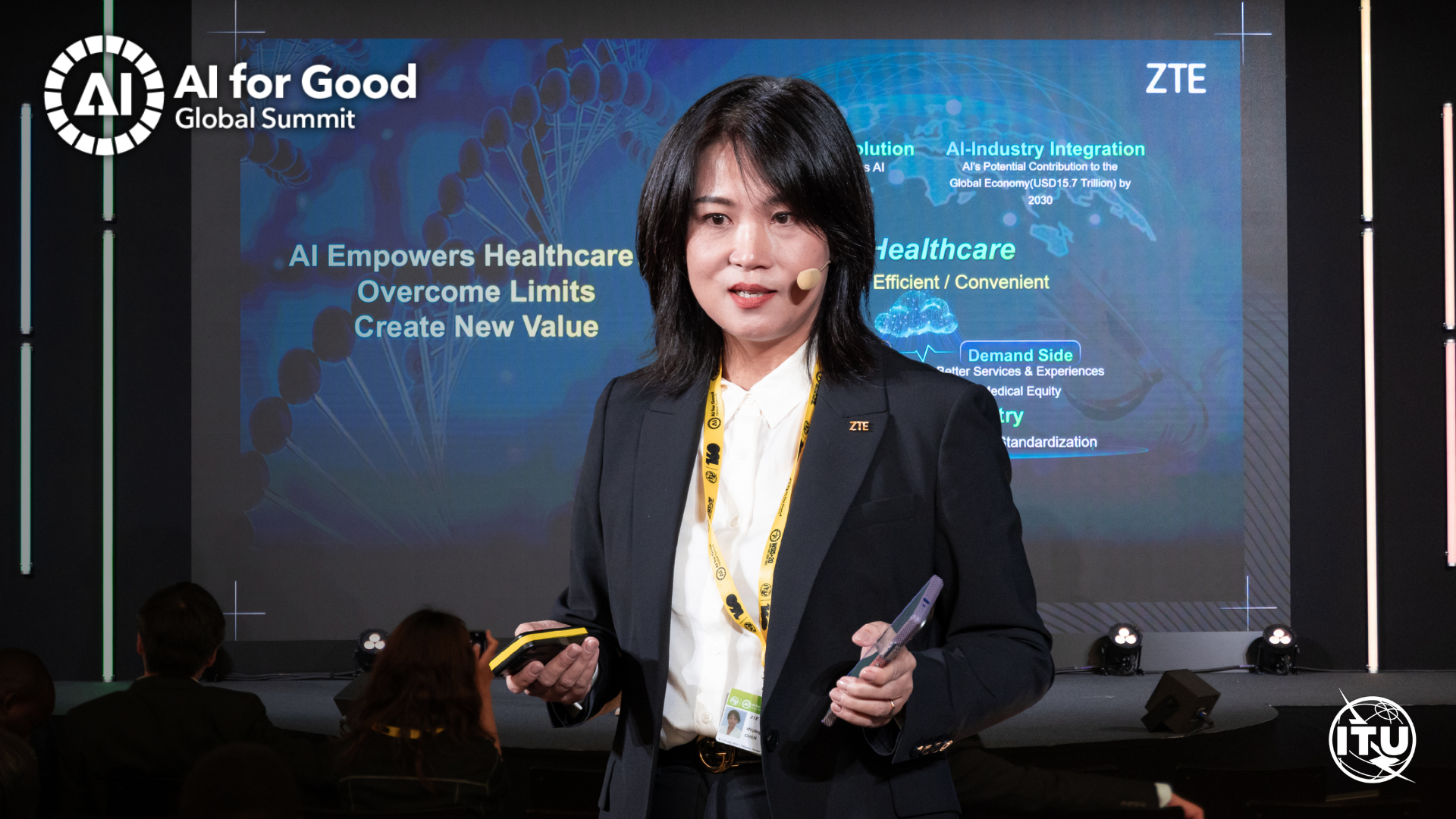
At the 2025 AI for Good Global Summit, Zhiping Chen, Vice President at ZTE Corporation, presented a grounded and application-driven vision of AI in healthcare. In a field where innovation must be measured not just by efficiency but by its capacity to save lives, Chen highlighted ZTE’s practical deployments of AI technologies, developed in collaboration with domain experts, hospitals, and local governments.
Framed as a response to pressing structural challenges such as resource shortages, expertise gaps, and inefficiencies in medical workflows, Chen’s talk illustrated how AI is not simply a future aspiration for healthcare, but a present force shaping diagnostics, logistics, and access to care.
Why healthcare?
Chen outlined three primary reasons ZTE focuses on healthcare as a key sector for AI deployment. First, the healthcare domain is well-positioned for digitization and standardization, which are prerequisites for effective AI integration. The availability of structured data and processes enables AI models to be trained and deployed with measurable impact.
Second, the supply side of healthcare is under immense pressure. Expertise is limited, particularly in underserved or rural areas, and healthcare professionals are a valuable but overstretched resource. AI, Chen argued, can support better allocation of talent and reduce the costs and time associated with manual diagnostic processes.
Third, the demand for accessible, timely care is growing worldwide. Patients often face barriers in reaching specialists or receiving quality diagnoses quickly. AI can help mitigate these limitations by enabling remote evaluations, accelerating medical imaging workflows, and enhancing the overall reach of healthcare systems.
Watch the full session here:
Enabling remote diagnostics at scale
The first real-world example Chen shared focused on medical check-ups and exam summaries. Typically, summarizing check-up data and identifying health risks requires highly experienced doctors, a resource not always available in less-developed regions.
To address this, ZTE and its partners developed an AI-enabled diagnostic assistant. The system allows doctors in major cities to remotely analyze patient data from locations as far as 3,000 kilometers away. According to Chen, this significantly reduces the workload on urban hospitals and extends high-quality diagnostic services to previously underserved populations.
“It’s highly relieved the pressure of the doctor’s workforce,” Chen said.
The approach enables large-scale processing of medical reports while preserving clinical accuracy. In doing so, it helps balance the uneven distribution of medical talent and expands the effective capacity of hospital systems without requiring proportional increases in staffing.
Accelerating tumor diagnosis through AI
The second case study centered on pathology and tumor cell detection. Traditional diagnosis can take weeks, as it often depends on limited availability of experienced pathologists and manual examination of large libraries of cellular images. Patients may face long waiting times just to receive critical results.
ZTE has implemented AI tools to assist doctors in analyzing tumor images more efficiently. These models help pinpoint anomalies and identify potential risks, cutting diagnostic times from two to three weeks down to minutes in some cases.
“[Patients] can get the report one or two days, [instead of] two or three weeks” Chen said.
Chen emphasized the life-saving implications of such acceleration. By identifying conditions earlier and more reliably, the system enables faster clinical intervention. The AI solution is already deployed in multiple hospitals and integrated into routine diagnostic workflows.
Drones, 5G-Advanced, and emergency plasma delivery
The third example highlighted ZTE’s use of AI in combination with 5G-Advanced networks and drone technology for emergency medical logistics. In situations requiring urgent delivery of blood or plasma, traditional ground transportation is often delayed by traffic congestion or logistical constraints. These delays can be life-threatening in emergency care settings.
ZTE collaborated with partners to build a low-altitude drone system supported by 5G-Advanced infrastructure. The drones are able to bypass road traffic and deliver plasma across cities in a matter of minutes. Chen shared a case where a drone delivered life-saving plasma within 10 minutes, helping a hospital respond to a critical hemorrhaging case involving a mother and newborn.
Currently, ten drone delivery routes operate in a pilot city, executing more than 50 deliveries per day. Chen described the system as a model for future urban emergency logistics, not limited to plasma delivery but adaptable to other urgent medical supplies as needed.
All-in-one platforms for flexible deployment
Beyond specific use cases, ZTE has developed a flexible AI healthcare platform that combines hardware and software into an all-in-one solution. On the hardware side, the system includes data centers to AI networks, servers, and all-in-one computing systems that can be adapted to different hospital or clinic environments. Chen noted that the design is highly customizable, depending on the shape, capacity, and requirements of each scenario.
On the software side, the company has developed a no-code training platform and a tool referred to as an “agent factory,” which helps medical institutions build and deploy AI applications without requiring in-house ICT expertise. The goal, Chen explained, is to lower the barrier to entry for medical AI adoption.
ZTE collaborates with healthcare partners who provide clinical expertise and data, while the company contributes AI calibration, system integration, and platform engineering to accelerate deployment.
“[Our medical partners] know healthcare, medicine, rescue life, but they’re not familiar with ICT technology. So, what we’ve done is calibrate with them to accelerate healthcare AI development,” Chen explained.
This joint model, she noted, has proven effective in translating technical capabilities into scalable, real-world healthcare solutions.
A broader commitment to accessible technology
Throughout the session, Chen emphasized that ZTE’s approach to AI in healthcare is defined not only by technical capability but also by accessibility and inclusiveness. The company’s strategy aims to deliver accurate, advanced, and deployable AI applications in a way that integrates with real-world constraints and user needs.
Chen summarized this philosophy by stating that AI for healthcare is not just about improving diagnostics or optimizing workflows. It is about making healthcare more human-centered and responsive by closing systemic gaps. From remote diagnostics and emergency logistics to flexible deployment platforms, ZTE is focused on removing barriers and ensuring that digital tools are available where they are needed most.
From concept to coordination
ZTE’s work demonstrates a critical principle that ran through many sessions at the summit: AI for Good is only meaningful when it is applied with precision, coordination, and purpose.
“AI for all is not just a slogan,” Chen stressed.
For ZTE, it is a direction, backed by partnerships, real deployments, and a focus on turning complex AI infrastructure into practical healthcare solutions.
By designing systems that meet the needs of both medical professionals and patients, and by doing so in collaboration with local institutions, ZTE is contributing to a healthcare future where innovation is measurable not just in efficiency but in lives impacted.