
 Register here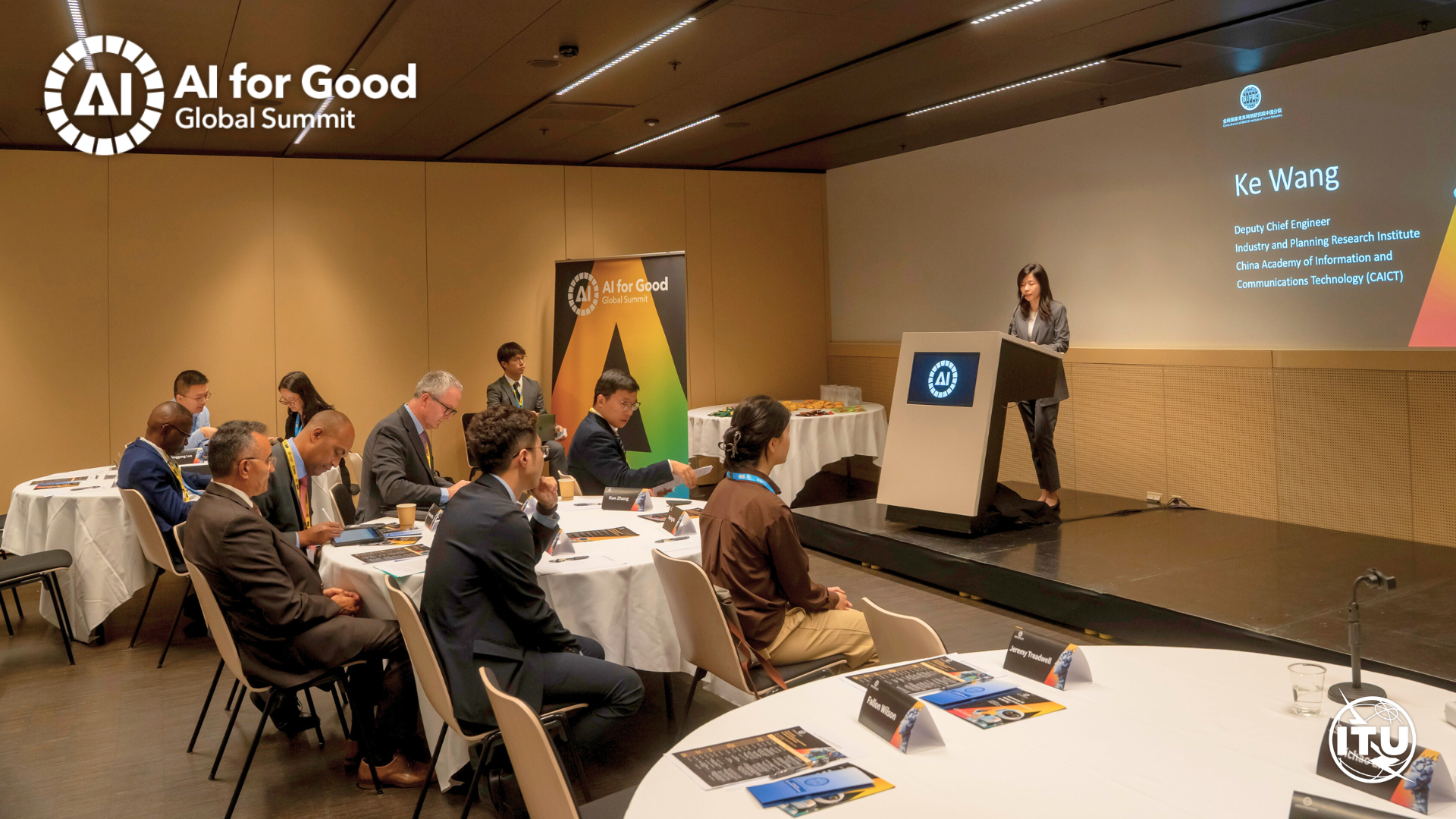
At the 2025 AI for Good Global Summit, the workshop Global AI convergence: Innovative practices for a shared sustainable future, organized by the China Branch of the BRICS Institute of Future Networks (BIFNC). Moderated by Wang Ke, Deputy Chief Engineer, Industry and planning research institute at the China Academy of Information and Communications Technology (CAICT), the session brought together international organizations, enterprises and researchers to explore cooperation and applied innovation in AI. The agenda combined opening perspectives, institutional insights and live demonstrations that illustrated AI’s role in standards, ecosystems and industry applications.
BIFNC outlines vision for international cooperation
The session opened with remarks from Lin Zhen, Director of the International Cooperation Department at BIFNC, who emphasized the institute’s focus on international joint research and long term collaboration with global partners. She highlighted recent steps including accelerator programs and policy workshops, and pointed to Shenzhen’s support for an innovation ecosystem through targeted AI measures. Lin also previewed current projects such as an open-source model platform, a new operating system, and progress in robotics and drones that would be featured later in the session. Her message was one of building a high-level international platform for dialogue, talent exchange and cooperative research.
Standards and Policy perspective from ITU
Dr. Bilel Jamoussi, Deputy Director of TSB & Chief, Study Groups & Policy Department (SPD) at the International Telecommunication Union (ITU), positioned standards as a central mechanism for ensuring responsible and inclusive AI. He explained that ITU members had prioritized AI as part of their broader work on emerging technologies, resulting in dozens of published standards and many more under development.
“Standards are the foundation of policy implementation,” Dr. Jamoussi noted.
This remark underscored how technical specifications translate into Policy and regulatory practice. He also pointed to the standards community’s response to deepfakes, which involved mapping tools and producing guidance, and highlighted cross agency collaborations on domain specific AI applications. He stressed that participation from developing countries is essential, drawing attention to initiatives that lower barriers and expand access to the standards process.
Building innovation ecosystems through acceleration centers
Turning to the development dimension, Mohamed Ba, Head of ITU’s Digital Innovation Service, described the relationship between standards and ecosystems in practical terms. He explained that while standards provide the technical foundation, ecosystems are needed to apply and scale innovations in real contexts. Ba outlined the role of ITU’s Acceleration Centers and the Innovation and Entrepreneurship Alliance as conveners of multi stakeholder projects. These centers are designed to build capabilities in strategic foresight, cluster development, project design, regulatory sandboxes and the integration of open technologies. He gave examples of how open embedded systems can support local industries, stressing that the aim is not just isolated innovation but network effects through collaboration across regions.
Negotiation as a tool for convergence
Jérôme Bellion-Jourdan, Senior Fellow at the Institute for Global Negotiation, introduced a negotiation lens to the discussion. He reflected on the language of “convergence” and “win win,” noting how these terms capture the mindset required when stakeholders hold diverging interests. Jourdan linked global compacts and regulatory processes to the practical translation of agreements into operational standards, and reminded the audience that negotiation also takes place inside organizations as different departments adapt to technological change. He suggested that AI could support negotiators by generating draft agreements that humans then refine, while still emphasizing “the importance of creating value at the negotiation table.” In his view, effective negotiation can deliver outcomes that benefit all parties, with wider gains for society.
Watch the full session here
BIFNC’s latest research projects
Fan Wei, Head of AI Group Products at BIFNC, opened the research segment with an overview of the team’s work on next-generation drone systems. He highlighted efforts to streamline flight control and perception within a unified architecture, with the aim of improving reliability, reducing complexity and enabling more responsive applications.
The session also featured broader updates on BIFNC’s recent research portfolio. These included an AI-driven education program developed with an academic partner to support content generation, adaptive learning and multilingual delivery; the launch of the BIFNC Lab platform as a regional hub consolidating datasets, models and compute resources for industrial deployment; and a demonstration of real-time 3D human pose estimation running on mobile devices, with potential uses in gaming, sports analysis and robotics. Together, these initiatives illustrated BIFNC’s focus on applied innovation and its ambition to bridge research with practical implementation.
From motion capture to intelligent vehicles: AI in action
The workshop then shifted to live demonstrations, each highlighting how AI is moving from research into real-world applications across consumer, mobility and industrial domains.
BIFNC introduced a smartphone based motion capture system designed to offer low latency performance for applications in gaming, sports analysis, rehabilitation and immersive exhibitions. Hangzhou Jianmo Technology followed with Cupboo, an AI enabled pet robot developed for responsive interaction and wellbeing support. Chongqing Changan Automobile presented an intelligent in-vehicle orchestration system combining voice interaction, an AI assistant and proactive service functions to support real-time driving needs. OPPO outlined its on-device AI approach, emphasizing privacy focused design and locally processed models for everyday education, productivity and communication tools.
The demonstrations also included an intelligent heating system from Huahui Beijing Energy, which applies data driven optimization to improve energy efficiency, as well as an overview of the Intelligent Manufacturing Training Campus, a simulation-based program designed to prepare talent for automation and robotics. These demonstrations illustrated how applied innovation is advancing in parallel across devices, vehicles, energy systems and training environments, reflecting a wider shift toward AI integrated ecosystems.
Emerging perspectives on security, regional collaboration and inclusive innovation
Following the demonstrations, speakers turned to the broader conditions needed to guide AI’s growth. Naying Hu, Senior Business Executive of AI Institute at CAICT outlined how industrial practices in China are addressing AI security, security and Policy, underscoring the importance of embedding protective measures within organizational systems as AI deployment accelerates.
From the Federal University of Technology Minna Nigeria, Professor James Agajo highlighted opportunities for collaboration across Sub-Saharan Africa. He pointed to the need for joint initiatives that combine local research with international partnerships, with the aim of scaling solutions that address pressing regional challenges.
The entrepreneurial dimension came through in Founder & CEO of Moddula Alex Nomberto’s intervention as he introduced ViDA, an AI powered strategic management model designed for micro, small and medium enterprises. He described how the tool can provide structured decision support to businesses that often lack access to advanced analytics.
Closing this sequence, Fallon S. Wilson, Co-Founder and Lead Principal Investigator at the #BlackTechFutures Research Institute, stressed the importance of a community rooted approach. She spoke about building a public interest tech workforce, with pathways that expand participation and ensure that AI’s benefits reach underserved communities.
Wilson’s team also outlined a bias-aware, localized education and job-matching platform, presented with colleagues Isaac McCoy and Jeremy Treadwell. They described personas-driven, culturally nuanced training, explainable matching tied to local labor data, and dashboards for NGOs to measure change, positioning the work as a movement for digital equity
A shared agenda for cooperation and innovation
The workshop closed with a clear line: cooperation, convergence and practical application. From standards and negotiation frameworks to research breakthroughs, live demos and forward-looking perspectives, the session underscored how technical progress and international collaboration must advance hand in hand. The discussions highlighted the need for shared platforms, inclusive participation and sustained capacity building to equip future talent. The presentations, ranging from research labs to regional collaborations and community initiatives, showed how ideas can move into real world contexts. Together, they reflected the workshop’s central ambition to pool global expertise and shape a future where AI innovation serves common goals.