

 Register here
This report highlights the outcomes of the International AI Standards Exchange which took place during the AI for Good Global Summit 2025 organized by ITU.

As the global AI race continues to accelerate, humanity stands at a unique, transformative moment. Our collective challenge is not whether to govern artificial intelligence, but to understand and ensure governance steers AI in the right direction. This is at the heart of ITU’s mission to offer a neutral, global platform for artificial intelligence where everyone has a voice and seat at the table. Our second annual AI Governance Dialogue provided a timely opportunity for exactly this kind of multi-stakeholder discussion among governments, the private sector, academia, civil society organizations, the technical community, and United Nations colleagues – each of whom has a key role to play.
This document is the final report of the ITU/WHO Focus Group on Artificial Intelligence for Health (FG-AI4H), detailing its activities from 2018 to 2023 to develop a standardized assessment framework for AI in health. The report covers the group’s structure, including various working and topic groups focused on specific governance and health areas, and lists its numerous deliverables, which provide guidance and best practices on ethical, regulatory, technical, and (clinical) evaluation aspects of AI for health as well as use case specific benchmarking procedures. It also highlights the Open Code Initiative (OCI) as a platform for testing AI assessment concepts and concludes by announcing a successor Global Initiative on AI for Health (GI-AI4H) to continue this important work.
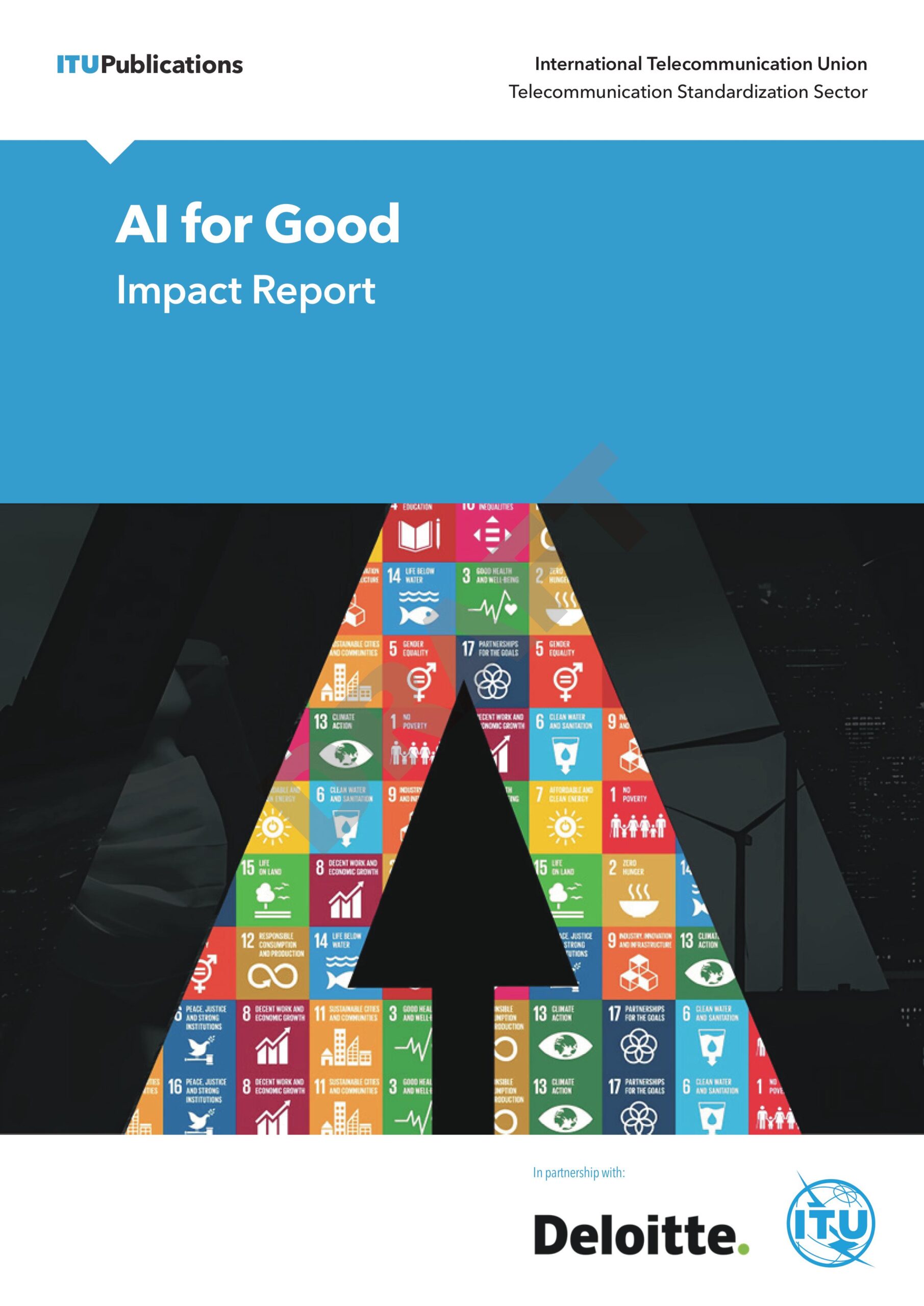
This AI for Good Impact Report examines the key role of AI in accelerating progress towards the Sustainable Development Goals (SDGs). Analysis of each SDG includes current progress towards the targets and practical examples of the real-world impact of AI solutions. It provides an overview of AI trends, governance, and opportunities to support informed decision-making across sectors. Additionally, the report offers recommendations for policymakers, government officials, policymakers, NGOs, international development organizations (IDOs), and industry leaders to guide the adoption and scaling of safe, responsible and ethical AI initiatives.
The first ever “AI Governance Day” subtitled “From Principles to Implementation” was held in Geneva, Switzerland, on 29 May 2024. Convened by the United Nations’ International Telecommunication Union (ITU), the event brought together a kaleidoscope of participants from around the world. This included government leaders, policymakers, researchers, and technologists from both developed and developing countries. The event’s multistakeholder composition aligned with ITU’s mission to provide an inclusive, neutral, and globally representative platform for artificial intelligence (AI). The day was marked by vibrant discussions and collaborations aimed at transforming AI governance principles into actionable frameworks. In the area of AI, the transition from principles to actionable governance is a challenge. These principles, while vital, have remained at a high level, often too abstract in their application for direct application in the ever-evolving AI landscape.
The roundtable, “Harmonizing Global Collaborations in the AI Industry: A roundtable on the future of AI standardization, regulation and industry development”, organized by the International Telecommunication Union (ITU) at its AI for Good Global Summit on 30 May 2024 provided a platform for dialogue and collaboration among all stakeholders in artificial intelligence (AI). The discussions underscored the necessity of continuous collaboration to navigate the rapid advancements in AI and their wide-ranging implications for various economic sectors and regions of the world. Participants recognized the importance of adaptive and dynamic AI governance to the sustainable and inclusive growth of AI.
An analysis of the UN system’s institutional models, functions, and existing international normative frameworks applicable to AI governance. The world is undergoing a fundamental technological shift in the age of rapid digitalization and deployment of artificial intelligence (AI) technologies. AI holds significant potential to be harnessed to support inclusivity, reduce inequalities, rescue the Sustainable Development Goals (SDGs) and bolster the operations of the United Nations (UN) system. However, harnessing the positive impacts of AI requires careful attention to ethical considerations, including safeguarding data privacy, mitigating biases, and ensuring transparent decision-making processes. It is therefore important to make the most of AI’s opportunities while addressing risks and harms.