
 Register here
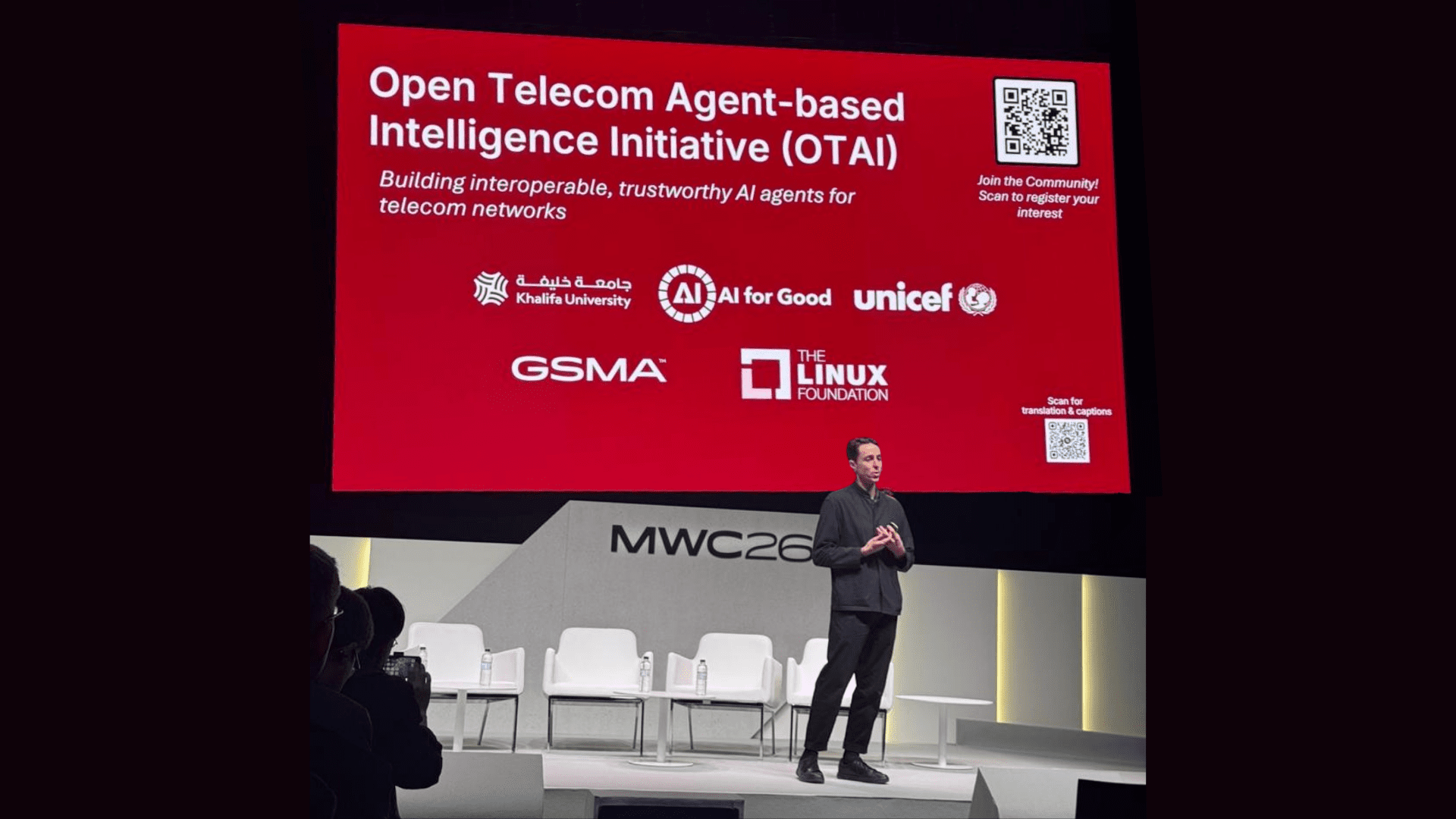
Under the umbrella of the ITU AI for Good Impact Initiative, a new global effort, the Open Telecom Agent-Based Intelligence (OTAI) initiative, has been launched to establish open foundations for interoperable, trustworthy, and deployable AI agents in telecom networks.
OTAI is a global, open, and neutral initiative designed to move telecom AI beyond isolated, vendor-specific agents toward cooperative, certifiable multi-agent ecosystems aligned with public-interest values and global digital development goals. The initiative aims to provide practical, reusable, and globally accessible building blocks that enable collaboration across operators, vendors, academia, and public-interest organizations.
The initiative is jointly chaired by Khalifa University’s Digital Future Institute and UNICEF, under the umbrella of the UN ITU Impact Initiative, with its Advisory Board includes representatives from Khalifa University’s Digital Future Institute, ITU, UNICEF, GSMA, Linux Foundation.
Why OTAI Initiative?
Telecom networks are increasingly incorporating AI-driven agents for tasks such as orchestration, optimization, troubleshooting, and service management. However, today’s ecosystem faces three critical challenges:
- Fragmentation: AI agents are developed in silos, with limited interoperability across vendors and operators.
- Lack of trust: There is no common framework to evaluate robustness, safety, and compliance in multi-agent coordination.
- Limited accessibility: Advanced AI agents remain out of reach for many regions and public-interest deployments.
OTAI initiative addresses these gaps by providing open, vendor-neutral foundations for telecom AI agents and their coordination.
The initiative is structured around three core pillars, comprising the development of open, reference-grade telecom AI agents, defining open coordination protocols that enable heterogeneous agents from different vendors and domains to communicate and collaborate reliably, as well as introducing transparent benchmarking frameworks and certification pathways to evaluate interoperability, robustness, safety, and real-world readiness. Together, these pillars aim to create a shared foundation for building, validating, and scaling trustworthy multi-agent intelligence in telecom networks.
Call for Contributions
OTAI invites operators, vendors, researchers, standards bodies, startups, and public-interest organizations to contribute to this global effort. Contributions are welcome across all pillars, including open agent blueprints, coordination protocols, datasets, evaluation frameworks, and real-world use cases. The initiative encourages cross-sector collaboration and aims to foster an inclusive ecosystem where both advanced markets and low-resource regions can participate in shaping the future of trustworthy telecom AI.
To register interest and join the initiative’s working groups, participants are invited to complete the official expression of interest form: https://forms.gle/HBgj8KdCbfbDL2cU6