


And that’s a wrap! The AI for Good Film Festival 2025 came to a close on 9 July during the Global Summit in Geneva, where four finalists presented their short films to a live audience and a panel of expert judges. Each film tackled different aspects of how artificial intelligence is shaping the world, from the challenges it raises to the possibilities it opens up.
The screening gave audiences a chance to see how filmmakers from different backgrounds are thinking about AI, not just in terms of technology, but also how it connects to people’s lives, social issues, and the future we’re all stepping into. The stories shared a focus on using AI to engage with real world problems in creative ways. After the screening, the judges selected this year’s winning film, recognizing its unique approach and strong message. The event wrapped up with a panel discussion featuring voices from both the film and tech industries, who reflected on how AI is starting to influence not just the stories we tell, but also the way those stories are made.
The finalists’ work was reviewed by a diverse panel of judges, each bringing a unique perspective from across film, technology, and policy. The 2025 jury included Lisa Russell, Emmy-winning filmmaker, AI artist, and founder of ArtsEnvoy.ai; Monica Lopez, Co-Founder and CEO of Cognitive Insights for Artificial Intelligence; Verena Puhm, an award-winning AI filmmaker; Irakli Beridze, Head of the Centre for AI and Robotics at UNICRI; Reza Sixo Safai, filmmaker, actor, writer, and co-founder of MASSIVE STUDIOS; and Michaela A. Ternasky-Holland, an Emmy Award-winning and Peabody-nominated director. Their combined experience reflected the intersection the festival aims to highlight: storytelling joining innovation.
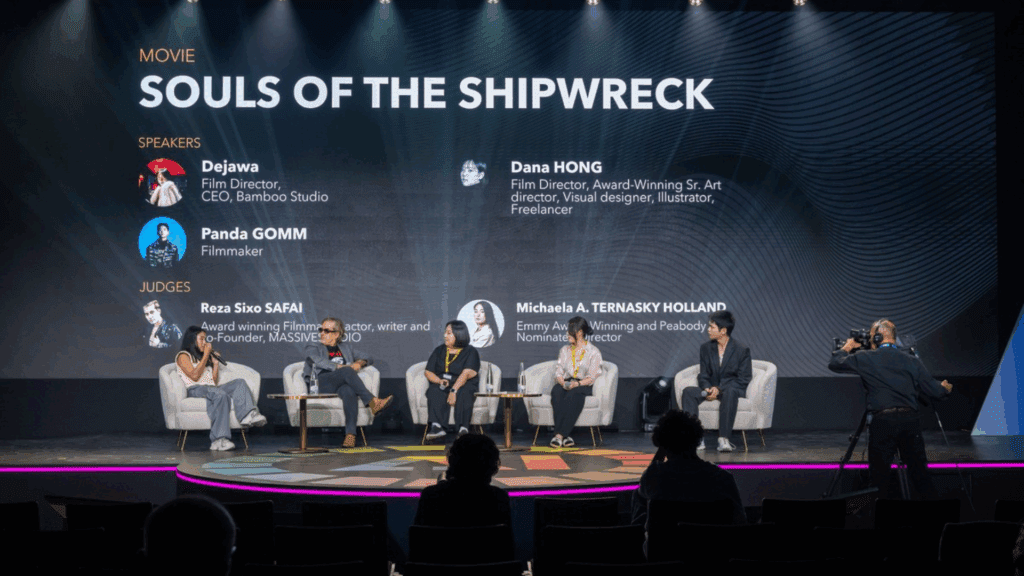
Winner Spotlight: Souls of the Shipwreck by Dejawa, Dana, and Panda Gomm
In Souls of the Shipwreck, filmmakers Dejawa (Yunsun Lee), Dana (Jungmin Hong), and Panda Gomm (Kyungsoo Lee) tell a quiet but powerful story about loss, memory, and rebuilding. Made across continents, in Korea and Canada, the film follows a woman who dives into the sea after a storm and brings color back to the souls of a forgotten shipwreck. It’s a very poetic take on how people and communities recover after disaster.
The project began as an experiment: could they make a film together remotely using AI? With Dana moving to Vancouver and Dejawa and Panda Gomm staying in Korea, the team found that the time difference actually helped them keep things moving. “We were basically working around the clock” they said. “One of us would sleep while another kept going.”
AI made the process faster and more flexible, letting them test ideas and build the film in just 48 hours. The surreal, dreamlike visuals helped tell an emotional story.
“We wanted to express things that are hard to put into words, grief, healing, the things people carry after war or loss,” they explained.
Still, the technology came with challenges. It was hard to keep scenes visually consistent, and some small details, like natural movements or subtle gestures, were difficult to get right. But those limits pushed them to be creative in new ways. “Instead of focusing on technical realism, we leaned into metaphor and mood.”
For the team, AI opens up new possibilities, not just for speed, but for access.
“It lowers the barrier to entry. More people can tell their stories” they said. What is their advice for others? “Just try it. Don’t wait until you feel like an expert.”
If they had to sum up the film in three words, those would be Empathy. Resilience. Ceremony. A simple story, made with new tools, about the things we all hold onto and the hope that things can be rebuilt.
Following Souls of the Shipwreck, the finalist selection was rounded out by three other exceptional works. Each brought a distinct creative vision to life through AI, using the technology not just as a tool, but as a means to amplify deeply human stories. From identity and illusion to emotional struggle and social perception, these films offered unique perspectives showing the rich potential of AI-driven storytelling.
CLOWN
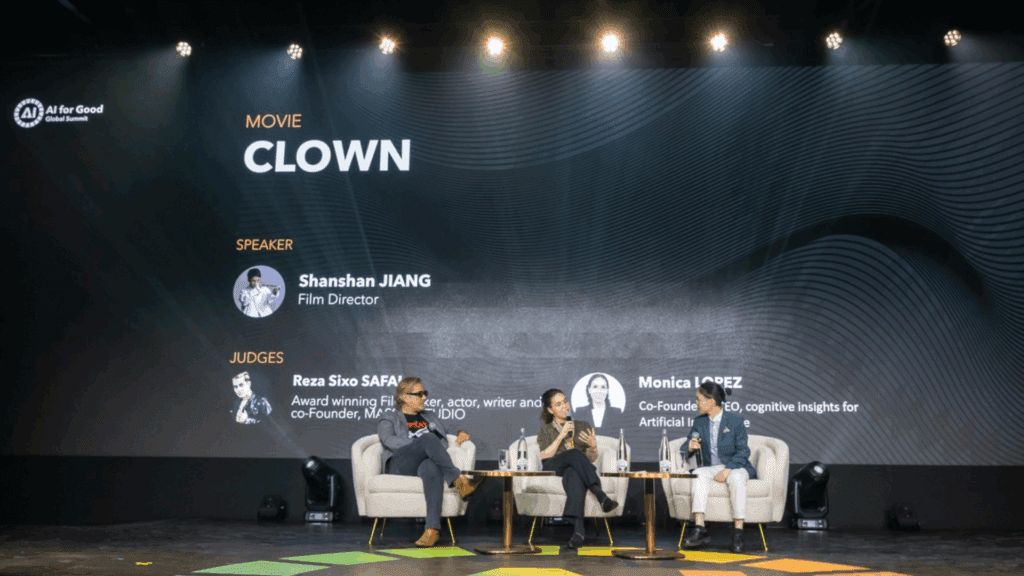
In Clown, director Shanshan Jiang blends live-action footage with AI-generated visuals to explore the psychological toll of constant self-performance. The film follows a talented clown who gradually loses her sense of identity as she reshapes her act, appearance, and even personality to satisfy the shifting expectations of her audience. As performance and reality blur, the film delves into how societal pressure, particularly toward women, can erode the self.
Beyond its striking visuals, Clown tackles discrimination and gender-based violence on a more subtle, psychological level. It asks viewers to consider how everyday judgment, objectification, and suppression leave lasting emotional marks, especially on women navigating public and private spaces where they are constantly asked to adapt.
CLOTHES OF DECEPTION
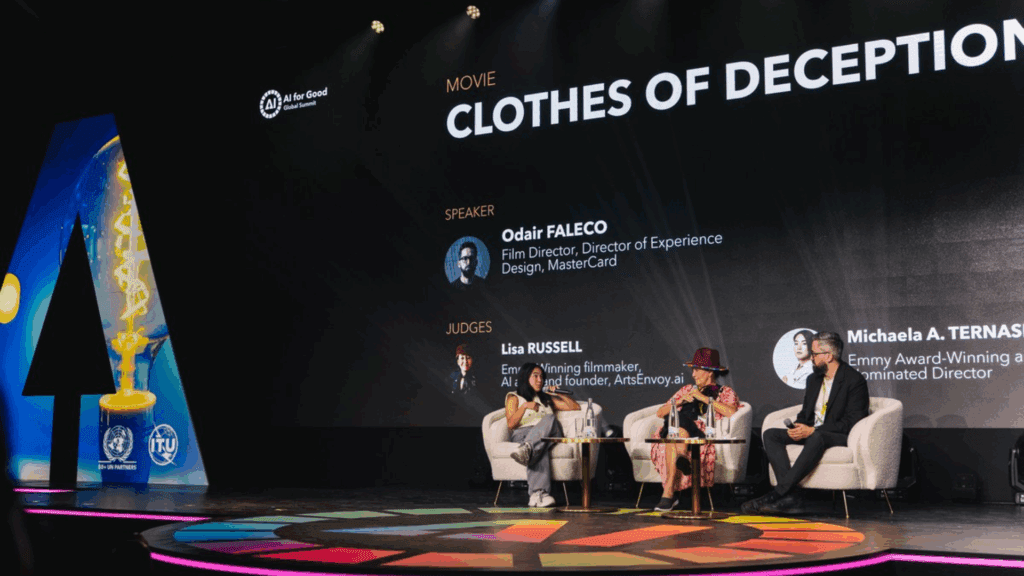
Clothes of Deception, directed by Odair Faléco, presents a Zen-inspired tale that questions how we see others and ourselves. Two figures enter the same waters, but when they re-emerge, they are perceived differently by the world. Through this layered narrative, the film asks us to reconsider the assumptions we make based on appearances.
Faléco’s work challenges conventional ideas of beauty and ugliness, inviting audiences to reflect on the ways social labels distort our understanding of others. In an age shaped by image and surface impressions, Clothes of Deception becomes a subtle critique of stereotype-driven thinking and a reminder to look beyond what’s visible.
SOLEDAD
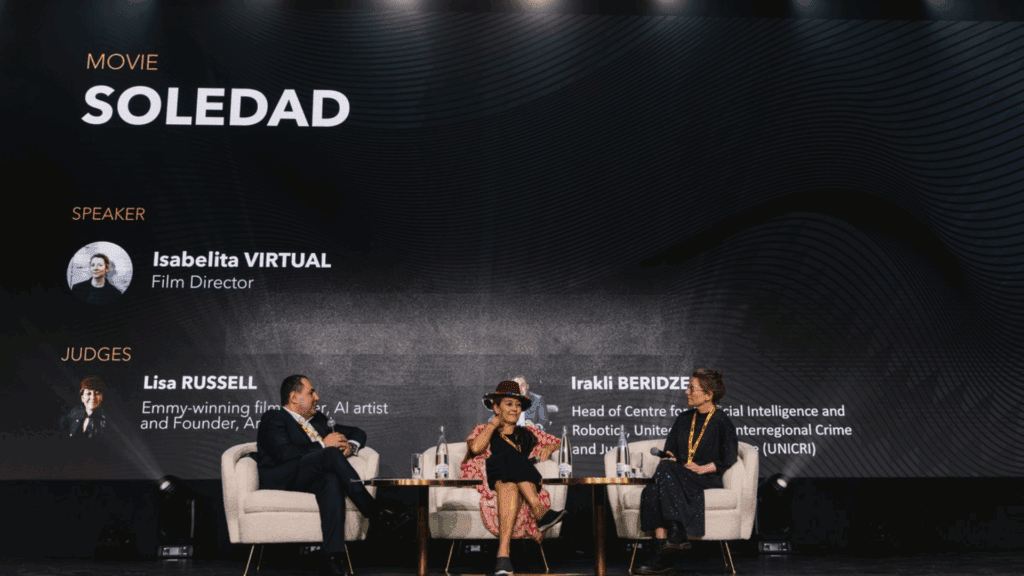
Directed by Isabel Martinez, in Soledad, a solitary specter leaves its quiet home in nature to seek connection in the city, only to find itself invisible and misunderstood. The journey ends not with assimilation, but with a return to the natural world where it joins another lonely soul and becomes something whole.
Isabel Martinez uses this simple yet symbolic story to examine what loneliness really means in today’s hyperconnected world. The film can be seen as a metaphor for many kinds of isolation, whether it’s the immigrant experience, the communication barriers faced by neurodivergent individuals, or a broader emotional disconnect in modern society. It’s a quiet, introspective work that speaks to the human need for belonging, and the difficulty some face in finding it.
These four films remind us that while AI may be the medium, it’s the human spirit behind the screen that truly moves us. Each story leaves a mark, not just for how it was made, but for what it says.
The AI for Good Award, powered by ITU, is a special category within the Replai Festival that brings storytelling and technology together in a meaningful way. This partnership celebrates short films that not only explore creative uses of AI, but also shine a light on urgent global challenges, from climate change to inequality, in line with the UN Sustainable Development Goals.
What makes Replai stand out is its focus on the intersection of artistic experimentation and social relevance. It’s not just about what AI can do visually, but how it can be used to tell human stories that matter. By screening four selected films at the AI for Good Summit in Geneva, this collaboration gave creators a platform to reach global audiences, connect with innovators across disciplines, and show how AI driven storytelling can inspire a better future.